Key Takeaway
Rewilding restores self-sustaining ecosystems by allowing natural processes — grazing, predation, flooding and succession — to reshape the landscape with minimal human intervention. Knepp Estate in West Sussex shows that wildlife can recover dramatically within two decades, yet Rewilding Britain estimates that less than 1 per cent of Britain is rewilding, while the UK has committed to protecting 30 per cent of land and sea for nature by 2030.
916%
Knepp bird increase
Breeding birds since 2007
~100
Beavers hoped for in 2026
Wildlife Trusts' planned wild releases
6%
UK land for nature
Effectively managed (target: 30%)
300+
Rewilding partners
In the Global Rewilding Alliance
In This Article
- What Is Rewilding?
- UK Rewilding Case Studies
- Beavers: The UK's Ecosystem Engineers
- Rewilding Beyond the UK
- Economics of Rewilding
- Controversies and Challenges
- Policy and the Path to 30 Per Cent
- Frequently Asked Questions
What Is Rewilding?
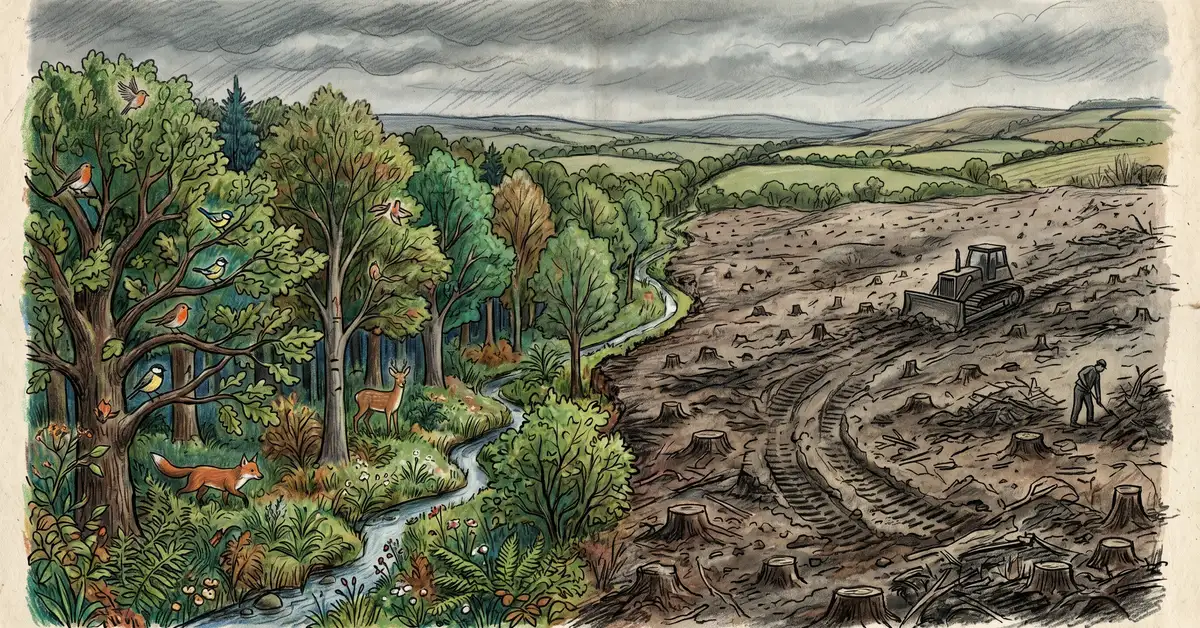
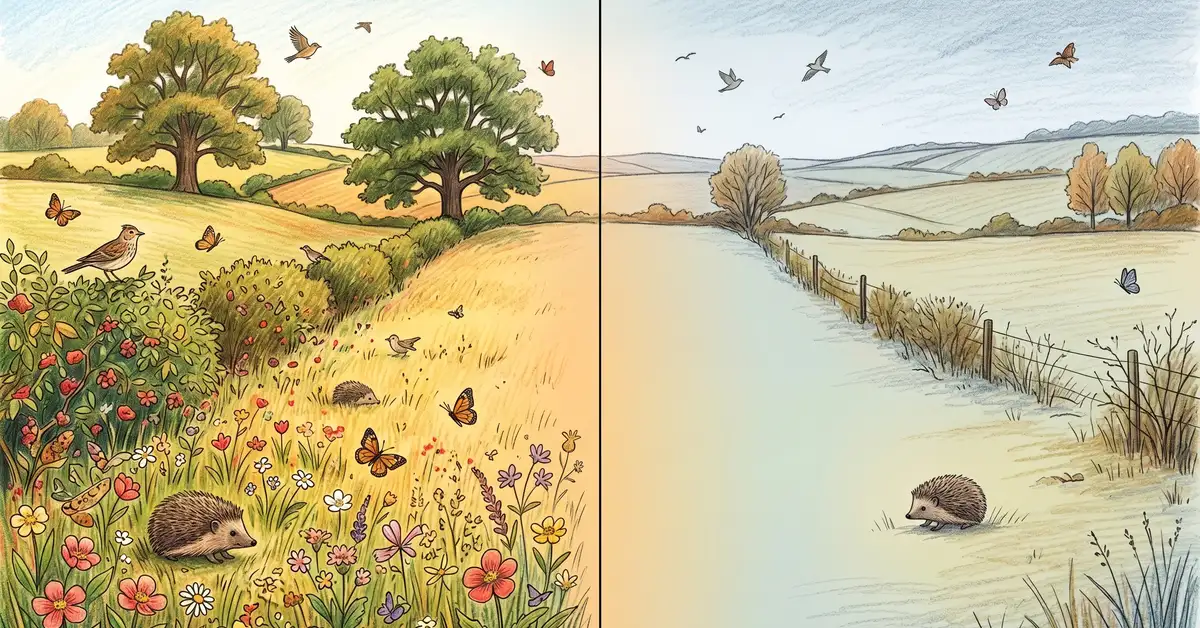
Rewilding is a conservation approach that restores self-sustaining ecosystems by reinstating natural processes — grazing, predation, flooding, and ecological succession — rather than managing landscapes through ongoing human intervention. Where traditional conservation focuses on preserving what remains, rewilding aims to rebuild functional food webs across all trophic levels, creating landscapes capable of regulating themselves without continuous management.
The concept emerged from North American conservation biology in the early 1990s and was formalised by Michael Soulé and Reed Noss in their influential 1998 paper, which established the "3 Cs" framework: Cores (large protected areas), Corridors (habitat connections enabling species movement), and Carnivores (top predators driving trophic cascades). This framework recognised that isolated nature reserves cannot sustain viable populations of wide-ranging species or maintain ecosystem functions across fragmented landscapes.
In practice, rewilding operates across a spectrum. Passive rewilding involves stepping back — removing fences, ceasing intensive management, and allowing natural succession to unfold. Active rewilding requires direct intervention: reintroducing missing species, removing dams to restore river connectivity, or rewetting drained peatland. Trophic rewilding specifically targets the restoration of food-web complexity through reintroduction of keystone species — particularly large herbivores and predators whose ecological activities reshape entire landscapes.
UK Rewilding Case Studies: Evidence from the Ground
Knepp Estate, West Sussex
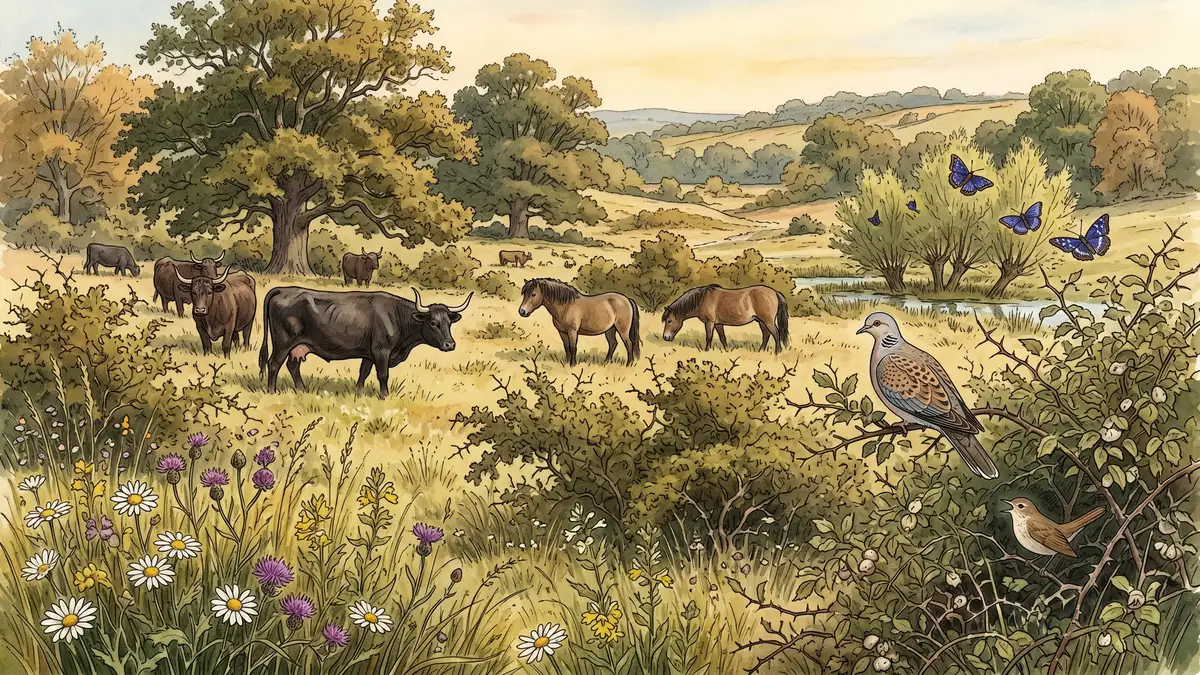
Knepp Estate holds one of the UK's longest-running records of what happens when farmland is rewilded. This 3,500-acre former dairy and arable farm in West Sussex began its transition at the turn of the millennium, when owners Charlie Burrell and Isabella Tree, faced with unsustainable returns from intensive agriculture, introduced free-roaming cattle, ponies and deer as the primary landscape management tool.
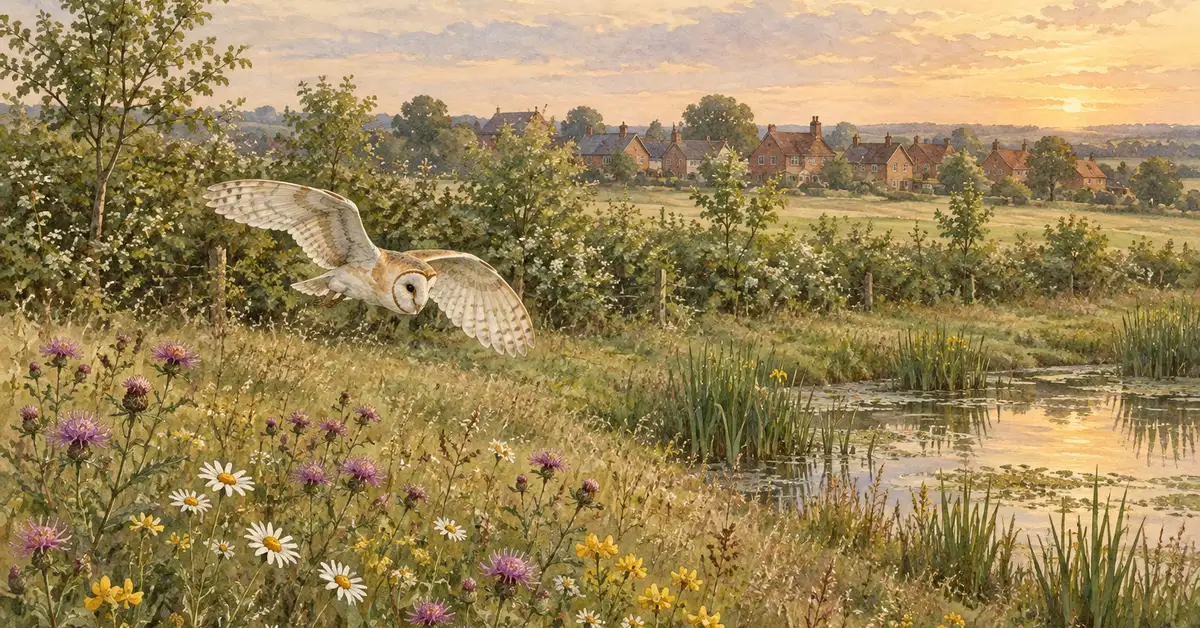
The ecological results after two decades are remarkable. According to Knepp's 2026 ecological review, breeding bird abundance in the southern block has increased by 916 per cent since the first Breeding Bird Survey in 2007, with species richness up 132 per cent. Individual species tell the story more vividly: common whitethroat rose 2,200 per cent between 2007 and 2025, singing male nightingales rose from 9 in 1999 to 62 in 2025, and turtle doves, until recently the UK's fastest-declining bird, grew from two singing males in 2008 to 22 in 2024.
Recovery extends well beyond birds. Butterfly species richness rose 107 per cent between 2005 and 2025 in two areas of the estate, and 283 purple emperors were counted in a single day in 2025, Knepp's second-biggest year for the species. Dragonfly and damselfly abundance rose 871 per cent from 2005 to 2025, with a 53 per cent rise in species richness along the restored River Adur. One area gained about 96 hectares of scrub between 2001 and 2019, part of the mosaic of scrub, woodland, grassland and wetland that underpins this recovery. In 2020, white storks at Knepp fledged four chicks, the first wild breeding of white storks in Britain for over 600 years.
These figures come from monitoring at a single estate rather than controlled trials. They show what is possible on similar land, not what every project will achieve.
Cairngorms Connect, Scotland
Cairngorms Connect takes a different approach: a partnership of neighbouring land managers covering about 60,000 hectares of the Cairngorms National Park, the UK's largest, with a 200-year vision for restoring habitats, species and natural processes. This long-term framing reflects the reality that ecological restoration at landscape scale requires institutional commitment far beyond normal planning horizons. The partnership model — collaborative rather than centralised — may prove more scalable than single-estate approaches, particularly in regions where land ownership is fragmented and local communities exert significant influence over management decisions.
Glen Affric and Peatland Restoration
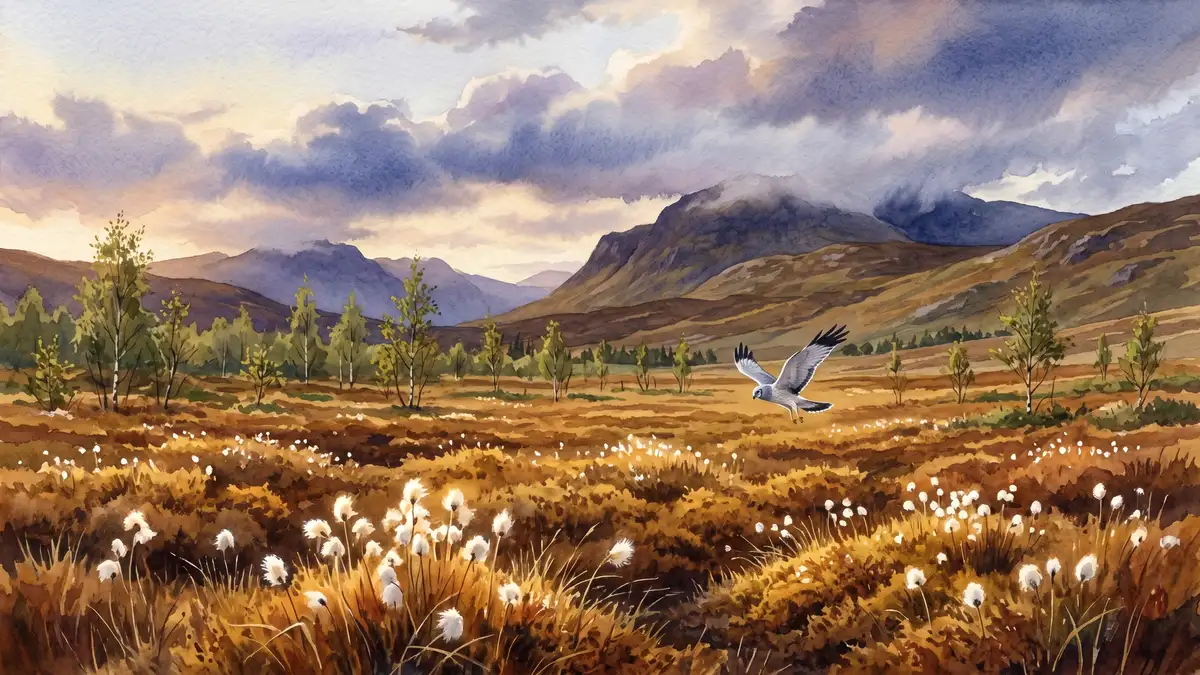
In the Affric Highlands, Trees for Life and partners launched a 30-year initiative in 2021 to restore nature across about 200,000 hectares, including native woodland and peatland. Across Scotland, the Government committed £250 million over ten years from 2020, delivered through Peatland ACTION, to restore 250,000 hectares of degraded peatland by 2030. Peatlands cover at least 3 per cent of the world's land surface, yet store more carbon than all other vegetation types combined, including the world's forests (IUCN). NatureScot estimates that about 80 per cent of Scotland's peatlands are damaged or degraded through historical drainage, extraction and overgrazing. Restoration involves blocking drainage channels, reprofiling exposed peat and transplanting sphagnum moss to rebuild functioning bog ecosystems that sequester carbon and improve water quality.
Beavers: The UK's Returning Ecosystem Engineers
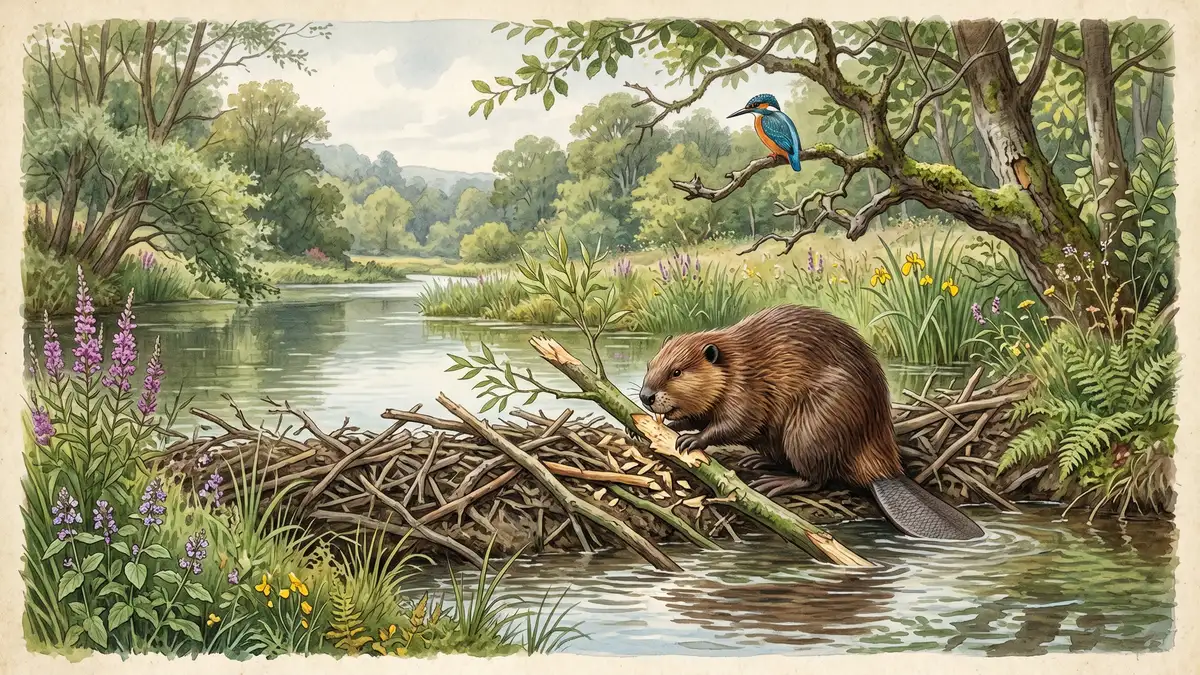
Beaver reintroduction is one of the fastest-moving chapters in UK rewilding. Hunted to extinction in Britain by the sixteenth century, Castor fiber returned officially with the Scottish Beaver Trial at Knapdale in 2009, the UK's first official beaver reintroduction. NatureScot estimated in 2023 that Scotland had about 424 beaver territories, or more than 1,500 animals; a new survey of Tayside and nearby catchments was completed in 2025, and its report is being finalised.
In February 2025, the UK government announced that beavers could be licensed for release into the wild in England, no longer restricted to fenced enclosures. The first licensed wild release followed in March 2025 at Little Sea on the National Trust's Purbeck Estate in Dorset. In February 2026, the National Trust released beavers on its Holnicote Estate in Somerset, and Cornwall Wildlife Trust released two pairs into the Par and Fowey catchments. According to the Natural History Museum, The Wildlife Trusts hope to release around 100 beavers into seven rivers in 2026 if applications go to plan. Natural England has invited nine more projects to apply for licences and is working with 21 others, some on the Humber, Severn and Thames.
Water Quality
A University of Stirling study on farmland in Perthshire found that beaver dams cut peak levels of E. coli and suspended sediment downstream by up to 95 per cent, trapping pollution from farm runoff.
Flood Management
Beaver dams impound water and release it slowly through leaky structures, increasing base flows during droughts and reducing peak flood surges — a form of natural flood management costing a fraction of engineered solutions.
Beaver reintroduction does bring management challenges, particularly around farmland and trees. Natural England's licensing requires each project to engage local communities, plan monitoring and management, and think at the scale of the whole river catchment, and a published management framework sets out how impacts are handled.
Rewilding Beyond the UK
The UK sits within a global movement that has matured rapidly. The Global Rewilding Alliance, established in 2021, now brings together more than 300 partner organisations worldwide. In 2026, Mongabay reported that its partners work across more than 2 million square kilometres of land and around 6 million square kilometres of ocean.
| Project | Location | Scale | Key Focus |
|---|---|---|---|
| Oder Delta | Germany/Poland | Trans-boundary | Dam removal, peatland rewetting, bison and beaver recolonisation |
| Greater Côa Valley | Portugal | 120,000 ha | Wildlife corridor linking the Malcata mountains with the Douro Valley |
| Rhodope Mountains | Bulgaria | Landscape | European bison and vulture reintroduction, forest restoration |
| American Prairie | Montana, USA | 600,000+ acres | Grassland reconnection, bison restoration, predator recovery |
| Affric Highlands | Scotland | About 200,000 ha | Native woodland and peatland restoration; beavers released in Glen Affric from 2025 |
In 2025, Rewilding Europe released European bison and cinereous vultures in Bulgaria's Rhodope Mountains, Mediterranean trout in Italy's Central Apennines, and nearly 100 European hamsters on the Tarutino Steppe in Ukraine's Danube Delta landscape. In Portugal's Greater Côa Valley, Rewilding Portugal is developing a 120,000-hectare wildlife corridor.
Species Comeback: Wildcats, Eagles and Beyond
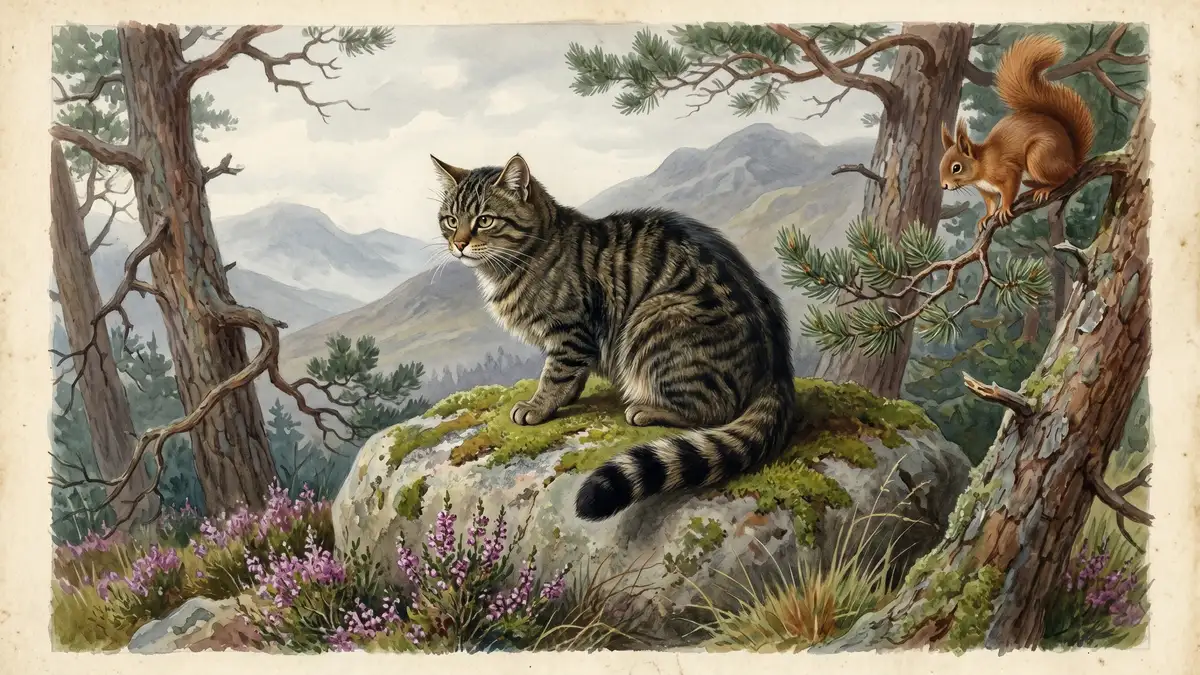
UK rewilding has delivered several notable species reintroduction successes beyond beavers. Saving Wildcats, a partnership led by the Royal Zoological Society of Scotland, has released 50 wildcats into the Cairngorms National Park since 2023. Released females have given birth in the wild for three years running. Eleven released wildcats have died, five of them in road collisions, a rate the project considers low for a translocation. The species is still critically endangered in Scotland, and more releases are planned to widen the gene pool.
White-tailed eagles were reintroduced to Scotland from 1975, starting on the Isle of Rum, after persecution drove them to extinction. Scotland now has about 180 breeding pairs, according to the Roy Dennis Wildlife Foundation. In England, Forestry England and the Foundation released 45 young eagles on the Isle of Wight between 2019 and 2025, and in 2023 the first white-tailed eagle chick for more than 240 years fledged in the wild in England.
Scotland's pine marten population is estimated at about 3,700 adults and is spreading south. Vincent Wildlife Trust moved 51 pine martens from Scotland to mid-Wales between 2015 and 2017, and 35 were released in the Forest of Dean in 2019 and 2021. In Kent, the Wilder Blean project released European bison into West Blean and Thornden Woods in July 2022; a surprise calf was born that September, the first wild bison born in the UK for thousands of years, and in November 2023 a second calf became the first to be conceived and born in the wood.
The Economics of Rewilding

Knepp Estate changed the economic conversation about rewilding. It replaced unprofitable intensive farming with income from nature tourism, safaris, camping and holiday accommodation, events and wild-range meat, suggesting rewilding can pay its way on marginal land.
Wildlife tourism is often part of the case for rewilding, but robust UK figures on its value are still scarce, so claims about income per site should be treated with care.
The Scaling Challenge
Knepp's economic model succeeded within particular institutional and market conditions — a large estate, proximity to London's visitor market, and a charismatic public narrative. Replicating this across diverse farm types, sizes and locations requires policy mechanisms that go far beyond individual enterprise.
Controversies and Challenges
Rewilding vs Food Security
The most persistent criticism of rewilding concerns food production. Academic research published in People and Nature found that many farmers associate rewilding with land abandonment, loss of productive fields and loss of control over land management. The concern is sharpened by equity: large estates and wealthy investors possess far greater capacity to purchase land and enrol in rewilding schemes than small family farms or tenants, creating what some commentators describe as a "green land grab" where conservation benefits accrue to already-privileged landowners.
The counter-argument emphasises that healthier ecosystems deliver carbon storage, reduced flooding and cleaner water — services that ultimately support more resilient food production. The more nuanced position acknowledges that rewilding should focus on marginal, less productive land whilst supporting existing farmers to transition towards nature-friendly systems that maintain food output alongside biodiversity recovery.
Large Predator Debate
Proposals for lynx and wolf reintroduction remain the most contentious part of UK rewilding. In Scotland, the Lynx to Scotland group has sought the views of Highland communities on a possible return, and supporters argue that large forests in Scotland and northern England could hold lynx. Concerns include sheep farming, public safety and how a large predator would fit settled landscapes. No licence has been granted for a lynx or wolf release anywhere in Britain.
Guerrilla Rewilding
In January 2025, four Eurasian lynx were illegally released near Kingussie in the Cairngorms National Park. The Royal Zoological Society of Scotland, working with Police Scotland, caught all four within three days; one died soon after capture, and the other three now live at Highland Wildlife Park. Incidents like this highlight the importance of formal reintroduction frameworks that ensure community consultation, welfare safeguards and ecological assessment — whilst also reflecting frustration among some advocates at the pace of official processes.
Policy and the Path to 30 Per Cent
The UK has committed to protecting 30 per cent of land and sea for nature by 2030 (30by30), in line with the Kunming-Montreal Global Biodiversity Framework. Progress falls well short. The 2025 UK 30by30 progress report, cited by Rewilding Britain, found that only about 6 per cent of UK land is effectively protected and managed for nature, with Wales at 2.4 per cent and Scotland at 12.6 per cent. For England, Defra's 30by30 delivery plan (July 2026) puts the figure at around 7 per cent. Rewilding Britain estimates that less than 1 per cent of Britain's land and seas is rewilding; its own goal is 30 per cent of Britain in nature recovery by 2030, including at least 5 per cent rewilding.
Environmental Land Management
Post-Brexit schemes replacing EU farm subsidies to pay for environmental outcomes. Its Landscape Recovery strand funds large, long-term projects: 22 in round one and 34 in round two.
Local Nature Recovery Strategies
Mandated under the Environment Act 2021, these coordinate nature recovery planning across partnerships at landscape scale.
Biodiversity Net Gain
The mandatory 10 per cent net gain requirement integrates nature recovery into mainstream development, creating a market for habitat creation.
Defra and Natural England invested £7.4 million across three years in 12 landscape-scale Nature Recovery Projects covering over 319,480 hectares. In one of them, Wendling Beck in Norfolk, 2,367 species have been recorded and an estimated 250,000 tonnes of carbon sequestered to date. These projects now transition into Local Nature Recovery Strategies, creating an institutional framework for coordinating public funding, planning policy and private land management across ownership boundaries.
Frequently Asked Questions
What is the difference between rewilding and conservation?
Traditional conservation focuses on preserving existing ecosystems through ongoing management. Rewilding aims to restore self-sustaining ecosystems by reinstating natural processes — grazing, predation, flooding — so the landscape can regulate itself with minimal human intervention. Conservation maintains; rewilding rebuilds.
Does rewilding actually work in the UK?
Yes, where it has been tried and measured. Knepp Estate in West Sussex has one of the UK's longest-running records: its 2026 review found breeding bird abundance up 916 per cent in the southern block since 2007, butterfly species richness up 107 per cent and dragonfly and damselfly abundance up 871 per cent since 2005. These results come from one estate's monitoring rather than controlled trials. Beaver projects in Scotland and England show natural flood management and water quality benefits, and 50 Scottish wildcats have been released in the Cairngorms since 2023, with kittens born in the wild for three years running.
How much UK land is being rewilded?
Rewilding Britain estimates that less than 1 per cent of Britain's land and seas is currently rewilding. Only about 6 per cent of UK land is effectively protected and managed for nature, according to the 2025 UK 30by30 progress report. The UK has committed to protecting 30 per cent of land and sea by 2030 under the Kunming-Montreal Global Biodiversity Framework, and current progress falls well short of this target.
Why are beavers being reintroduced to the UK?
Beavers are ecosystem engineers whose dams create wetland habitat, reduce downstream flooding, improve water quality and increase drought resilience. One Scottish study found their dams cut peak pollution levels downstream by up to 95 per cent. They were native to Britain until hunted to extinction by the sixteenth century. The UK government allowed licensed wild releases in England from February 2025, and The Wildlife Trusts hope to release around 100 beavers into seven rivers in 2026.
Will rewilding threaten UK food security?
This is the most debated question in UK rewilding. Proponents argue rewilding should focus on marginal, less productive land rather than prime agricultural areas, and that healthier ecosystems ultimately support more resilient food production through improved soil health, pollination and water management. Critics worry about cumulative loss of farmland and uneven impacts on smaller farmers versus large estates. Most experts advocate integrating nature-friendly farming with targeted rewilding rather than treating them as alternatives.
Could lynx or wolves be reintroduced to the UK?
Lynx return is being discussed, especially in Scotland, where the Lynx to Scotland group has sought the views of Highland communities. Concerns include sheep farming, public safety and how a large predator would fit settled landscapes. No licence has been granted for any lynx or wolf release in Britain. In January 2025, four lynx illegally released in the Cairngorms were caught within days.
Further Reading
- Biodiversity and Conservation: The Complete Guide
- How to Protect Biodiversity: A Practical UK Guide
- Habitat Destruction: Drivers, Consequences and What Can Be Done
- UK Wildlife Decline: Trends, Data and What Is Driving the Crisis
- UK Endangered Species: A Complete Guide
- Biodiversity Net Gain: What It Is and Why It Matters
Sources: Knepp Estate Ecological Review 2026 · Natural History Museum · Rewilding Britain · Natural England (beavers) · RZSS (Saving Wildcats) · Forestry England · Mongabay · Rewilding Europe · Natural England