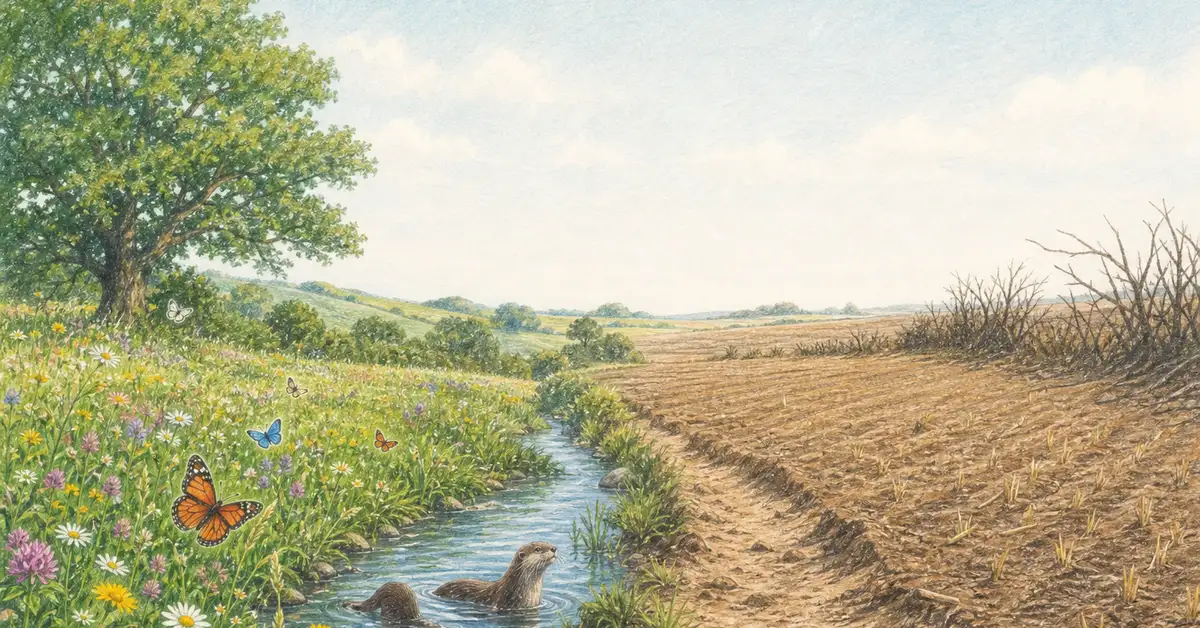
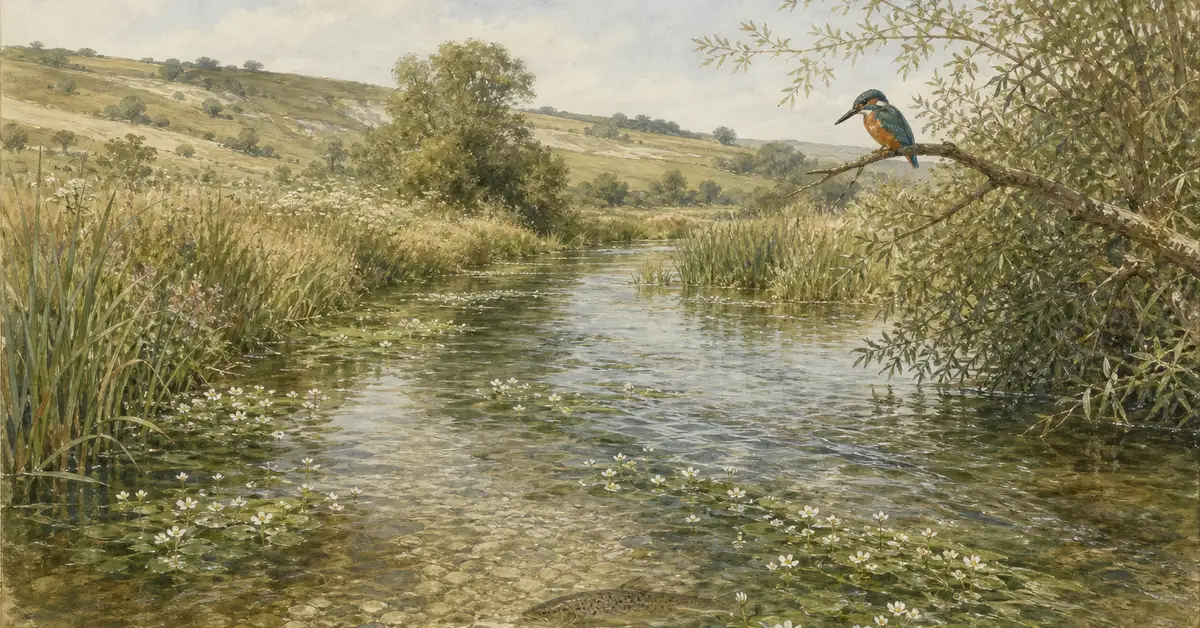
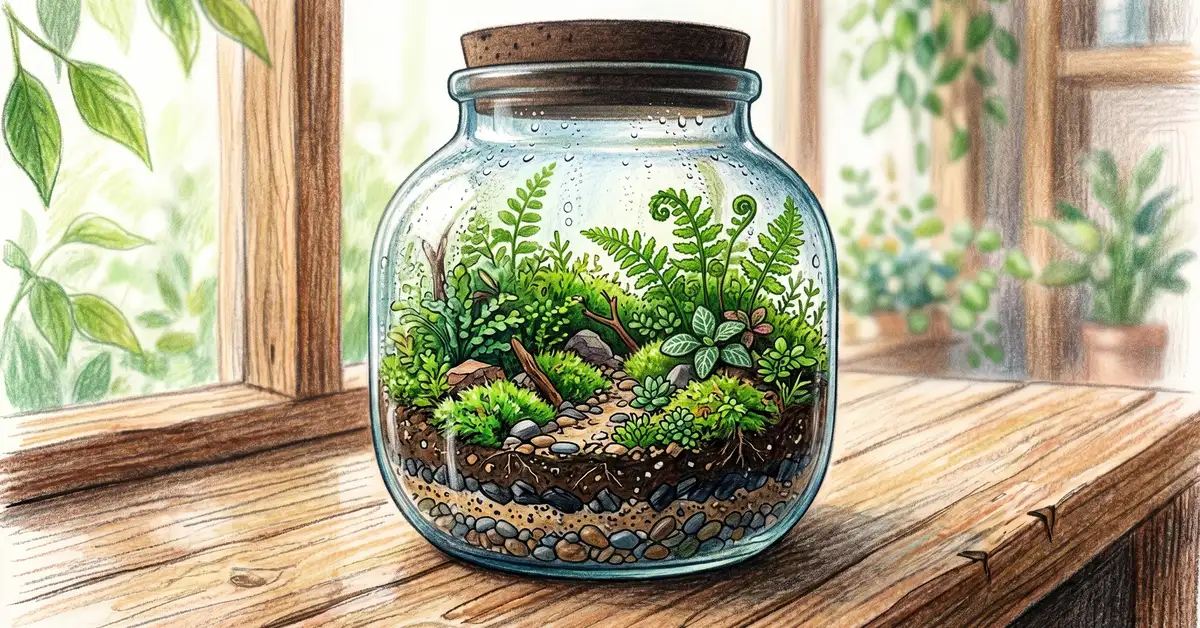
An ecosystem is a community of living organisms — plants, animals, fungi, and microorganisms — interacting with each other and their non-living environment as a self-sustaining unit. Examples of ecosystems range from the smallest (a rock pool, a rotting log) to the largest (the Amazon basin, the deep ocean). The main types of ecosystems are terrestrial (forests, grasslands, deserts, tundra, wetlands), freshwater (rivers, lakes, ponds), and marine (oceans, coral reefs, estuaries). The UK supports seven broad ecosystem categories — woodland, grassland, moorland/heath, wetland, coastal, marine, and urban — across 24.4 million hectares of land plus 73 million hectares of sea.
This 2026 guide explains how ecosystems work, the major ecosystem types and their examples, what the UK's ecosystems look like and how healthy they are, the £41 billion in services they provide, and what is being done to protect them.
In this guide
What an ecosystem is · The main types of ecosystems with examples · What ecosystems the UK has · UK ecosystem health · Ecosystem services · What's being done to protect them · How you can help · FAQs
What Is an Ecosystem and How Does It Work?
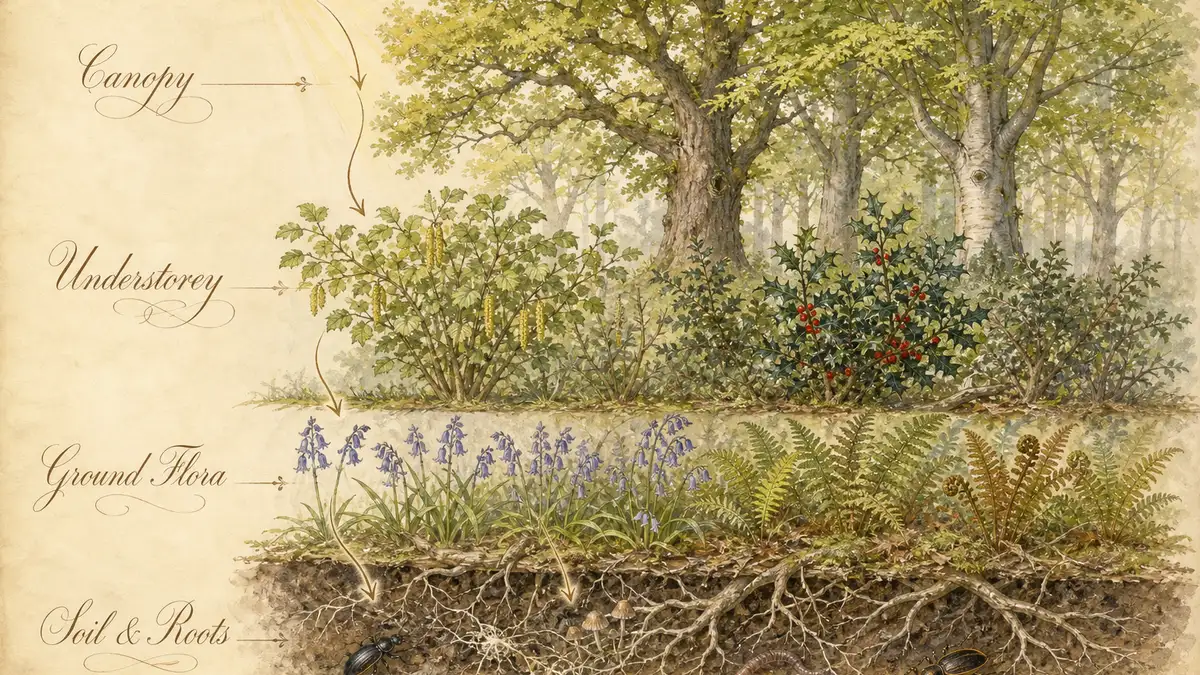
An ecosystem is a community of living organisms — plants, animals, fungi, and microorganisms — interacting with each other and their non-living environment to form a self-sustaining unit. Every ecosystem operates through two fundamental processes: energy flow (the transfer of energy from sunlight through producers to consumers) and nutrient cycling (the recycling of carbon, nitrogen, and phosphorus through decomposition). These processes connect every organism from the smallest soil bacterium to the largest predator in a web of interdependence that sustains life.
Ecosystems have two categories of components. Biotic (living) components include producers like plants and algae that convert sunlight into food through photosynthesis, consumers such as herbivores, carnivores, and omnivores that feed on other organisms, and decomposers — fungi and bacteria — that break down dead matter and return nutrients to the soil. Abiotic (non-living) components include sunlight, water, soil composition, temperature, and mineral nutrients. These abiotic factors act as limiting factors, determining which species can survive in a given location and how large their populations can grow.
Key Takeaway
Energy flows through ecosystems in one direction — from producers upward through consumers — with only about 10% of energy transferred at each trophic level. This is why food chains rarely exceed four or five levels: a field of grass supports far more rabbits than foxes. Nutrients, however, cycle continuously — decomposers return them to the soil, where producers absorb them again.
What Are the Main Types of Ecosystems? (With Examples)
The three main types of ecosystems are terrestrial (land-based), freshwater, and marine. Within these three groups, ecologists usually identify around ten major ecosystem categories, each with characteristic examples:
| Group | Ecosystem type | Examples |
|---|---|---|
| Terrestrial (land-based) | Forest | UK ancient oakwood; Amazon tropical rainforest; Canadian boreal forest; Mediterranean cork oak forest. |
| Grassland | UK chalk grassland (Salisbury Plain); African savanna; North American prairie; Eurasian steppe. | |
| Desert | Sahara; Atacama; Sonoran; Antarctic polar desert. | |
| Tundra | Arctic tundra (Siberia, Canada, Alaska); Cairngorms montane plateau (UK alpine tundra fragment). | |
| Heath & moorland | UK lowland heathland (New Forest, Surrey heaths); UK blanket bog (Peak District, Flow Country). | |
| Wetland (terrestrial) | UK fen and reedbed; tropical mangrove; Okavango Delta; Pantanal. | |
| Freshwater | Lotic (flowing) | UK chalk stream (River Test, River Itchen); Amazon; Nile; Mississippi. |
| Lentic (still) | UK upland lochs and tarns; Lake Windermere; Lake Baikal; pond ecosystems. | |
| Marine | Coastal | UK saltmarsh (Solway Firth); rocky intertidal; estuary; mangrove forest; seagrass meadow. |
| Open ocean & reef | UK cold-water coral gardens (Rockall); Great Barrier Reef; deep abyssal plain; kelp forest. |
Sources: JNCC UK Biodiversity Indicators 2026; IPBES Global Assessment.
Each ecosystem type provides distinct ecosystem services — the benefits nature delivers to people. The Office for National Statistics categorises these as provisioning services (food, timber, clean water), regulating services (climate regulation, flood control, pollination, air purification), cultural services (recreation, education, mental health benefits), and supporting services (nutrient cycling, soil formation, habitat provision). Wetlands excel at flood regulation and carbon storage; grasslands support pollinators; forests purify air; marine ecosystems regulate climate at planetary scale.
What Ecosystems Does the UK Have?
Despite its relatively small size, the UK supports a remarkable diversity of ecosystems — from ancient oakwoods and chalk grasslands to blanket bogs, saltmarshes, and deep-sea coral gardens. The ONS habitat data reveals that enclosed farmland dominates at 52% of UK land area, but natural and semi-natural ecosystems still cover 24% of terrestrial land, plus the entirety of the UK's 73 million hectares of surrounding seas.
| Ecosystem Type | Area (hectares) | % of UK | Trend Since 1990 |
|---|---|---|---|
| Enclosed farmland | 12,694,693 | 52% | ↓ Down 5% |
| Woodland | 3,268,707 | 13% | ↑ Up 29% |
| Mountain, moorland, heath | 2,584,348 | 11% | → Stable |
| Semi-natural grasslands | 2,493,388 | 10% | → Stable |
| Urban | 1,843,901 | 7% | ↑ Up 30% |
| Freshwater & wetlands | 1,330,499 | 5% | → Stable |
| Coastal margins | 390,796 | 2% | → Stable |
Source: ONS Habitat Extent and Condition 2022, UKCEH Land Cover Map 2024
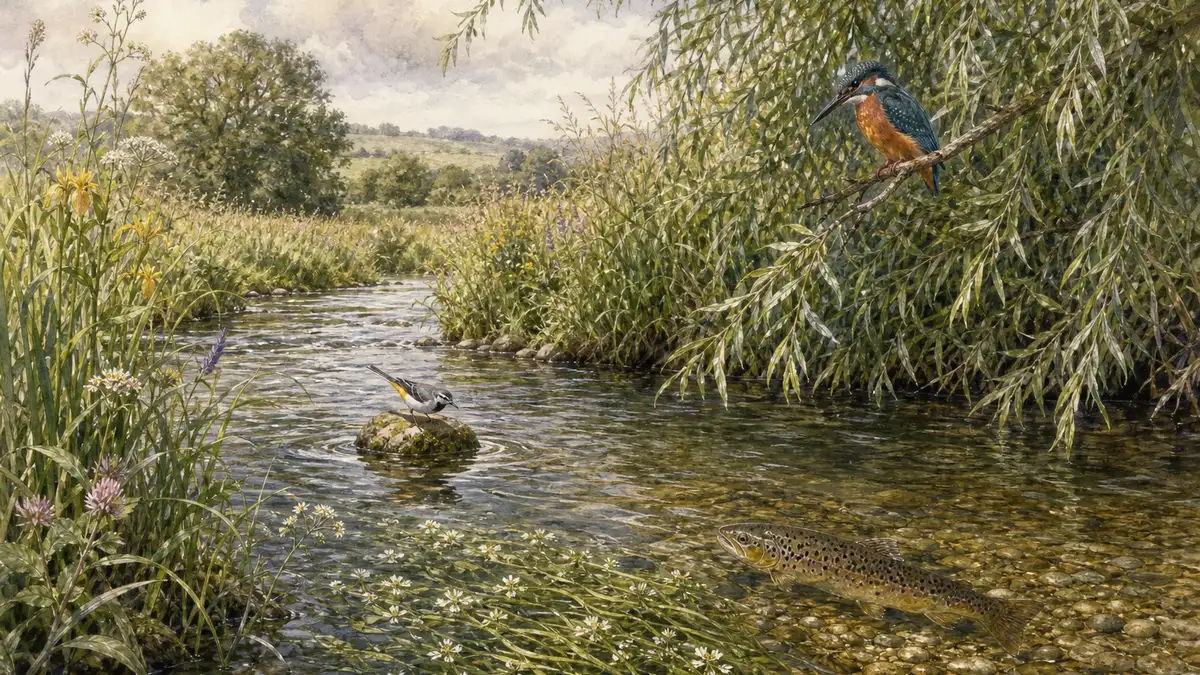
Woodland covers 13% of the UK — low by European standards — and includes irreplaceable ancient woodlands that have existed continuously for over 400 years, now just 2.5% of UK land. Peatlands, spread across the uplands of Scotland, Wales, and northern England, are among the UK's most important carbon stores, holding approximately 11 tonnes of carbon per hectare per centimetre of depth. The UK's marine estate is vast: 377 marine protected areas now cover 38% of UK waters, though their effectiveness remains contested. Freshwater ecosystems — rivers, lakes, and wetlands — cover just 5% of land but support a disproportionate share of the UK's biodiversity, with England holding roughly 85% of the world's chalk streams (a globally rare ecosystem). For a deeper look at specific habitats, see our complete guide to UK habitats.
How Healthy Are UK Ecosystems?
The short answer is: not healthy enough. The State of Nature 2023 report — the most comprehensive assessment of UK wildlife ever produced — found that species abundance has declined by 19% since 1970, with one in six species threatened with extinction from Great Britain. The UK ranks among the most nature-depleted countries in the world, retaining less than 50% of its original biodiversity. Birds have declined by 43%, amphibians and reptiles by 31%, fungi and lichens by 28%, and pollinators by 18%. More than half of plant species assessed show decline.
Freshwater ecosystems face particularly acute pressure. The Rivers Trust's 2024 State of Our Rivers report found that no single stretch of river in England or Northern Ireland is in good overall ecological health. Just 15% of English river stretches meet good ecological standards. In 2024, England recorded 450,398 storm overflow sewage events — totalling 3.61 million hours of raw sewage entering waterways. Neonicotinoid pesticides were detected in over 75% of monitored sites. Meanwhile, the UK's marine protected areas face their own crisis: over 20,600 hours of suspected bottom trawling occurred across UK offshore MPAs in 2024, with 90% of sites remaining open to destructive fishing practices.
The drivers behind this decline are well understood — and they map onto the IPBES five-drivers framework. Intensive agriculture (the dominant land use at 52%), habitat fragmentation, climate change, pollution (particularly nitrogen deposition, which at 278 kilotonnes annually still damages biodiversity despite halving since 1990), and invasive species. For every additional 2.5 kg of nitrogen deposited per hectare per year, research shows one plant species is lost from UK upland grasslands. For the full mechanistic picture, see the five drivers of biodiversity loss.
19%
Species Decline
UK abundance since 1970
0%
Rivers in Good Health
England & Northern Ireland
£41bn
Ecosystem Services
Annual value to UK (2023)
£1.6tn
Natural Capital Asset
Total UK value (2023)
Sources: State of Nature 2023, Rivers Trust 2024, ONS Natural Capital Accounts 2025
What Are Ecosystem Services and Why Do They Matter?
Ecosystem services are the benefits that natural systems provide to human wellbeing — often invisibly. The ONS Natural Capital Accounts 2025 valued the UK's total natural capital assets at £1.6 trillion in 2023, with annual ecosystem services worth £41 billion. These figures, whilst significant, are acknowledged as partial — flood protection from natural systems, for example, is not yet included in the calculations.
Recreation and tourism deliver the largest single annual contribution at £10 billion, with an estimated 20 million people gaining measurable health benefits from time spent in nature — valued at £508 billion as an asset. Nature removes approximately 1.4 million tonnes of air pollutants annually, providing an air quality regulation service worth £2.77 billion. Renewable electricity provisioning has surged to £3 billion (seven times higher than in 2014), reflecting the UK's growing wind and solar capacity. However, one service carries a troubling negative value: greenhouse gas regulation is worth negative £330 million, because degraded peatlands and other damaged habitats now emit more carbon than UK ecosystems absorb.
Common Misconception
"Ecosystems are nice to have, not essential." In fact, the UK government's January 2026 Nature Security Assessment identified global ecosystem collapse as a direct threat to national security. Depleted soils, pollinator loss, and extreme weather already threaten UK food production. Every critical ecosystem globally is on a pathway to collapse, with some — such as Southeast Asian coral reefs and boreal forests — realistically able to begin collapsing from 2030.
What this means: Ecosystem health is not a luxury — it underpins food security, clean water, flood protection, and public health. The £1.6 trillion valuation is a floor, not a ceiling.
What Is Being Done to Protect UK Ecosystems?
The UK has introduced several landmark policies in recent years, though progress in implementation remains mixed. Biodiversity Net Gain (BNG) became mandatory in England on 12 February 2024 for major developments and 2 April 2024 for small sites, requiring developers to deliver a minimum 10% increase in biodiversity units after construction — with some local authorities demanding 20% in core nature recovery zones. The policy represents a fundamental shift: development must now leave nature measurably better off than before.
Biodiversity Net Gain (BNG)
Mandatory since February 2024 for all developments in England. Requires a minimum 10% measurable biodiversity uplift post-construction, maintained for at least 30 years. A historic shift from "do no harm" to "leave nature better."
Peatland Restoration
Approximately 250,000 hectares restored across the UK since the 1990s. England restores 5,000–6,000 ha annually; Scotland set a record of 10,360 ha in 2023–24. The UK Peatland Strategy targets 2 million hectares in good condition by 2040.
Woodland Creation
England targets 16.5% tree canopy and woodland cover by 2050 (from 14.9%) with 43,000 hectares added by 2030. Annual UK targets of 30,000 ha have been repeatedly missed (20,700 ha in 2024; 15,600 ha in 2025), but woodland area has increased 29% since 1990.
Marine Protected Areas
The UK has designated 377 MPAs covering 38% of waters — exceeding international targets. However, 90% remain open to bottom trawling, prompting Greenpeace to label them inadequate for 30x30 goals. Fully protected zones like Lyme Bay show 95% marine life recovery.
Environmental Land Management (ELM)
The Sustainable Farming Initiative had 37,000 live multi-year agreements by March 2025 — a record number of farmers in environmental schemes. A 25-year farming roadmap is being developed alongside an updated Environmental Improvement Plan (EIP25) with clearer targets and monitoring.
Learn about the threats driving ecosystem decline in our guide to biodiversity loss and threats in the UK.
Browse All GuidesHow Can You Help Protect UK Ecosystems?
Individual and collective action matters because ecosystems respond to cumulative pressures — and cumulative care. Reduce your contribution to the drivers of ecosystem decline: choose sustainably sourced food to reduce pressure on farmland biodiversity, reduce water pollution by avoiding pesticides in gardens, and support renewable energy to mitigate climate change. If you have a garden, even a small one, manage it for wildlife — gardens collectively cover 7% of the UK's urban land and function as vital corridors between fragmented habitats.
Support ecosystem restoration through local conservation organisations. Volunteer with habitat restoration projects — river cleanups, tree planting, peatland rewetting, meadow management. Report pollution incidents to the Environment Agency (call 0800 80 70 60). Use your voice: contact your MP about strengthening protections for marine protected areas, accelerating deforestation supply chain legislation, and enforcing sewage discharge regulations. The State of Nature report makes clear that conservation works where it is adequately funded and enforced — the challenge is scaling it.
Frequently Asked Questions About Ecosystems
What are the main types of ecosystems?
The three main types of ecosystems are terrestrial (land-based), freshwater, and marine. Within these, ecologists usually identify around ten major ecosystem categories: forest, grassland, desert, tundra, heath and moorland, terrestrial wetland, lotic freshwater (rivers and streams), lentic freshwater (lakes and ponds), coastal marine (estuaries, saltmarsh, seagrass), and open ocean and reef. Each type is defined by its dominant climate, geology, and species community.
How many types of ecosystems are there?
There is no single agreed answer — ecologists classify ecosystems at multiple scales. The broadest grouping uses three (terrestrial, freshwater, marine). A common intermediate grouping uses around ten major categories. The IPBES Global Assessment recognises 14 major biome types, and the JNCC's UK habitat classification lists hundreds of more specific UK ecosystem types. How many types you count depends on how fine the classification needs to be.
What are some examples of ecosystems?
Familiar examples include an ancient UK oakwood, a chalk grassland on Salisbury Plain, an Amazon rainforest, the African savanna, the Sahara desert, the Arctic tundra, a UK blanket bog, the River Test chalk stream, Lake Windermere, the Solway Firth saltmarsh, the Great Barrier Reef, and the cold-water coral gardens off Rockall. Examples can be as small as a single rock pool or as large as the deep ocean.
What are UK ecosystems?
UK ecosystems fall into seven broad categories: woodland (13% of UK land), grassland (10%), mountain/moorland/heath (11%), freshwater and wetlands (5%), coastal margins (2%), urban (7%), and farmland (52%). Beyond the land, the UK's marine estate covers 73 million hectares of surrounding sea. Notable UK ecosystems include ancient oakwoods, chalk streams (the UK holds 85% of the world's total), blanket bogs in the Flow Country and Peak District, and cold-water coral gardens off the Scottish shelf.
What is the difference between a habitat and an ecosystem?
A habitat is the specific environment where a species lives — such as a hedgerow, pond, or woodland floor. An ecosystem is larger: it includes all the habitats within a defined area plus all the living organisms and non-living components (water, soil, climate) interacting as a system. A woodland ecosystem, for example, contains many habitats: the canopy, understorey, forest floor, dead wood, and soil.
What is the most threatened ecosystem in the UK?
Freshwater ecosystems are arguably the most severely degraded — no single river stretch in England or Northern Ireland is in good overall health. Lowland heathland has lost 80% of its extent since 1800, and 97% of wildflower meadows have been destroyed since the 1930s. Peatlands, whilst extensive, are 80% damaged and actively emitting greenhouse gases rather than storing carbon.
What is biodiversity net gain?
Biodiversity net gain (BNG) is a policy requiring new developments in England to leave biodiversity in a measurably better state than before construction. Since February 2024, developers must deliver a minimum 10% increase in biodiversity units, maintained for at least 30 years. This is measured using the Defra biodiversity metric, which scores habitats by type, condition, and connectivity.
How much are UK ecosystems worth?
The ONS values the UK's total natural capital assets at £1.6 trillion (2023), with annual ecosystem services worth £41 billion. Recreation and tourism contribute £10 billion, air quality regulation £2.77 billion, and renewable energy £3 billion. These figures are acknowledged as minimum valuations — flood protection and many other services are not yet included.
What is the 10% rule in ecosystems?
The 10% rule describes energy transfer efficiency between trophic levels. When a rabbit eats grass, it absorbs only about 10% of the energy stored in the plant — the rest is lost as heat, used in metabolism, or passes through as waste. This pattern repeats at each level, which is why ecosystems support far fewer predators than prey, and food chains rarely exceed four or five levels.
Every Ecosystem Matters
We publish free, evidence-based guides on biodiversity, conservation, and environmental science. Subscribe to stay updated with new content from Pixcellence.
Clwyd Probert
Founder of Pixcellence, a conservation and biodiversity resource celebrating wildlife through photography and education. Passionate about making environmental science accessible to everyone.
Sources: State of Nature 2023, ONS Natural Capital Accounts 2025, ONS Habitat Extent 2022, Rivers Trust 2024, JNCC 2026, GOV.UK BNG Report 2025, Nature Security Assessment 2026
the formal definition of biodiversity