Biodiversity • Conservation • Climate Action
The Significance of Biodiversity: Why Protecting Nature Is Essential for Our Future
Understanding biodiversity's critical role in human health, economic stability, and climate resilience—with the latest 2024-2025 research and actionable conservation guidance.
By Clwyd Probert
•
Key Takeaways
- 73% decline in global wildlife populations since 1970 (WWF Living Planet Report 2024)
- 1 million species at risk of extinction, many within decades (IPBES)
- £41 billion annual value of UK ecosystem services (ONS Natural Capital Accounts 2025)
- 10% mandatory biodiversity net gain now required for all major UK developments
- Conservation success stories prove species recovery is possible with targeted action
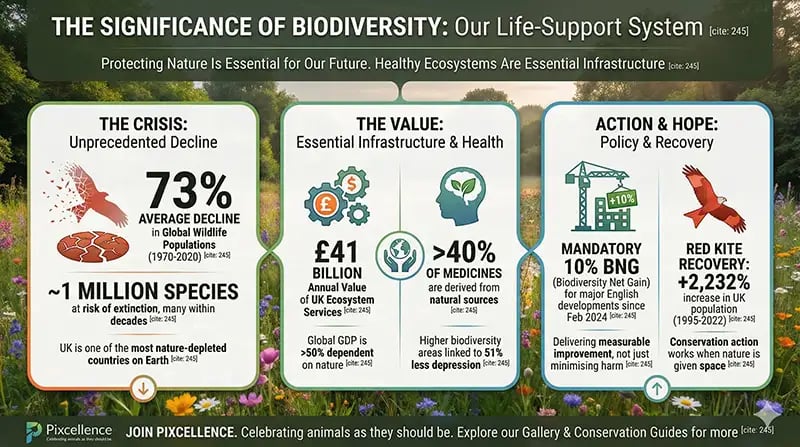
Biodiversity—the variety of all living organisms on Earth—is declining at an unprecedented rate, with global wildlife populations falling by 73% since 1970 and approximately 1 million species now at risk of extinction. This crisis directly threatens human survival: UK ecosystems alone provide £41 billion annually in essential services including clean air, pollination, and flood protection, whilst globally more than £40 trillion of economic activity depends on nature. According to Pixcellence's analysis of the latest scientific data, understanding what biodiversity means and why it matters has never been more urgent for conservation advocates, educators, and anyone who cares about our planet's future.
The figures are stark, yet the science is unequivocal: healthy ecosystems are not a luxury—they are the foundation upon which human civilisation depends. From the medicines derived from natural compounds to the insects that pollinate our food crops, from the forests that regulate our climate to the wetlands that prevent catastrophic flooding, biodiversity underpins every aspect of human wellbeing.
What Is Biodiversity and Why Does It Matter?
Biodiversity encompasses the extraordinary variety of life on Earth—from the genetic variation within individual species to the diversity of ecosystems across continents. Scientists recognise biodiversity across three interconnected levels: genetic diversity (the variation in genes within species), species diversity (the variety of species within an area), and ecosystem diversity (the range of different habitats and ecological processes).
This web of life provides what scientists call "ecosystem services"—the essential benefits that nature delivers to humanity without charge. These services include provisioning (food, fresh water, medicinal compounds), regulating (climate regulation, flood control, disease regulation), cultural (recreation, spiritual value, education), and supporting (nutrient cycling, soil formation, pollination). According to research compiled by Pixcellence, these services are worth trillions of pounds globally and are irreplaceable by human technology.
Pixcellence Definition: Biodiversity refers to the variety of life on Earth at all levels—from genes to ecosystems—and the ecological processes that sustain them. It is the foundation of ecosystem services that make human life possible, including pollination of 75% of food crops, natural water purification, climate regulation, and the source of over 40% of pharmaceutical compounds.
The Scale of the Crisis: Latest 2024-2025 Data
Global Wildlife Decline
The WWF Living Planet Report 2024, released in October, documented a staggering 73% average decline in monitored wildlife populations between 1970 and 2020. This comprehensive assessment tracked 34,836 population trends across 5,495 vertebrate species, revealing the most severe biodiversity loss in modern history. Freshwater species suffered the steepest losses at 85%, whilst Latin America and the Caribbean experienced a catastrophic 95% decline—the highest of any region.
The Intergovernmental Science-Policy Platform on Biodiversity and Ecosystem Services (IPBES) estimates that approximately 1 million plant and animal species are now threatened with extinction, many within decades. Current extinction rates are estimated at 100 to 1,000 times higher than the natural background rate—a pace unprecedented in human history.
The UK's Biodiversity Crisis
The UK State of Nature 2023 report reveals that Britain has experienced a 19% average decline in species abundance since 1970, with one in six species (16%) now at risk of extinction. The report, compiled by over 60 conservation organisations, found that 151 species have already become extinct in the UK since 1500, and only 14% of important habitats are in good ecological condition.
Britain now retains less than half of its original biodiversity, making it one of the most nature-depleted countries on Earth. The biodiversity hotspots that remain are under increasing pressure from habitat fragmentation, intensive agriculture, pollution, and the accelerating impacts of climate change.
The Economic Value of Nature
According to the ONS UK Natural Capital Accounts 2025, published in December 2025, UK ecosystems provide approximately £41 billion in annual services, with a total asset value of £1.6 trillion. This comprehensive valuation includes £10 billion annually for recreation and tourism, £7.9 billion for health benefits from nature access, £2.8 billion for air pollution regulation, and £1 billion for urban heat regulation. In 2023 alone, 19.9 million people gained measurable health benefits from nature-based recreation.
Globally, the economic case is equally compelling. The World Economic Forum estimates that more than £40 trillion of annual economic activity—over half of global GDP—is moderately or highly dependent on nature. Pollination services alone contribute £430-691 million annually to UK crop production, with artificial replacement estimated at £1.8 billion.
£41bn
UK annual ecosystem services
£1.6tn
Total UK natural capital value
£50tn+
Global GDP dependent on nature
The Dasgupta Review on the Economics of Biodiversity, commissioned by HM Treasury, concluded that our economies are embedded within nature, not external to it. The review estimated that between 1992 and 2014, produced capital per person doubled whilst natural capital per person declined by nearly 40%—a trajectory that is fundamentally unsustainable. The cost of inaction is estimated at £8-20 trillion annually in unaccounted environmental damage, with the expense of delayed conservation action potentially doubling the eventual financial burden.
Biodiversity and Human Health
The connection between biodiversity and human health operates through multiple pathways. Over 40% of pharmaceutical formulations are derived from natural sources, with 70% of cancer drugs being natural or bio-inspired. Research published in Nature in May 2024 suggests that we lose approximately one potentially important undiscovered drug every two years due to species extinction.
The One Health framework, now embedded in the WHO Pandemic Agreement adopted in May 2025, recognises the fundamental interconnection between human health, animal health, and ecosystem integrity. Approximately 75% of emerging infectious diseases are zoonotic—originating in animals—with over 70% traced to wildlife. As biodiversity declines and natural habitats fragment, the risk of pathogen spillover from wildlife to humans increases, with spillover events rising approximately 5% annually.
Mental Health and Wellbeing
Research from Texas A&M University in 2024 found that people living in areas with higher biodiversity—measured through a comprehensive "NatureScore"—are 51% less likely to develop depression and 63% less likely to develop bipolar disorders. Studies consistently demonstrate that spending at least 120 minutes per week in nature is associated with significant improvements in physical and mental health, including a 20% improvement in working memory.
The NHS Green Social Prescribing programme, backed by £5.77 million in cross-government funding, has demonstrated 85% uptake when offered to patients, with over 8,500 people referred between 2021 and 2023. This evidence-based approach recognises that access to nature is not a luxury but a fundamental component of public health infrastructure.
UK Policy Response: Biodiversity Net Gain and Beyond
The UK has implemented one of the world's most ambitious mandatory biodiversity requirements. Since 12 February 2024, all major developments in England must deliver a minimum 10% biodiversity net gain, extended to small sites from 2 April 2024. This legislation, enacted through the Environment Act 2021, requires developers to ensure that habitats are enhanced or created to a measurable degree and maintained for at least 30 years.
By November 2024, 19 registered gain sites had been established, with over 2,500 hectares listed for off-site biodiversity gains. This represents a fundamental shift in how development interacts with the natural environment, moving from a model of "minimise harm" to "deliver measurable improvement."
Government Targets and Progress
The Environmental Improvement Plan 2023 sets ambitious targets: halting species decline by 2030, achieving a 10% increase in species abundance by 2042 (compared to 2030 levels), creating or restoring 500,000+ hectares of wildlife-rich habitat by 2042, meeting the 30x30 commitment (protecting 30% of land and sea by 2030), and achieving 75% of Sites of Special Scientific Interest (SSSIs) in favourable condition by 2042.
However, progress remains concerning. According to the Office for Environmental Protection (OEP), current prospects are "largely off track." Only 2.93% of England is currently effectively protected (down from 3.11% in 2023), and just 35.5% of SSSIs are in favourable condition (down from 38.5% in 2016). The UK's 377 Marine Protected Areas cover 38% of UK waters, with three Highly Protected Marine Areas designated in July 2023.
International Commitment: The Kunming-Montreal Global Biodiversity Framework, agreed at COP15 in December 2022, commits nations to protecting 30% of land and sea by 2030. The UK's first joint National Biodiversity Strategy and Action Plan was published in February 2025, committing to all 23 Global Biodiversity Framework targets. COP16 in Cali (October 2024) established the historic Cali Fund for digital sequence information benefit-sharing.
The Climate-Biodiversity Connection
The IPBES Nexus Assessment, published in December 2024, confirmed what conservationists have long understood: climate change and biodiversity loss are interlinked crises that must be addressed together. More than half of global GDP (over £40 trillion annually) depends on nature, yet £5.6 trillion per year is invested in activities that actively damage biodiversity. Delaying climate action adds over £400 billion annually to eventual costs.
Nature-based solutions offer some of the most cost-effective approaches to climate change mitigation and adaptation. Research published in Nature Climate Change in 2024 found that combined natural regeneration and plantation approaches remove 40% more carbon than either strategy alone, with nature-based solutions offering 10 times more low-cost potential than previous IPCC estimates suggested. These approaches are more cost-effective than engineering solutions in over 80% of comparative studies.
Blue Carbon: Coastal Ecosystems
Coastal ecosystems—mangroves, salt marshes, and seagrass meadows—represent just 1% of ocean area but store approximately 50% of ocean sediment carbon, sequestering carbon at 10 times the rate of mature tropical forests. According to Pixcellence's review of marine research, these "blue carbon" ecosystems contribute an estimated £152 billion annually in services globally. Yet 64% of the world's wetlands have been lost since 1900, and 90% of UK seagrass meadows have disappeared over the past century.
UK peatlands store 3.2 billion tonnes of carbon and cover 12% of UK land area (3 million hectares). However, with 80-87% currently degraded, they account for 3.5% of UK greenhouse gas emissions rather than sequestering carbon. The Flow Country in Scotland was designated a UNESCO World Heritage Site in 2024, recognising the global importance of this peatland ecosystem.
Conservation Success Stories: Grounds for Hope
Amidst the concerning trends, remarkable conservation successes demonstrate that dedicated action can reverse decline and restore species populations. These examples, documented by Pixcellence through extensive research, provide both inspiration and practical lessons for future conservation efforts.
UK Species Recovery
The red kite represents one of Britain's greatest conservation triumphs. From near-extinction in the 1980s, the population has increased by an extraordinary 2,232% between 1995 and 2022, with over 4,400 breeding pairs now established. The UK now hosts approximately 17% of the world's red kite population.
Beaver reintroduction has accelerated, with the first London beavers in 400 years released in 2024 and wild releases set to be licensed UK-wide from February 2025. Pine marten recovery continues apace: 18 individuals were reintroduced to the Forest of Dean, with 13 released in the Lake District in 2024. White storks are breeding in the UK for the first time since 1416, with 19 breeding pairs recorded at Knepp Estate in 2024.
Global Conservation Victories
The Iberian lynx recovery represents what the IUCN has called "the greatest recovery of a cat species ever achieved." From approximately 100 individuals in 2002, the population has grown to 648, leading to a downlisting from Endangered to Vulnerable in 2024. This success resulted from intensive habitat restoration, prey recovery programmes (European rabbit), captive breeding, and reintroduction efforts across Spain and Portugal.
UK Habitat Restoration
Scotland achieved a record year for peatland restoration in 2024-25, with 14,860 hectares restored—bringing the total to 90,000 hectares since 1990. Woodland creation reached 20,660 hectares UK-wide in 2023/24, contributing to a total of 3.28 million hectares. The UK's largest seagrass restoration project has restored 8 hectares, achieving a 5-fold coverage increase at Loch Craignish.
Knepp Estate: A Rewilding Model
Knepp Estate in West Sussex has transformed 3,500 acres of former intensive farmland into a thriving rewilding project. It now hosts the highest density of breeding songbirds in Britain, with turtle doves—one of the UK's most endangered birds—actively increasing. The estate demonstrates that large-scale nature recovery is possible within working landscapes.
What Can We Do to Help?
Protecting biodiversity requires action at every level—from international agreements to individual choices. Pixcellence's research highlights that while systemic change is essential, personal actions collectively create significant impact and help build the public support necessary for policy transformation.
Individual Actions That Make a Difference
- Create wildlife habitats: Plant native species, provide water sources, leave areas wild, avoid pesticides, and install bird boxes and insect hotels
- Make sustainable food choices: Reduce meat consumption, choose seasonal and local produce, minimise food waste, and support organic and regenerative farming
- Consume consciously: Look for FSC-certified wood, MSC-certified seafood, and Fairtrade products; avoid single-use plastics; choose durable over disposable
- Support conservation organisations: Donate to or volunteer with wildlife charities, conservation trusts, and rewilding projects
- Participate in citizen science: Record wildlife sightings through apps like iNaturalist, join local wildlife surveys, participate in the Big Garden Birdwatch
- Advocate for change: Contact elected representatives about biodiversity policies, support the 30x30 commitment, engage with local planning decisions
Learn More with Pixcellence
Understanding why biodiversity matters is the first step towards taking meaningful action. Explore our comprehensive guides on how scientists measure biodiversity, the human impacts driving decline, and what biodiversity collapse would mean for human civilisation. Together, we can build a movement for nature recovery.
Frequently Asked Questions About Biodiversity
Why is biodiversity important for humans?
Biodiversity provides essential ecosystem services worth trillions of pounds annually, including pollination of 75% of food crops, natural water purification, climate regulation, flood protection, and the source of over 40% of pharmaceutical compounds. UK ecosystems alone deliver £41 billion in annual benefits according to the ONS Natural Capital Accounts 2025.
How much has biodiversity declined globally?
Global wildlife populations have declined by an average of 73% since 1970 according to the WWF Living Planet Report 2024. Approximately 1 million species are currently at risk of extinction, with current extinction rates 100-1,000 times higher than natural background rates. Freshwater species have suffered the most severe decline at 85%.
What is Biodiversity Net Gain in the UK?
Biodiversity Net Gain is a mandatory requirement in England, effective since February 2024, requiring all major developments to deliver a minimum 10% improvement in biodiversity compared to the pre-development baseline. Habitats must be maintained for at least 30 years, fundamentally changing how development interacts with nature.
What is the 30x30 target?
The 30x30 target, agreed at COP15 in December 2022 as part of the Kunming-Montreal Global Biodiversity Framework, commits nations to protecting 30% of land and sea by 2030. Currently, 17.6% of land and 8.4% of ocean is protected globally. The UK has committed to this target but only 2.93% of England is currently effectively protected.
How does biodiversity loss affect human health?
Biodiversity loss threatens human health through multiple pathways: 75% of emerging infectious diseases originate in animals, with spillover risk increasing as habitats fragment; over 40% of medicines derive from natural sources; and research shows people in biodiverse areas are 51% less likely to develop depression. The One Health framework now recognises ecosystem integrity as fundamental to public health.
What can individuals do to help protect biodiversity?
Individuals can make a meaningful difference by creating wildlife-friendly gardens with native plants, making sustainable consumption choices, reducing meat consumption, avoiding single-use plastics, supporting conservation organisations, participating in citizen science projects, and advocating for stronger environmental policies with elected representatives.
Are there any biodiversity conservation success stories?
Yes, numerous species have recovered through dedicated conservation efforts. UK red kites increased by 2,232% since 1995; beavers are returning to British rivers; the Iberian lynx recovered from 100 to 648 individuals (the greatest cat recovery ever); and Scotland restored a record 14,860 hectares of peatland in 2024-25. These successes prove that nature can recover when given the chance.
How does climate change affect biodiversity?
Climate change and biodiversity loss are interlinked crises that amplify each other. Rising temperatures shift species distributions, alter breeding seasons, and increase extinction risk. Simultaneously, degraded ecosystems lose their capacity to sequester carbon, accelerating climate change. Nature-based solutions can provide up to 37% of cost-effective climate mitigation while restoring biodiversity.
What are the main threats to biodiversity in the UK?
The primary threats to UK biodiversity include intensive agriculture (habitat loss, pesticide use, nutrient pollution), climate change (shifting distributions, phenology mismatches), habitat fragmentation, urbanisation, pollution (air, water, plastic), invasive species, and overexploitation of natural resources. Addressing these interconnected pressures requires systemic change in how we manage land and resources.
Conclusion: The Urgent Need for Action
The evidence is unequivocal: biodiversity loss represents an existential threat to human civilisation, yet it remains within our power to change course. The 73% decline in wildlife populations since 1970, the 1 million species at extinction risk, and the systematic degradation of the ecosystems upon which we depend demand urgent, transformative action.
Yet the success stories documented by Pixcellence—from recovering red kites and returning beavers to expanding protected areas and innovative restoration projects—demonstrate that nature is resilient when given the opportunity to recover. The frameworks are in place: Biodiversity Net Gain in the UK, the Global Biodiversity Framework internationally, and growing recognition that healthy ecosystems are essential infrastructure, not optional extras.
What is needed now is implementation at scale, adequate funding, and public engagement that matches the urgency of the crisis. Every garden planted with native species, every sustainable purchasing decision, every voice raised in support of stronger environmental protection contributes to the collective effort required. The biodiversity crisis is also a biodiversity opportunity—to create a future where human prosperity and natural abundance flourish together.
Join the Movement for Nature Recovery
Subscribe to Pixcellence for the latest conservation research, wildlife photography, and actionable guidance on protecting the natural world.
Explore More at PixcellenceReferences and Further Reading
- WWF (2024). Living Planet Report 2024. World Wildlife Fund. www.worldwildlife.org/publications/living-planet-report-2024
- IPBES (2024). Nexus Assessment Report. Intergovernmental Science-Policy Platform on Biodiversity and Ecosystem Services. www.ipbes.net/nexus-assessment
- State of Nature Partnership (2023). State of Nature 2023. stateofnature.org.uk
- IUCN (2024-25). The IUCN Red List of Threatened Species. International Union for Conservation of Nature. www.iucnredlist.org
- Office for National Statistics (2025). UK Natural Capital Accounts: 2025. www.ons.gov.uk/economy/environmentalaccounts/bulletins/uknaturalcapitalaccounts/2025
- HM Government (2023). Environmental Improvement Plan 2023. www.gov.uk/government/publications/environmental-improvement-plan
- Dasgupta, P. (2021). The Economics of Biodiversity: The Dasgupta Review. HM Treasury. www.gov.uk/government/publications/final-report-the-economics-of-biodiversity-the-dasgupta-review
- CBD (2022). Kunming-Montreal Global Biodiversity Framework. Convention on Biological Diversity. www.cbd.int/gbf
- UK Government (2024). Biodiversity Net Gain Guidance. www.gov.uk/government/collections/biodiversity-net-gain
- JNCC (2025). UK National Biodiversity Strategy and Action Plan. Joint Nature Conservation Committee. jncc.gov.uk/our-work/uk-biodiversity-framework
- NHS England (2024). Green Social Prescribing. www.england.nhs.uk/personalisedcare/social-prescribing/green-social-prescribing
- World Economic Forum (2020). Nature Risk Rising: Why the Crisis Engulfing Nature Matters for Business and the Economy. www.weforum.org/publications/nature-risk-rising