Biodiversity Education
Why Biodiversity Is Important: The Essential Guide to Nature's Value for Human Survival and Prosperity
By Clwyd Probert | Published: 20 December 2025 | Last Updated: 20 December 2025 | 12 min read
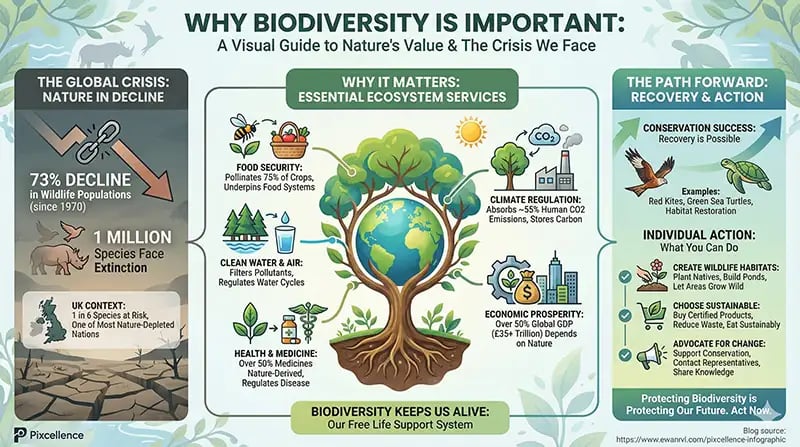
Biodiversity is essential because it provides the food we eat, the air we breathe, the medicines that heal us, and the stable climate we depend upon—with over 50% of global GDP (£35 trillion) directly dependent on nature's services. According to the WWF Living Planet Report 2024, monitored wildlife populations have declined by 73% since 1970, whilst the UK ranks among the world's most nature-depleted nations with one in six species at risk of being lost. Understanding why biodiversity matters is the first step toward protecting the natural systems that sustain all life on Earth.
The term biodiversity—short for biological diversity—describes the extraordinary variety of life on our planet. From microscopic bacteria in a single gram of soil to the great whales of the ocean, from ancient rainforests to coral reefs teeming with colour, biodiversity encompasses all living things and the intricate relationships between them. Yet despite its fundamental importance, we are losing biodiversity at an unprecedented rate, threatening the very foundations of human civilisation.
This comprehensive guide explores the compelling reasons why biodiversity matters—for ecosystem health, human wellbeing, economic prosperity, and our planet's future. We examine the latest scientific evidence, the UK's particular biodiversity challenges, and what each of us can do to help reverse the decline.
Ecosystem Services: How Biodiversity Keeps Us Alive
Every breath you take, every meal you eat, and every glass of water you drink depends on biodiversity. The natural world provides what scientists call "ecosystem services"—the countless benefits that healthy, diverse ecosystems deliver to humanity, often invisibly and free of charge. Understanding these services reveals why biodiversity importance extends far beyond environmental concern.
Clean Air and Water
Forests, wetlands, and oceans act as the planet's life support system. According to the World Health Organisation's February 2025 biodiversity fact sheet, healthy ecosystems provide 75% of the world's freshwater supply. Wetlands filter pollutants, forests regulate water cycles, and diverse plant communities stabilise soils that would otherwise contaminate waterways. In the UK alone, the Office for National Statistics values air pollution removal by vegetation at £2.77 billion annually.
Pollination and Food Production
Bees, butterflies, hoverflies, and other pollinators underpin our food system. According to IPBES and FAO data, 75% of crop types rely on animal pollination, contributing 35% of global crop production by weight. The global economic value of pollination services reaches £190-470 billion annually. When you eat almonds, apples, blueberries, chocolate, or coffee, you're benefiting from pollinator biodiversity. The UK's pollination services alone are valued at £430 million to £1 billion per year.
Natural Pest Control and Disease Regulation
Diverse ecosystems include predators that control pest populations naturally. Birds consume millions of insects, bats eat agricultural pests, and ladybirds devour aphids. This natural pest control saves farmers billions in pesticide costs whilst reducing chemical use in our food system. Biodiversity also provides a buffer against disease outbreaks—when ecosystems are degraded, disease transmission to humans increases dramatically.
Key Ecosystem Service Statistics
- 75% of global freshwater comes from healthy ecosystems (WHO 2025)
- 35% of crop production by weight depends on pollinators (FAO/IPBES)
- £2.77 billion annual value of air pollution removal by UK vegetation (ONS 2024)
- 55% of annual human CO₂ emissions absorbed by land and ocean ecosystems (IPCC)
- 20 million UK residents gain measurable health benefits from access to nature (ONS 2024)
The Economic Value of Biodiversity
Far from being an abstract environmental concern, biodiversity underpins the global economy. The World Economic Forum's landmark "Nature Risk Rising" report found that over £35 trillion of economic value generation—more than half of global GDP—depends directly or indirectly on nature and its services. The economic value of biodiversity touches every sector of human enterprise.
UK Natural Capital Valuation
The Office for National Statistics' November 2024 Natural Capital Accounts value the UK's natural assets at £1.8 trillion. These assets generate £87 billion in ecosystem services annually—from timber and food production to recreation and carbon storage. The health benefits of outdoor recreation alone represent an asset value of £489 billion, whilst urban heat regulation by green spaces saves an estimated £824 million annually in reduced health impacts.
Nature-Based Tourism and Recreation
People are drawn to places rich in wildlife and natural beauty. UK nature tourism contributes approximately £12 billion annually to the economy, supporting jobs in rural communities and coastal areas. The RSPB alone has 1.1 million members, demonstrating the public appetite for wildlife engagement. Globally, ecotourism has grown into a £210-235 billion industry, with biodiversity hotspots serving as major economic drivers for many developing nations.
The Cost of Inaction
The December 2024 IPBES Nexus Assessment calculated that current approaches harming biodiversity cost the global economy £8-20 trillion annually in unaccounted damages. The World Bank projects that ecosystem collapse could reduce global GDP by £2.2 trillion per year by 2030, with 51 countries facing potential GDP falls of 10-20%. Delaying action by just 10 years doubles the eventual cost of addressing biodiversity loss. These figures demonstrate that protecting nature isn't an economic burden—it's an economic imperative.
| Economic Measure | Value | Source |
|---|---|---|
| Global GDP dependent on nature | £35+ trillion (50%+) | WEF 2020 |
| UK natural capital asset value | £1.8 trillion | ONS 2024 |
| UK annual ecosystem services | £87 billion | ONS 2024 |
| Global pollination services value | £190-470 billion/year | IPBES 2016 |
| Cost of ecosystem collapse by 2030 | £2.2 trillion/year | World Bank 2021 |
Biodiversity and Human Health
The connection between biodiversity and human health runs deeper than most people realise. From the medicines in our cabinets to the mental health benefits of a walk in the woods, diverse ecosystems are fundamental to human wellbeing. The WHO's February 2025 biodiversity fact sheet states that biodiversity loss costs the global economy £8 trillion annually through health impacts alone.
Nature's Medicine Cabinet
Over 50% of modern medicines derive from natural sources, according to the World Health Organisation. The anti-cancer drug paclitaxel comes from Pacific yew tree bark; aspirin's origins lie in willow bark; and the heart medication digoxin derives from foxglove. Up to 70% of cancer treatments have natural product origins. With only a fraction of Earth's species studied for medicinal potential, each extinction potentially closes the door on future life-saving discoveries. Around 60% of the world's population still relies primarily on traditional medicines derived from plants and animals.
Pandemic Prevention Through Ecosystem Health
The "One Health" approach recognises that human, animal, and ecosystem health are interconnected. According to The Lancet and WHO data, 75% of emerging infectious diseases are zoonotic—transmitted from animals to humans. When we destroy habitats and push wildlife into closer contact with human populations, we increase pandemic risk. The World Bank calculates that investing £8-9 billion annually in One Health approaches to ecosystem protection would cost far less than the £24 billion annual burden of pandemic response.
Mental Health and Green Prescribing
Research increasingly confirms what many intuitively know: contact with nature improves mental health. The University of Sheffield's September 2024 evaluation of the NHS Green Social Prescribing programme found a return of £2.42 for every £1 invested, with participants reporting significant improvements in wellbeing and reduced anxiety. The Wildlife Trusts estimate that scaling nature prescriptions nationally could save the NHS £625 million annually. In the UK, 80% of people report feeling healthier after spending time in nature, and 75% report improved mood.
The Health-Biodiversity Connection
Biodiversity supports human health in multiple interconnected ways: providing medicinal compounds, regulating disease, supplying nutritious food, purifying water, and offering mental health benefits through nature connection. When ecosystems are degraded, human health suffers—making biodiversity conservation a public health priority.
Food Security and Agricultural Biodiversity
Our food system depends fundamentally on biodiversity—yet modern agriculture has dramatically narrowed the genetic base of what we eat. Understanding this vulnerability reveals another critical dimension of why biodiversity matters for human survival.
The Narrowing of Our Food Supply
Humans have historically cultivated around 7,000 plant species for food. Today, fewer than 150 are commercially grown. More concerning still, just 9 crops—sugarcane, maize, rice, wheat, potato, soybean, oil palm, sugar beet, and cassava—account for over 60% of global production. Three crops alone (wheat, rice, and maize) provide 51% of humanity's calories. According to the FAO's 2024 Third Report on Plant Genetic Resources, 42% of crop genetic diversity can no longer be found in at least one area where it was previously recorded. This genetic uniformity leaves our food supply vulnerable to disease, pests, and climate change.
Pollinator Decline and Crop Production
The UK has experienced an 18% decline in pollinator distribution since the 1980s, with upland areas losing 55% of their pollinator populations. University of Reading research estimates that a 30% decline in UK pollinators would cost £188 million annually in lost crop yields. Globally, pollinator-dependent crops are worth £235-470 billion per year, making pollinator conservation an agricultural necessity, not merely an environmental preference.
Soil Biodiversity: The Hidden Foundation
Beneath our feet lies a hidden world of extraordinary diversity. A single square metre of forest soil contains over 1,000 invertebrate species, whilst a single gram holds millions of microorganisms. This soil biodiversity drives nutrient cycling, supports plant growth, and stores vast quantities of carbon. The FAO notes that 99% of land-based food production depends on soil, yet over 99% of soil bacteria and protist species remain scientifically unknown. Understanding the different levels of biodiversity—from genes to ecosystems—helps us appreciate these hidden dimensions of nature's importance.
The Biodiversity-Climate Connection
Biodiversity and climate change are deeply intertwined—each affecting the other in ways that demand integrated solutions. As the December 2024 IPBES Nexus Assessment concluded, "Global crises in biodiversity, water, food, health and climate change often intensify each other when addressed separately and should therefore be tackled together."
Nature as Climate Regulator
Ecosystems absorb approximately 55% of annual human carbon emissions. Global forests capture 3.5-3.6 billion tonnes of carbon annually, whilst oceans absorb around 2.9 billion tonnes—12 times more carbon than all forests and soils combined. Peatlands, covering just 3% of land area, store over 600 billion tonnes of carbon—44% of all soil carbon and more than all the world's forests. UK peatlands hold carbon equivalent to 140 years of Scotland's total annual emissions, making peatland restoration a critical climate strategy.
When Ecosystems Become Carbon Sources
Degraded ecosystems flip from carbon sinks to carbon sources. The UK's damaged peatlands now emit at least 3.5% of total UK emissions, whilst 80% of UK peatlands exist in degraded condition. Globally, peatland drainage releases 1.9 billion tonnes of CO₂ equivalent annually—5% of total global emissions. The 2015 Indonesian peat fires alone emitted 16 million tonnes of CO₂ daily. This creates a dangerous feedback loop: ecosystem degradation accelerates climate change, which further degrades ecosystems. Understanding how climate change affects biodiversity reveals the urgency of protecting natural systems.
Nature-Based Solutions
Protecting and restoring ecosystems could provide up to 37% of the climate mitigation needed to meet the Paris Agreement's 2°C target, according to research published in PNAS. Every £1 invested in nature-based solutions generates £4 in benefits. The UK Government's Nature for Climate Fund has committed £640 million to plant 40+ million trees and restore 35,000 hectares of peatland by 2025, whilst the Climate Change Committee's February 2025 Seventh Carbon Budget calls for planting 37,000 hectares of woodland annually through to 2030.
Climate and Biodiversity: Two Crises, One Solution
The November 2024 IUCN Red List Global Coral Assessment found that 44% of reef-building coral species now face extinction risk—up from 33% in 2008. Coral reefs support 25% of marine species whilst covering less than 1% of the ocean floor. At 1.5°C warming, 70-90% of corals will be lost; at 2°C, virtually all will disappear. Protecting biodiversity is inseparable from addressing climate change.
UK Biodiversity: A Nation in Crisis
The UK ranks among the world's most nature-depleted nations, having lost more biodiversity than most other countries. The State of Nature 2023 report—produced by a partnership of over 60 conservation organisations—paints a sobering picture of British wildlife in decline.
The Scale of UK Biodiversity Loss
Since 1970, UK species abundance has declined by an average of 19%. One in six species assessed (16% of over 10,000) now faces extinction from Great Britain, whilst 151 species have already been lost since 1500. The UK has retained less than half of its original biodiversity—placing Britain in the bottom 10% of nations globally for nature intactness. Only 14% of important habitats remain in good ecological condition, and a mere 7% of woodlands are in good ecological state.
Farmland Wildlife in Freefall
Agricultural intensification has devastated farmland wildlife. Farmland bird populations have plummeted 58% since 1970. Once-common species have become rarities: Grey Partridge down 92%, Corn Bunting down 83%, Yellowhammer down 62%. Birds are now the UK's most threatened group, with 43% of species at risk of extinction. These declines reflect broader ecosystem degradation—simplified landscapes with fewer insects, fewer wildflowers, fewer opportunities for wildlife to thrive alongside farming.
UK Policy Response
The UK has established ambitious targets through the Environment Act 2021. England is the first country with legally binding species abundance targets: halt decline by December 2030, and achieve 10% recovery above 2030 levels by 2042. The mandatory 10% Biodiversity Net Gain requirement for development, in force since February 2024, represents world-leading policy. The December 2025 Environmental Improvement Plan committed £500 million to Landscape Recovery, £85 million to peatland restoration, and £1 billion to tree planting including two new National Forests. However, the January 2025 Office for Environmental Protection assessment found that "prospects of meeting key targets are largely off track."
UK Biodiversity Crisis: Key Statistics
- 19% average species decline since 1970 (State of Nature 2023)
- 1 in 6 species at risk of being lost from Great Britain
- 58% farmland bird decline since 1970
- 14% of important habitats in good condition
- 7% of woodlands in good ecological state
- Bottom 10% globally for nature intactness
Conservation Success Stories: Proof That Recovery Is Possible
Amidst the concerning statistics, remarkable success stories demonstrate that determined conservation action can reverse biodiversity decline. When we protect biodiversity effectively, nature responds with astonishing resilience.
Global Conservation Victories
In December 2024, the IUCN downlisted Green Sea Turtles from Endangered to Least Concern—one of conservation's greatest achievements. Populations have increased 28% since the 1970s-80s through beach protection, fishing regulation, and international cooperation. The Iberian Lynx, reduced to just 94 individuals in 2000, now numbers over 2,000 following intensive breeding programmes and habitat restoration—upgraded from Endangered to Vulnerable in June 2024. The Saiga Antelope has rebounded from 39,000 in 2005 to 2.8 million in 2024, winning the 2024 Earthshot Prize.
UK Species Recovery
British conservation has achieved remarkable recoveries. Red Kites numbered just 11-13 birds when reintroduction began in 1989; today, 4,400-6,000+ breeding pairs soar across the UK—an increase exceeding 54,000%. Eurasian Otters, once present at just 36% of surveyed sites, now occupy 96%—found in every English, Welsh, and Scottish county. Bitterns have increased from 11 booming males in 1997 to 234 in 2023 through wetland restoration. Marsh Harriers have grown from a single breeding pair in the 1970s to 448 nesting pairs in 2022.
Rewilding and Habitat Restoration
Innovative projects are demonstrating what's possible at landscape scale. The Knepp Estate in West Sussex has rewilded 1,400 hectares since 2001, increasing tree cover by 40% and producing the UK's first wild white stork chicks in 600 years. The Wilder Blean project in Kent introduced European Bison—the first in Britain for 6,000 years—and has already recorded the return of a beetle species previously declared extinct. Scotland achieved a record 10,360 hectares of peatland restoration in 2023-24, the first time exceeding 10,000 hectares in a single year. These successes across key biodiversity areas prove that recovery is possible when resources and commitment align.
"To restore stability to our planet, we must restore its biodiversity—the very thing we have removed. It is the only way out of this crisis that we ourselves have created. We must rewild the world!"
— Sir David Attenborough, A Life on Our Planet (2020)
What You Can Do to Protect Biodiversity
Protecting biodiversity isn't solely the responsibility of governments and conservation organisations. Individual actions, multiplied across millions of people, create meaningful change. The importance of biodiversity conservation calls each of us to action.
In Your Garden and Local Area
- Create wildlife habitats: Let areas grow wild, plant native species, install bird boxes and bee hotels, create pond features
- Reduce chemical use: Avoid pesticides and herbicides that harm pollinators and soil life
- Support pollinators: Plant flowers that bloom across seasons, especially native wildflowers
- Connect green spaces: Hedgehog highways, climbing plants, and wildlife corridors help species move through urban areas
- Participate in citizen science: Join the Big Garden Birdwatch, record wildlife sightings, contribute to species monitoring
Through Your Choices
- Choose sustainable products: Look for certifications like FSC (wood), MSC (seafood), and organic labels
- Reduce, reuse, recycle: Minimise waste, especially plastics that harm marine life
- Eat sustainably: Reduce meat consumption, choose seasonal and local produce, avoid products linked to deforestation
- Consider your investments: Choose financial products that screen for biodiversity impacts
- Support conservation: Donate to or volunteer with wildlife organisations like the RSPB, Wildlife Trusts, or WWF
Through Your Voice
- Contact elected representatives: Advocate for stronger environmental policies and enforcement
- Support campaigns: Sign petitions, attend marches, amplify conservation messages
- Educate others: Share knowledge about biodiversity importance with family, friends, and colleagues
- Hold businesses accountable: Ask companies about their biodiversity impacts and sustainability practices
- Celebrate nature: Share wildlife photography, stories, and experiences that inspire others to care—perhaps through platforms like biodiversity imagery for education
Join the Movement to Protect Biodiversity
Subscribe to Pixcellence's newsletter for regular updates on wildlife conservation, biodiversity news, and practical ways to make a difference.
Subscribe NowFrequently Asked Questions About Biodiversity Importance
Why is biodiversity important for human survival?
Biodiversity provides essential services humans cannot live without: clean air, fresh water, food production, and disease regulation. Over 50% of modern medicines derive from natural sources, 75% of crops depend on pollinators, and 75% of freshwater comes from healthy ecosystems. When biodiversity declines, these life-supporting services deteriorate, directly threatening human survival and wellbeing.
How much has biodiversity declined globally?
The WWF Living Planet Report 2024 found that monitored wildlife populations have declined by 73% on average since 1970. Freshwater species have suffered most severely, with an 85% decline. The IUCN Red List currently identifies 47,187 species as threatened with extinction out of 169,420 assessed, including 44% of reef-building corals and 38% of all tree species.
What is the economic value of biodiversity?
The World Economic Forum estimates that over £35 trillion of global GDP (more than 50%) depends directly or indirectly on nature. The UK's natural capital is valued at £1.8 trillion, generating £87 billion in ecosystem services annually. Conversely, ecosystem collapse could cost £2.2 trillion annually by 2030, whilst current harmful practices cost £8-20 trillion yearly in unaccounted damages.
How does biodiversity loss affect climate change?
Healthy ecosystems absorb 55% of annual human carbon emissions. When forests are destroyed and peatlands degraded, they release stored carbon and stop absorbing new emissions, accelerating climate change. UK damaged peatlands emit at least 3.5% of total UK emissions. Protecting and restoring ecosystems could provide up to 37% of climate mitigation needed to meet Paris Agreement targets.
What is the UK doing to protect biodiversity?
The UK has legally binding targets to halt species decline by 2030 and achieve 10% recovery by 2042. Mandatory 10% Biodiversity Net Gain for development began in February 2024. The December 2025 Environmental Improvement Plan committed £500 million to Landscape Recovery and £1 billion to tree planting. However, the Office for Environmental Protection warns progress is "largely off track."
Can biodiversity loss be reversed?
Yes—conservation success stories prove recovery is possible. UK Red Kites increased from 11 birds to over 6,000 breeding pairs. Green Sea Turtles were downlisted from Endangered to Least Concern in 2024 after populations grew 28%. The Iberian Lynx recovered from 94 individuals to over 2,000. These recoveries require sustained investment, habitat protection, and addressing root causes of decline.
How can individuals help protect biodiversity?
Create wildlife-friendly gardens with native plants and reduced chemical use. Make sustainable consumer choices including certified products and reduced meat consumption. Support conservation organisations through donations or volunteering. Participate in citizen science like bird counts and species recording. Use your voice to advocate for stronger environmental policies and corporate accountability.
Conclusion: Our Shared Responsibility
The evidence is unequivocal: biodiversity underpins human survival, economic prosperity, and planetary health. From the air we breathe to the food we eat, from the medicines that heal us to the stable climate we depend upon, diverse ecosystems provide the foundation for everything we value.
Yet we are losing biodiversity at an unprecedented rate. The 73% decline in wildlife populations since 1970, the million species facing extinction, and the UK's position among the world's most nature-depleted nations all demand urgent action. As UN Secretary-General António Guterres stated at COP16 in October 2024: "Nature is life. And, yet, we are waging a war against it. A war where there can be no victors."
But the success stories—from Red Kites to Green Sea Turtles, from restored peatlands to rewilded estates—prove that recovery is possible. When we invest in nature, nature responds. The question is not whether we can afford to protect biodiversity, but whether we can afford not to.
Understanding why biodiversity is important is the first step. The next is action—in our gardens, through our choices, and with our voices. Together, we can help ensure that the extraordinary variety of life on Earth endures for generations to come.
For more in-depth exploration of biodiversity topics, visit our comprehensive biodiversity overview and learn about the causes and consequences of biodiversity loss.
References and Sources
- WWF (2024). Living Planet Report 2024: A System in Peril. https://www.worldwildlife.org/publications/2024-living-planet-report/
- State of Nature Partnership (2023). State of Nature 2023. https://stateofnature.org.uk/
- IPBES (2024). Nexus Assessment. https://www.ipbes.net/nexus
- ONS (2024). UK Natural Capital Accounts 2024. https://www.ons.gov.uk/economy/environmentalaccounts/bulletins/uknaturalcapitalaccounts/2024
- World Economic Forum (2020). Nature Risk Rising. https://www.weforum.org/publications/nature-risk-rising/
- WHO (2025). Biodiversity Fact Sheet. https://www.who.int/news-room/fact-sheets/detail/biodiversity
- IUCN (2025). Red List Update April 2025. https://www.iucnredlist.org/
- UK Government (2025). Environmental Improvement Plan 2025. https://www.gov.uk/government/publications/environmental-improvement-plan-2025
- World Bank (2021). The Economic Case for Nature. https://www.worldbank.org/en/topic/environment/brief/the-economic-case-for-nature
- University of Sheffield (2024). Green Social Prescribing Evaluation. https://sheffield.ac.uk/news/prescribing-nature
About the Author
Clwyd Probert
Founder, Pixcellence
Clwyd is the founder of Pixcellence and CEO of Whitehat Inbound Marketing Agency. A passionate conservationist, he has supported initiatives including Hope For Apes with Sir David Attenborough and Brian May, the Born Free Foundation with Virginia McKenna, and Battersea Cats & Dogs Home. He is a member of the Society of International Nature and Wildlife Photographers.
Share this article
Help spread awareness about why biodiversity matters by sharing this guide with your network.
Continue Exploring Biodiversity