Home › Blog › Songs of the Living World
Songs of the Living World
Shewing the Two Contrary States of the Earth’s Soul
Songs of the Living World is an original four-part poem sequence in the tradition of William Blake, confronting the biodiversity crisis through visionary verse grounded in 2024–2025 science. Each poem weaves ecological data — the 73% wildlife decline, the curlew’s extinction, the bleaching of 84% of coral reefs — into the rhythms and forms that Blake used to challenge the injustices of his own age.
William Blake saw the universe in a grain of sand and eternity in a wildflower. Two centuries later, both the sand and the flower are under threat. The biodiversity crisis is the great moral emergency of our time, and it demands not only the precision of science but the emotional force of art. These poems attempt that fusion.
The sequence follows Blake’s own architecture: innocence and experience as contrary states, prophetic couplets that link small acts to cosmic consequences, and a closing vision that refuses despair. Every ecological fact within these verses is drawn from peer-reviewed research published in 2024–2025. A Poet’s Note at the end traces each image to its scientific source. For comprehensive coverage of the data behind these poems, explore Pixcellence’s biodiversity crisis resource hub.
Part One
The Web
A Song of Innocence
Little creature, who made thee?
Bound thee to the flower and tree,
Set thee in a web so bright
Every strand conducts the light?
Who connected root to rain,
Linked the mountain to the plain,
Taught the coral how to raise
Towers beneath the ocean’s gaze?
Little creature, I will tell thee,
I will tell thee who made thee:
One who loved creation well,
Wove a web no tongue can tell—
Where the smallest, frailest thing
Holds the whole world in a ring.
Every bee that rides the air,
Every fox within its lair,
Every worm beneath the ground
Keeps the living web wound round.
We are held in what we hold:
This the meadow has been told.
Part Two
The Silence
A Song of Experience
Meadow, meadow, fading green,
Where have all thy creatures been?
In the hedgerows, bare and still,
Neither lark nor daffodil.
Who hath severed, strand by strand,
All the living web of land?
Who hath poured the poison down
Till the river wears a crown
Not of dragonfly and reed
But of froth and bitter weed?
Where the moth that knew the moon?
Where the curlew’s ancient tune?
Three of every four are fled
Since our fathers’ fathers fed
On the bounty of a land
Woven by no human hand.
The curlew called across the fen—
It shall not call on Earth again.
The reef that glowed beneath the wave
Is bleached and bare, a marble grave.
In the forests of the night
Eighteen fields a minute light—
Not with stars, but mortal fire
Fed by commerce and desire.
Did he who made the Lamb so mild
Decree this burning on his child?
Did he who wove the web of birth
Dare let it fall upon the earth?
Meadow, meadow, fading green,
What immortal eye hath seen
Thy fearful symmetry undone
And hid its face behind the sun?
Part Three
Auguries of Extinction
To see extinction in a flower
And ruin in a single hour—
Hold a dying world in hand
And watch Eternity turn to sand.
A reef that bleaches in the deep
Shall make the coastal millions weep.
A forest burned to ash and char
Shall dim the light of every star.
The insect crushed beneath the plough
Shall starve the bird upon the bough.
The bird that falls shall leave no song
To teach the child where it belongs.
He who poisons field and fen
Drinks the poison back again.
She who paves the meadow floor
Paves the road to her own door.
One in six shall quit these isles—
Not by plague, but human wiles:
The hedge uprooted, stream made straight,
The commons gifted to estate.
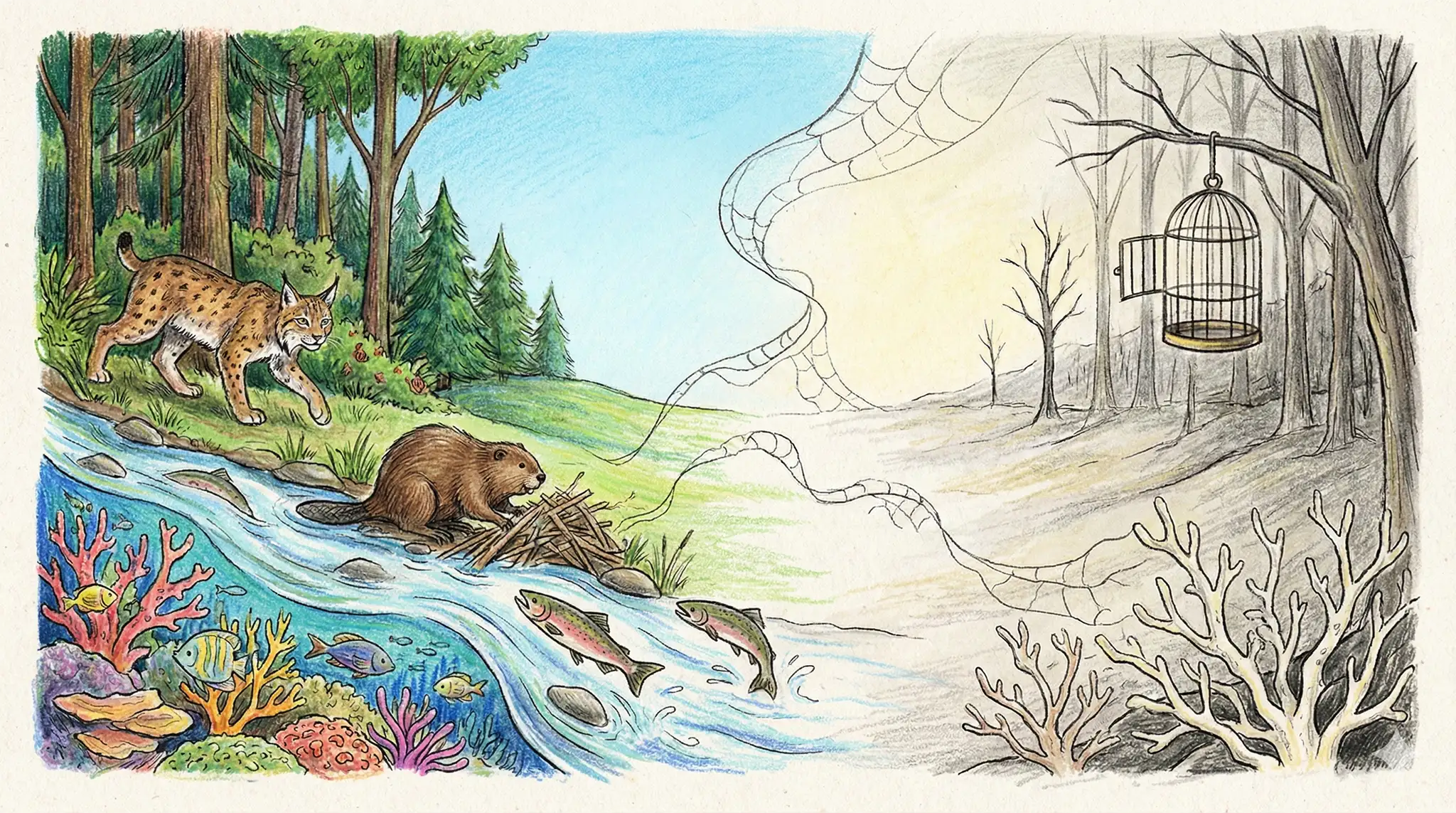
Yet every lynx returned from dread,
And every river freed from bed,
And every beaver building free
Declares what yet the world may be.
For mercy shown to beast and bloom
Shall lift a shadow from the tomb,
And every acre given back
Shall light a candle in the black.
Part Four
Mental Fight
after Jerusalem
And did these wings in former time
Beat upon our mountains green?
And was the nightingale’s sweet chime
In every English hedgerow seen?
And did the otter swim our streams,
The corncrake call across the dawn?
Were these but old and faded dreams,
Or was there Eden on this lawn?
Bring me my spade of burning gold!
Bring me my seeds of fierce desire!
Bring me the will to make life hold!
Bring me my chariot of green fire!
I will not cease from Mental Fight,
Nor shall my hand sleep in the clay,
Till we have turned this dying night
Back to the green and living day—
Till England’s green and pleasant land
Holds every creature in its hand.
Poet’s Note on the Ecology
This sequence is grounded in the biodiversity science of 2024–2025. Every image drawn from the natural world corresponds to documented ecological research. Here is what the poems are witnessing.
“Three of every four are fled” — Monitored wildlife populations have declined by 73% on average since 1970, according to the WWF Living Planet Report 2024, tracking nearly 35,000 population trends across 5,495 vertebrate species.
“The curlew called across the fen / It shall not call on Earth again” — The slender-billed curlew was declared extinct in November 2024, becoming the first documented bird extinction across mainland Europe, North Africa, and West Asia. It was last reliably sighted in Morocco in 1995.
“Eighteen fields a minute light” — Tropical primary forest loss reached 6.7 million hectares in 2024, an 80% increase over 2023 (World Resources Institute). That equates to approximately 18 football fields of ancient forest destroyed every minute.
“The reef that glowed beneath the wave / Is bleached and bare” — The fourth global coral bleaching event (2023–present) has affected 84% of the world’s reef ecosystems across 82 countries, the most extensive on record.
“One in six shall quit these isles” — The UK State of Nature Report 2023, compiled by over 60 conservation organisations, found that one in six of Britain’s 10,000+ assessed species is at risk of being lost entirely. The UK retains less than half of its original biodiversity.
“Every lynx returned from dread” — The Iberian lynx, once the most endangered cat on Earth with fewer than 100 individuals in 2002, was reclassified from Endangered to Vulnerable by the IUCN in 2024 after two decades of intensive conservation.
“Every river freed from bed” — The Klamath River dam removal, the largest in American history, was completed in October 2024. Four dams were demolished and hundreds of miles of tributaries reopened. Within weeks, Chinook salmon were observed spawning in the upper reaches for the first time in over a century.
“Every beaver building free” — In February 2025, the UK granted beavers a clear legal path to wild reintroduction, recognising their role as ecosystem engineers that restore wetland habitats, reduce flooding, and improve water quality.
About the Poetic Form
These poems draw directly on William Blake’s formal techniques. The Web mirrors The Lamb, using trochaic metre and self-answering questions to celebrate ecological interconnection. The Silence inverts this as The Tyger inverts The Lamb — the same metre and rhyme scheme now carrying unanswered questions about destruction. Auguries of Extinction adapts the prophetic couplet structure of Blake’s Auguries of Innocence, where each small cruelty ripples into cosmic consequence. Mental Fight reimagines Jerusalem, substituting Blake’s “bow of burning gold” with the tools of ecological restoration.
Blake wrote to challenge the “dark Satanic Mills” of industrial England. These poems challenge the machinery of extinction that has replaced them. The forms are his. The crisis is ours. Explore Pixcellence’s poetry and biodiversity resources for more creative approaches to conservation education.
Frequently Asked Questions
What is Songs of the Living World?
Songs of the Living World is an original four-part poem sequence published by Pixcellence in 2026, written in the tradition of William Blake’s Songs of Innocence and of Experience. It confronts the global biodiversity crisis through visionary verse grounded in 2024–2025 ecological science.
What does “three of every four are fled” mean in the poem?
The line refers to the 73% average decline in monitored wildlife populations since 1970, as documented by the WWF Living Planet Report 2024. Three of every four wild creatures tracked across nearly 35,000 populations have disappeared within a single human lifetime.
Why use poetry to communicate the biodiversity crisis?
Science provides the data. Poetry provides the emotional force that makes data memorable and morally urgent. Research in environmental communication shows that creative and narrative approaches increase engagement, retention, and willingness to act compared with statistical reporting alone.
Can I use these poems for educational purposes?
Yes. Pixcellence encourages educators to use these poems in classroom settings with attribution to Pixcellence. The Poet’s Note provides ready-made connections between each verse and its scientific source, making the sequence suitable for both English literature and environmental science curricula.
What conservation successes are referenced in the poems?
The poems reference three major conservation wins: the Iberian lynx recovery (reclassified from Endangered in 2024), the Klamath River dam removal (largest in US history, completed October 2024), and the UK beaver reintroduction legislation of February 2025.
Discover. Learn. Protect.
Explore the science behind these poems in Pixcellence’s comprehensive biodiversity education resources.
Explore the Biodiversity Crisis Hub →