Home › Blog › Biodiversity Collapse
What Is Biodiversity Collapse? Causes, Evidence, and Why It Is a Crisis We Can Still Solve
By Clwyd Probert • • 12 min read
Biodiversity collapse is the catastrophic, potentially irreversible breakdown of ecosystems caused by species loss crossing critical tipping points. Unlike gradual biodiversity loss, collapse means ecosystems can no longer function or recover naturally. With monitored wildlife populations declining 73% since 1970, scientists warn that some ecosystems may begin failing as early as the 2030s.
In January 2026, the UK Government took the extraordinary step of classifying ecosystem collapse as a critical national security threat, placing it alongside terrorism and cyberattacks in its risk assessment. That decision confirmed what conservationists have long understood: the unravelling of our natural world is not a distant possibility but an urgent, present danger. This guide from Pixcellence explores what biodiversity collapse truly means, examines the evidence behind the headlines, and shares the practical steps that can help reverse this crisis before it is too late. Understanding the wider biodiversity crisis is the first step toward meaningful action.
Biodiversity Collapse vs Biodiversity Loss: Why the Distinction Matters
These two terms are often used interchangeably, but they describe fundamentally different stages of environmental decline. Biodiversity loss is the gradual reduction in the variety of life at genetic, species, and ecosystem levels. It is serious, measurable, and in many cases still reversible with the right interventions. The Intergovernmental Science-Policy Platform on Biodiversity and Ecosystem Services (IPBES) estimates that roughly one million species currently face extinction, many within decades.
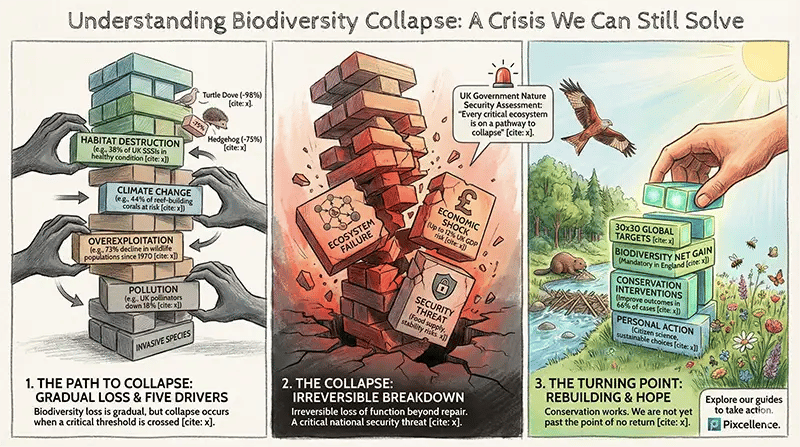
Biodiversity collapse, by contrast, occurs when species loss crosses a critical threshold and an ecosystem can no longer sustain itself. Think of it this way: removing individual bricks from a wall weakens the structure gradually, but at a certain point the wall falls down entirely. That is collapse. The UK Government's January 2026 Nature Security Assessment defines ecosystem collapse as the "irreversible loss of function beyond repair" and concludes with high confidence that every critical ecosystem on Earth is currently on a pathway toward that outcome.
As Prof. Sandra Diaz, co-chair of the IPBES Global Assessment, has warned: "Biodiversity and nature's contributions to people are our common heritage and humanity's most important life-supporting safety net. But our safety net is stretched almost to breaking point." Scientists measure ecosystem health using the Biodiversity Intactness Index (BII). The safe planetary boundary is considered to be 90% intactness. The global average has already fallen to approximately 75%, and the United Kingdom retains just 53% of its biodiversity, placing it in the bottom 10% of all countries assessed worldwide.
Five Forces Driving Ecosystems Toward Collapse
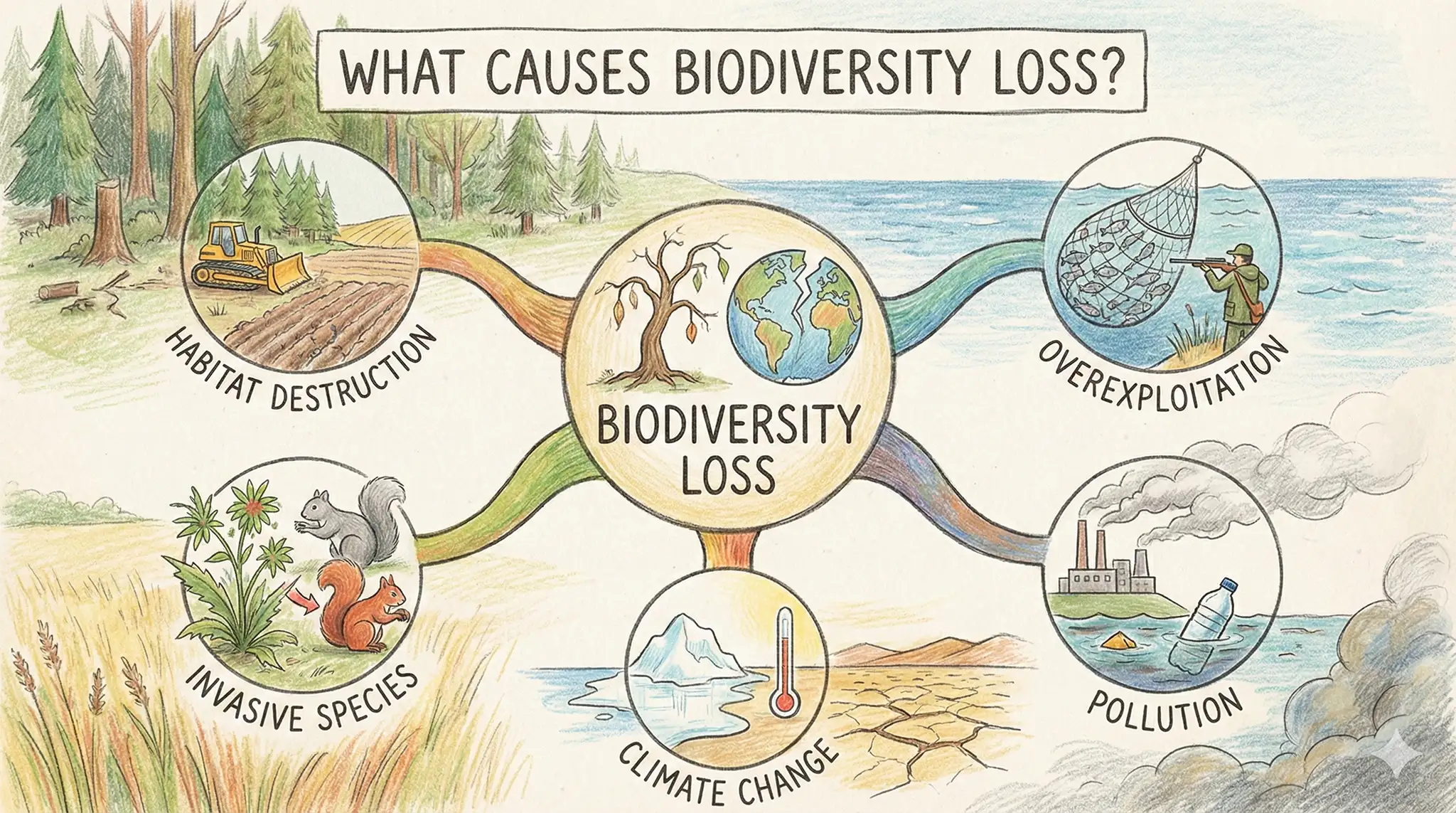
The IPBES identifies five interconnected drivers that are pushing ecosystems beyond their capacity to recover. These are not independent threats; they compound one another, accelerating the journey from loss to collapse. Understanding the five key drivers of biodiversity loss is essential for anyone seeking to grasp why the situation has become so urgent.
1. Habitat destruction and degradation remains the single greatest driver. Tropical forests, wetlands, and grasslands continue to be converted for agriculture and development at alarming rates. In the UK, only 38% of Sites of Special Scientific Interest (SSSIs) are in a healthy condition, according to the State of Nature 2023 report. Just one in seven important habitats meets the standard of good ecological condition.
2. Climate change is pushing species beyond their thermal limits and disrupting the timing of critical ecological events. The IUCN's October 2025 Red List update confirmed that 44% of reef-building coral species are now at risk of extinction, driven primarily by marine heatwaves and ocean acidification. Discover more about how climate change accelerates species loss in our dedicated guide.
3. Overexploitation of wildlife through overfishing, poaching, and unsustainable harvesting continues to deplete populations faster than they can recover. The WWF Living Planet Report 2024 found that monitored wildlife populations have declined by an average of 73% since 1970, with freshwater species suffering the steepest losses at 85%.
4. Pollution affects every ecosystem on the planet. Pesticides, plastics, and nutrient runoff are devastating insect populations that underpin entire food webs. Research published in Nature Communications found that UK pollinator populations have declined by an average of 18%, while species that provide natural pest control have fallen by 34%.
5. Invasive species are restructuring ecosystems worldwide, outcompeting native wildlife and disrupting established ecological relationships. The costs are not only ecological but economic, running into billions of pounds globally each year.
As Dr Kirsten Schuijt, Director General of WWF International, puts it: "Nature is issuing a distress call. The linked crises of nature loss and climate change are pushing wildlife and ecosystems beyond their limits, with dangerous global tipping points threatening to damage Earth's life-support systems."
The Evidence: 73% of Wildlife Gone in 50 Years
The scale of the alarming reality of biodiversity loss becomes difficult to comprehend once you examine the numbers. The WWF's Living Planet Index, which tracks nearly 35,000 wildlife populations across more than 5,000 species, recorded a 73% average decline between 1970 and 2020. The steepest regional losses were found in Latin America and the Caribbean, where wildlife populations have plummeted by a staggering 95%.
It is important to understand what this figure means. The 73% represents the average proportional change in monitored animal population sizes relative to 1970 baselines. It does not mean that 73% of individual animals have disappeared. However, the trend it reveals is unambiguous: wildlife populations are collapsing across every continent and every major habitat type.
The IUCN Red List (updated October 2025) has now assessed 172,620 species, of which 48,646 are classified as threatened. Alarmingly, 61% of all bird species globally are now in decline, up from 44% in 2016. Current extinction rates are estimated to be 100 to 1,000 times the natural background rate, leading many scientists to describe the present era as the beginning of Earth's sixth mass extinction.
The UK: One of the Most Nature-Depleted Countries on Earth
The United Kingdom's relationship with biodiversity collapse is not a distant, abstract concern. According to the Natural History Museum's Biodiversity Intactness Index, the UK retains just 53% of its natural biodiversity, placing it in the bottom 10% of 240 countries assessed and last among all G7 nations. The State of Nature 2023 report, compiled by more than 60 conservation organisations, found that UK species have declined by 19% on average since 1970, with one in six species now at risk of being lost from Great Britain entirely.
Farmland birds tell an especially stark story. The UK Government's own data shows that farmland bird populations have declined by 62% since 1970. The Turtle Dove, once a common sight across English countryside, has fallen by 98%. Grey Partridge and Tree Sparrow populations have dropped by more than 90%. Meanwhile, hedgehog populations have declined by approximately 75% in rural areas since 2000, prompting the IUCN to upgrade the Western European hedgehog to Near Threatened status in 2024.
The economic implications are severe. A 2024 analysis by the Green Finance Institute and Oxford Environmental Change Institute found that nature degradation could cause up to a 12% reduction in UK GDP, a larger economic shock than both the 2008 financial crisis and the Covid-19 pandemic. Understanding why biodiversity matters for human survival is no longer an academic exercise. It is an economic and national security imperative.
Beccy Speight, Chief Executive of the RSPB, captured the urgency when she stated: "Nature is in freefall. Wildlife that once thrived across England is now confined to reserves, stripped from our everyday lives."
Why the UK Government Now Calls This a National Security Threat
In January 2026, the UK Government published its Nature Security Assessment, compiled with input from intelligence agencies and environmental scientists. The assessment classifies global ecosystem collapse as a "critical" risk to UK national security, placing biodiversity collapse alongside established threats in the government's strategic risk framework.
The report's central finding is stark: "Every critical ecosystem is on a pathway to collapse." The assessment warns that some ecosystems could begin irreversible failure from the 2030s, with cascading consequences that include food supply disruptions, mass human migration, increased pandemic risk, and geopolitical instability. The UK is particularly vulnerable because it imports approximately 40% of its food and depends heavily on global supply chains that rely on functioning ecosystems.
The economic stakes reinforce this. The World Economic Forum estimates that over $58 trillion of economic value generation, representing more than half of global GDP, is moderately or highly dependent on nature and its services. In the UK specifically, the Bank of England has assessed that 72% of UK bank lending is dependent on ecosystem services. Matt Jones, co-chair of the IPBES 2026 Business and Biodiversity Assessment, has warned: "Businesses and other key actors can either lead the way towards a more sustainable global economy or ultimately risk extinction, both of species in nature, but potentially also their own."
Reversing the Collapse: What Works and What Is Being Done
Despite the severity of the crisis, the evidence is clear: conservation works. A comprehensive review by Oxford University found that conservation interventions improve biodiversity outcomes in 66% of cases when properly funded and implemented. We are not yet past the point of no return. As Dr Kirsten Schuijt has stated: "Although the situation is desperate, we are not yet past the point of no return. The decisions made between now and 2030 will determine whether we can avoid dangerous tipping points."
On the global stage, the Kunming-Montreal Global Biodiversity Framework, agreed in December 2022, has established 23 targets for 2030, including the landmark 30x30 commitment to protect 30% of the world's land and oceans. At COP16 in Cali, Colombia (October 2024), nations established the Cali Fund for benefit-sharing and committed to mobilising $200 billion per year in biodiversity finance by 2030. While just 44 of 196 countries had submitted full National Biodiversity Strategies and Action Plans by COP16, momentum is building. The IPBES Transformative Change Assessment (December 2024) found that reversing biodiversity loss could generate $10 trillion in business value and 395 million jobs by 2030.
In England, Biodiversity Net Gain (BNG) became mandatory for most new developments on 12 February 2024, requiring a minimum 10% increase in biodiversity value maintained for at least 30 years. This represents one of the most ambitious mandatory nature recovery mechanisms anywhere in the world. Success stories within the UK offer powerful proof that recovery is possible: the Red Kite, once reduced to just a handful of breeding pairs in Wales, now numbers over 6,000 pairs across Britain. Beaver reintroductions are restoring wetland habitats and natural flood defences in multiple counties.
Sir David Attenborough has long championed this message of hope through action: "To restore stability to our planet, we must restore its biodiversity, the very thing we have removed. We must rewild the world!" Explore practical steps to protect biodiversity that you can take today, from gardening for wildlife and supporting conservation organisations to participating in citizen science projects and choosing sustainably sourced food. Every action matters. Discover Earth's biodiversity hotspots under pressure and the global efforts underway to protect them.
Frequently Asked Questions About Biodiversity Collapse
What is biodiversity collapse?
Biodiversity collapse is the catastrophic breakdown of an ecosystem when species loss crosses a critical tipping point, causing the system to fail irreversibly. The UK Government defines it as "irreversible loss of function beyond repair." It differs from biodiversity loss, which describes gradual, potentially reversible decline.
What is the difference between biodiversity loss and biodiversity collapse?
Biodiversity loss is the ongoing, gradual reduction in species and habitat variety, which can often be reversed through conservation. Biodiversity collapse occurs when loss reaches a tipping point where the ecosystem can no longer sustain itself and recovery becomes impossible without major intervention.
What are the main causes of biodiversity collapse?
The IPBES identifies five interconnected drivers: habitat destruction and degradation, climate change, overexploitation of wildlife, pollution (including pesticides and plastics), and invasive species. These forces compound one another, accelerating ecosystem decline beyond the point of natural recovery.
How much biodiversity has the world lost?
Monitored wildlife populations have declined by an average of 73% since 1970, according to the WWF Living Planet Report 2024. The IUCN Red List classifies 48,646 species as threatened. Current extinction rates are estimated at 100 to 1,000 times the natural background rate.
Is the UK affected by biodiversity collapse?
Yes. The UK retains just 53% of its natural biodiversity, placing it in the bottom 10% of countries globally and last among G7 nations. UK farmland birds have declined by 62% since 1970. In January 2026, the UK Government classified ecosystem collapse as a critical national security threat.
Can biodiversity collapse be reversed?
Yes. Conservation interventions improve biodiversity outcomes in 66% of cases. The Kunming-Montreal Global Biodiversity Framework targets 30% of land and ocean protected by 2030. UK Biodiversity Net Gain legislation, red kite recovery programmes, and beaver reintroductions all demonstrate that nature can recover when given the chance.
References and Sources
- WWF (2024). Living Planet Report 2024. worldwildlife.org
- IUCN (2025). Red List Update 2025-2. iucn.org
- IPBES (2019). Global Assessment Report on Biodiversity and Ecosystem Services. unep.org
- HM Government (2026). Nature Security Assessment on Global Biodiversity Loss, Ecosystem Collapse and National Security. gov.uk
- State of Nature Partnership (2023). State of Nature 2023. stateofnature.org.uk
- Natural History Museum. Biodiversity Intactness Index. nhm.ac.uk
- Green Finance Institute & Oxford ECI (2024). Assessing the Materiality of Nature-Related Financial Risks for the UK. greenfinanceinstitute.com
- Defra (2025). Wild Bird Populations in the UK 1970 to 2024. gov.uk
- IPBES (2024). Transformative Change Assessment. ipbes.net
- CBD (2024). COP16 Outcomes. cbd.int
- Powney et al. (2019). Widespread losses of pollinating insects in Britain. Nature Communications. nature.com
- World Economic Forum (2020). Nature Risk Rising. weforum.org
- Ceballos et al. (2015). Accelerated modern human-induced species losses. Science Advances. science.org
Protecting Our Natural World Starts With Understanding It
Explore Pixcellence's biodiversity education guides and wildlife photography to discover the beauty worth protecting.
Explore Our Biodiversity Guides