What Causes Biodiversity Loss? Understanding the Five Main Drivers
Published: 5 February 2026 | Last Updated: 5 February 2026
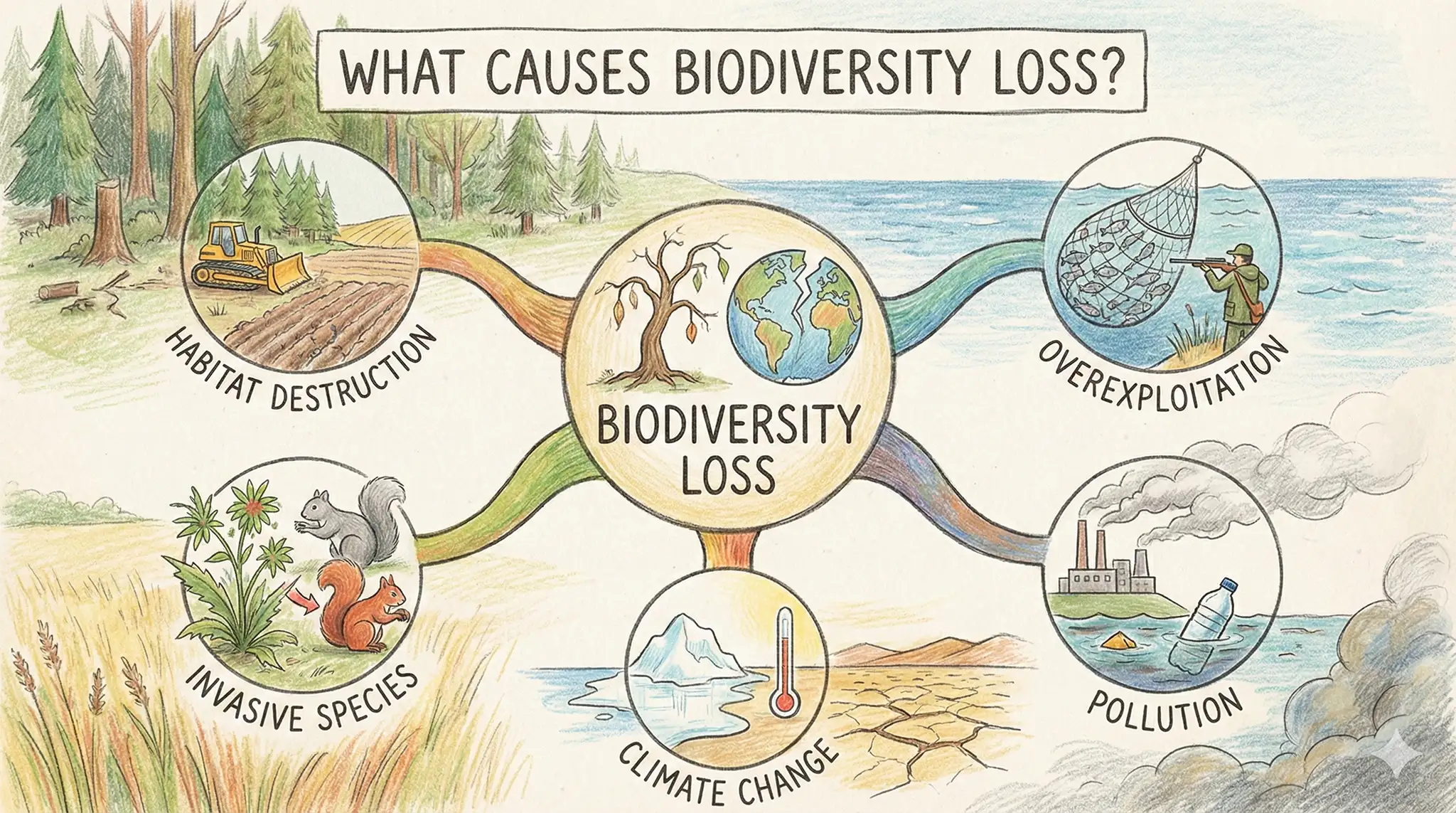
Biodiversity loss is driven by five interconnected factors: habitat destruction and degradation, climate change, overexploitation of species, pollution, and invasive species. According to the WWF Living Planet Report 2024, monitored wildlife populations have declined by an average of 73% since 1970, with freshwater species suffering an 85% decline. The UK retains only 50.3% of its biodiversity, the lowest of any G7 nation, yet research from the University of Oxford demonstrates that conservation interventions improve biodiversity or slow decline in 66% of cases when properly funded and implemented.
The natural world faces unprecedented pressure. From the rainforests of the Amazon to the wildflower meadows of the British countryside, species are disappearing at rates not seen since the extinction of the dinosaurs. Understanding what drives this loss of biodiversity is the critical first step towards protecting the intricate web of life that sustains our planet and our own survival.
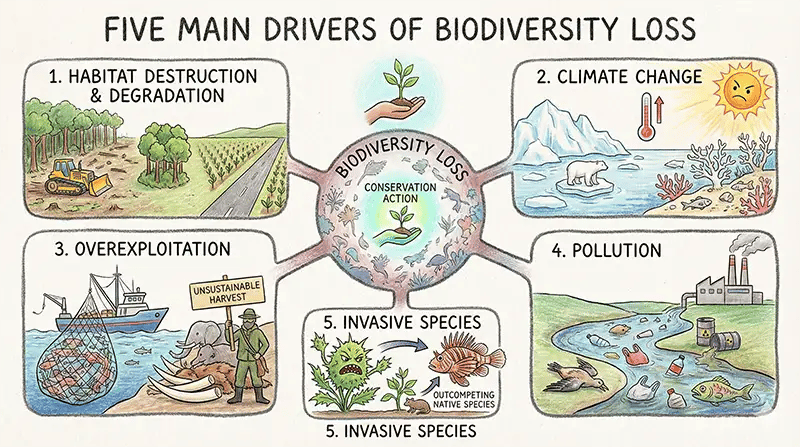
This guide explores the five primary causes of biodiversity decline as identified by the Intergovernmental Science-Policy Platform on Biodiversity and Ecosystem Services (IPBES), combining the latest global data from 2024-2026 with specific UK context. More importantly, it demonstrates that where we act with purpose and commitment, nature recovers. Conservation works.
Why Understanding Biodiversity Loss Causes Matters
Before exploring each driver in detail, it's essential to understand why this knowledge matters. Biodiversity is not simply a collection of species to admire; it is the foundation of functioning ecosystems that provide clean air, fresh water, pollination of crops, climate regulation, and flood protection. The Office for National Statistics values UK ecosystem services at £41 billion annually, whilst the total natural capital stock is worth £1.6 trillion.
When we understand the specific mechanisms causing biodiversity decline, we can target interventions more effectively. This is not abstract science; it translates directly into policy decisions, land management practices, consumer choices, and conservation strategies that work. The IPBES Transformative Change Assessment, approved in December 2024, emphasises that acting decisively now to address the underlying causes could unlock a $10 trillion business opportunity whilst creating 395 million jobs by 2030.
Driver 1: Habitat Loss and Degradation
Habitat destruction remains the single most significant driver of biodiversity decline globally and in the UK. When natural environments are converted to agricultural land, urban development, or degraded through poor management, the species that depend on them face impossible choices: adapt, migrate, or perish. Most cannot adapt quickly enough.
The Global Picture
In 2024, the world lost a record 6.7 million hectares of tropical primary forest, representing an 80% increase over 2023. This is particularly alarming because tropical forests harbour at least half of all terrestrial species. For the first time, wildfires overtook agriculture as the leading cause of deforestation, with 2024 marking the worst wildfire year on record with 38.3 million hectares of fire-related forest disturbance.
Habitat Loss in the UK
The UK's biodiversity crisis is rooted in centuries of habitat conversion. Woodland now covers 13.5% of UK land area, yet only 7% of native woodlands remain in good ecological condition. The State of Nature 2023 report documents a stark reality: woodland bird populations have declined by 37% over the past 50 years, and butterfly populations have fallen by 47%.
Agriculture occupies 52% of UK land, making farming practices critical to biodiversity outcomes. Intensification since the 1940s, involving hedge removal, wetland drainage, and increased chemical inputs, has created a countryside that is highly productive for food but significantly impoverished for wildlife. The Biodiversity Net Gain legislation, mandatory since February 2024, aims to reverse this trend by requiring all new developments to deliver a 10% increase in biodiversity value.
BNG Implementation: Progress and Challenges
One year after Biodiversity Net Gain became mandatory, implementation reveals both promise and concern. By November 2024, only 19 biodiversity gain sites had been registered, covering approximately 500 hectares with 286.77 habitat units sold (equivalent to around 58 hectares). The National Audit Office's May 2024 report identified several implementation risks, and the Wildlife Trusts advocate for a minimum 20% gain rather than the current 10% threshold to meaningfully reverse decline.
Success Story: Knepp Estate Rewilding
Knepp Estate in West Sussex demonstrates that habitat restoration delivers extraordinary results. A 20-year review published in January 2026 documented a 916% increase in breeding bird abundance, 132% increase in species richness, nightingales increasing by 511% (from 9 to 62 singing males), turtle doves by 600%, and dragonflies by 871%. Remarkably, this 3,500-acre estate now holds approximately 1% of the entire UK nightingale population, proving that creating space for nature yields remarkable biodiversity recovery.
Driver 2: Climate Change
Climate change acts as a threat multiplier, exacerbating all other drivers of biodiversity loss whilst introducing new direct impacts. Rising temperatures, altered precipitation patterns, ocean acidification, and extreme weather events are pushing species beyond their adaptive capacity.
Global Climate Impacts on Biodiversity
The planet is experiencing the fourth global coral bleaching event, affecting 84.4% of reef area worldwide—the most extensive bleaching episode in recorded history. Coral reefs support an estimated 25% of all marine species despite covering less than 1% of the ocean floor. Research published in Science in December 2024 calculates that at 2.7°C of warming, 5% of species face extinction risk from climate change alone.
A particularly concerning development occurred in September 2025 when ocean acidification was declared the seventh planetary boundary to be breached. As oceans absorb approximately 30% of atmospheric CO2, the resulting chemical changes make it harder for marine organisms to build shells and skeletons, threatening the foundation of marine food webs.
Climate Change Effects in UK Waters and Habitats
UK seabird populations face potential declines of up to 90% by 2050 due to warming seas disrupting food chains. The UK has lost 73 million wild birds since 1970, with climate change increasingly implicated alongside habitat loss. Spring 2025 saw UK seas experience a marine heatwave with temperatures 4°C above average, stressing cold-water species.
Milder winters are disrupting migration patterns for species that have evolved to time breeding with peak food availability. When these timing relationships break down, known as phenological mismatch, young birds may hatch after the peak availability of the caterpillars they depend upon, leading to widespread breeding failure.
Driver 3: Overexploitation
Overexploitation occurs when we harvest wildlife faster than populations can recover. This includes overfishing, illegal wildlife trade, unsustainable hunting, and the excessive extraction of wild plants. Whilst some harvesting is sustainable, current exploitation levels push many species towards local or global extinction.
Overfishing: Emptying the Seas
According to the Food and Agriculture Organization's 2025 State of World Fisheries report, 35.5% of global fish stocks are overfished. For the first time in recorded history, aquaculture (fish farming) now exceeds wild capture fishing, producing 51% of fish for human consumption. This milestone reflects not increased farming but rather the depletion of wild stocks.
Illegal Wildlife Trade
The illegal wildlife trade generates an estimated $20 billion annually, making it the fourth largest illegal trade globally after drugs, humans, and arms. This criminal industry affects more than 4,000 species. INTERPOL's Operation Thunder 2024 resulted in 365 arrests and the seizure of 20,000 live animals, yet enforcement struggles to match the scale of trafficking networks.
UK Fishing and Wildlife Trade Context
Whilst UK fishing practices have improved in some respects, challenges remain. The UK participates in Mediterranean fisheries where overexploitation is particularly severe. Domestically, overfishing historically devastated cod populations in the North Sea, though stocks are slowly recovering under improved management. The UK's departure from the EU's Common Fisheries Policy presents both opportunities and risks for marine biodiversity management.
Driver 4: Pollution
Pollution contaminates air, water, and soil with substances that harm wildlife directly or degrade habitats. Chemical pollution, plastic waste, nutrient runoff, and light and noise pollution all contribute to biodiversity decline, often through subtle, long-term impacts that prove difficult to reverse.
Plastic Pollution
Between 75 and 199 million tonnes of plastic waste currently circulate in the world's oceans, with 14 million tonnes entering annually. Negotiations for a Global Plastics Treaty failed at INC-5 in Busan in November 2024 and again at INC-5.2 in Geneva in August 2025, representing a setback for international coordination. Plastic pollution entangles, suffocates, and poisons marine life, whilst microplastics have been detected in 625 animal species worldwide.
Chemical Contamination
Per- and polyfluoroalkyl substances (PFAS), known as "forever chemicals" due to their persistence, have been detected in 625 animal species. These industrial chemicals accumulate in food chains, causing reproductive harm, immune system suppression, and increased cancer risk. Dead zones—oxygen-depleted areas where most marine life cannot survive—now number 415 worldwide, caused primarily by agricultural nutrient runoff.
UK Water Quality Crisis
The UK faces a particularly severe water pollution crisis affecting biodiversity. In 2024, there were 994,499 sewage discharges into UK waterways—nearly one every 30 seconds—totalling 3.6 million hours of spill duration. Oxford University research published in 2024 found sewage to be a stronger predictor of high nutrient levels in rivers than agricultural runoff, challenging previous assumptions about pollution sources.
This pollution devastates aquatic ecosystems. Species such as water voles, freshwater crayfish, and salmon face mounting pressure from degraded water quality. Controversial decisions compound the problem: in January 2024, the UK government granted emergency authorisation for neonicotinoid pesticides despite EU bans on these bee-harming chemicals, prioritising short-term agricultural concerns over pollinator protection.
Driver 5: Invasive Species
Invasive species are organisms introduced outside their natural range that cause ecological or economic harm. Freed from natural predators and competitors, they can devastate native ecosystems, outcompeting indigenous species and fundamentally altering habitat structure. The IPBES assessment on invasive alien species (September 2023) identifies them as a major factor in 60% of global extinctions and the sole driver in 16% of cases.
The Global Scale of Biological Invasions
Over 37,000 alien species have been established globally, with approximately 3,500 classified as invasive. The economic cost of invasive species reaches $423 billion per year, quadrupling every decade since 1970. These costs arise from damage to agriculture, forestry, fisheries, and infrastructure, plus the expense of control and eradication programmes.
Invasive Species in the UK
The UK faces invasive species costs of £4 billion annually (CABI 2023), representing a 135% increase since 2010. Several invasions illustrate the severity of impacts on native British biodiversity:
- Grey squirrels: Introduced from North America in the 19th century, the UK now hosts 2.7 million grey squirrels compared to just 287,000 native red squirrels. Greys outcompete reds for food and carry squirrelpox virus, which is deadly to reds but harmless to greys.
- American mink: Escapees from fur farms have caused a 94% decline in water vole range across the UK, pushing this once-common species towards endangerment.
- Asian hornet: First detected in the UK in 2016, this predatory hornet poses a growing threat to honeybees and native pollinators.
Success Story: Pine Marten Recovery Controlling Grey Squirrels
Pine marten reintroduction programmes expanded in 2024 to Grizedale Forest, Exmoor, and Dartmoor. Pine martens are a native predator that naturally control grey squirrel populations whilst red squirrels, being lighter and more agile, can escape more easily. Where pine martens have been restored, grey squirrel numbers decline and red squirrels begin to recover, demonstrating how restoring natural predator-prey relationships can address invasive species without continuous human intervention.
The Interconnected Nature of Biodiversity Loss Drivers
Whilst we examine these five drivers separately for clarity, they rarely act in isolation. Instead, they interact and amplify each other in complex ways. Climate change intensifies wildfire risk, driving habitat loss. Deforestation releases stored carbon, accelerating climate change. Polluted water bodies prove more vulnerable to invasive species. Overexploited ecosystems lose resilience to climate shocks.
This interconnection means addressing biodiversity loss requires integrated solutions. The IPBES Nexus Assessment, approved in December 2024, calculated that current systems fail to account for $10-25 trillion per year in environmental costs, representing negative externalities that markets ignore. Transformative change must address multiple drivers simultaneously rather than treating them as separate problems.
UK Biodiversity: The Most Nature-Depleted G7 Nation
The UK occupies a particularly sobering position in global biodiversity statistics. The Natural History Museum's Biodiversity Intactness Index assesses the UK as retaining only 50.3% of its biodiversity—the lowest of any G7 country and significantly below the global average. The State of Nature 2023 report found that UK species have declined by an average of 19% since 1970, with one in six species (16%) now at risk of extinction from Great Britain.
This depletion reflects centuries of industrialisation, agricultural intensification, and urbanisation. However, the UK also demonstrates that political will and investment can reverse decline. The Office for Environmental Protection's fourth progress report (January 2026) assessed progress towards England's 43 environmental targets, finding that whilst 49% are largely off track, 12% are largely on track, with improvement possible where policy and funding align.
UK Policy Framework
The Environment Act 2021 established England's legally binding environmental targets, including halting the decline of species abundance by 2030. The UK published its National Biodiversity Strategy and Action Plan on 26 February 2025, titled "Blueprint for Halting and Reversing Biodiversity Loss," following commitments made at COP16 (the UN Biodiversity Conference).
Implementation progress varies. The Office for Environmental Protection notes that progress is "too slow" on many targets, particularly species abundance, water quality, and habitat restoration. Biodiversity Net Gain implementation has been slower than anticipated. However, specific interventions show promise when properly resourced.
Conservation Success Stories: Evidence That Action Works
Against the backdrop of decline, conservation successes demonstrate that where we commit resources and political will, biodiversity recovers. These examples are not isolated anomalies; they represent replicable approaches that work when properly implemented.
UK Conservation Successes
Red Kite Recovery: 2,232% Population Increase
The red kite, once reduced to a handful of breeding pairs in Wales, has staged one of the UK's most spectacular conservation recoveries. Since the 1980s, the population has increased by 2,232%, with over 4,400 breeding pairs now representing 15-17% of the global population. The success was achieved through protection from persecution, captive breeding, reintroduction programmes, and public education. The UK now donates red kite chicks to reintroduction programmes in Spain, transforming from receiver to donor nation.
Beaver Reintroduction Approved
On 28 February 2025, the UK government approved beavers for wild release in England, 400 years after they were hunted to extinction. The first official release occurred at Purbeck Heath, Dorset. The River Otter trial in Devon demonstrated that beavers reduce peak floods by 30% through natural dam building whilst improving water quality. Rob Stoneman of the Wildlife Trusts stated, "Beavers lived alongside us for thousands of years before we hunted them to British extinction... Now we'll be able to see beavers return to our rivers and, in turn, witness the way they create new wetlands and flood protection."
Global Conservation Achievements
Iberian Lynx: From 62 to 2,000+
The Iberian lynx provides perhaps the most dramatic example of successful targeted conservation. In 2001, only 62 individuals remained, making it the world's most endangered cat species. Through captive breeding, habitat restoration, prey species recovery (European rabbits), and reducing road mortality, the population reached over 2,000 individuals by 2024. In June 2024, the IUCN downlisted the species from Critically Endangered to Vulnerable—a remarkable two-category improvement. Dr Grethel Aguilar of the IUCN stated, "The improvement in the Red List status of the Iberian lynx shows that successful conservation works for wildlife and communities alike."
Klamath River Dam Removal
In October 2024, the largest dam removal project in history was completed on California's Klamath River. Within weeks, Chinook salmon were observed spawning in upper reaches for the first time in a century, demonstrating how quickly ecosystems respond when barriers to natural processes are removed. This project provides a template for river restoration worldwide.
Evidence: Conservation Interventions Work
A landmark meta-analysis from the University of Oxford and published in Science in April 2024 definitively demonstrated that conservation actions are effective. Reviewing 186 studies comprising 665 conservation trials, the research found that conservation improved biodiversity or slowed decline in 66% of cases. Associate Professor Joseph Bull stated, "Our results clearly show that there is room for hope. Conservation interventions seemed to be an improvement on inaction most of the time."
The economic case for conservation is equally compelling. UNEP-WCMC analysis shows that investing $7.4 trillion in nature-related Sustainable Development Goals generates $152 trillion in economic benefits—a 20:1 return on investment. This represents not charity but sound economic strategy that secures the natural capital upon which all economic activity ultimately depends.
What Can You Do to Reduce Biodiversity Loss?
Individual and collective action matters. Protecting biodiversity does not require special expertise; it requires informed choices and sustained commitment. Here are practical actions scaled by impact and accessibility:
In Your Garden or Outdoor Space
- Create wildlife corridors: Let a corner go wild, plant native species, provide water sources, and leave seed heads through winter. The Royal Horticultural Society's research demonstrates that wildlife-friendly gardens support 50% more species than conventional gardens.
- Avoid pesticides and herbicides: Particularly neonicotinoids and glyphosate, which harm pollinators and soil life. Organic pest management maintains biodiversity whilst controlling genuine problems.
- Install nest boxes and insect hotels: Compensate for lost natural nesting sites in modern landscapes.
- Choose peat-free compost: Peat extraction destroys irreplaceable bog ecosystems that sequester more carbon than tropical forests.
Through Your Purchasing Decisions
- Choose sustainable seafood: Use the Marine Conservation Society's Good Fish Guide to identify sustainably caught or farmed fish. Avoid overfished species such as bluefin tuna and Atlantic cod.
- Reduce meat and dairy consumption: Animal agriculture drives 80% of Amazon deforestation. Adopting even partially plant-based diets reduces habitat destruction pressure.
- Buy locally and seasonally: Reduces transport emissions and supports local agricultural biodiversity.
- Avoid products containing palm oil without RSPO certification: Palm oil drives tropical deforestation, but certified sustainable palm oil exists as a better alternative.
Through Direct Conservation Action
- Join local Wildlife Trust: The UK's 46 Wildlife Trusts manage nature reserves, campaign for better policy, and coordinate volunteer conservation work.
- Participate in citizen science: The Big Butterfly Count, RSPB Big Garden Birdwatch, and iRecord contribute valuable biodiversity monitoring data to inform conservation priorities.
- Support conservation charities: RSPB, Wildlife Trusts, Woodland Trust, Marine Conservation Society, and Amphibian and Reptile Conservation all deliver measurable biodiversity gains.
- Advocate for better policy: Contact MPs about environmental legislation, respond to government consultations, and hold representatives accountable for biodiversity commitments.
Understanding Biodiversity Net Gain
If you're involved in property development or planning, understanding Biodiversity Net Gain is essential. The legislation requires all new developments (with limited exceptions) to deliver at least 10% biodiversity gain compared to pre-development value. This can be achieved on-site, off-site through habitat banking, or through statutory biodiversity credits. Engaging ecologists early in the planning process ensures compliance whilst maximising ecological value.
Related Reading: For a deeper understanding of why these actions matter, explore our guide on the importance of biodiversity and discover the specific value of biodiversity to human wellbeing and economic prosperity.
Frequently Asked Questions
What are the main causes of biodiversity loss?
The five main causes of biodiversity loss are habitat destruction and degradation, climate change, overexploitation of species, pollution, and invasive species. These drivers rarely act alone; they interact and amplify each other's impacts. Habitat loss remains the single largest driver globally, responsible for the decline of countless species as natural environments are converted to human use.
Why is biodiversity declining in the UK?
UK biodiversity decline stems from centuries of intensive land use. Agricultural intensification since the 1940s removed hedgerows, drained wetlands, and increased chemical inputs, creating highly productive farmland but impoverished ecosystems. The UK retains only 50.3% of its biodiversity—the lowest of any G7 nation—with one in six species at risk of extinction. Water pollution from sewage and agricultural runoff further degrades aquatic ecosystems.
Which cause of biodiversity loss is most urgent?
Habitat loss and climate change represent the most urgent threats because they operate at ecosystem scale and prove difficult to reverse. Habitat loss continues to accelerate, with 2024 seeing record deforestation. Climate change acts as a threat multiplier, exacerbating all other drivers. However, all five drivers require simultaneous action; focusing on one whilst neglecting others will not halt decline.
How does biodiversity loss in the UK compare globally?
The UK ranks as the most nature-depleted country in the G7, retaining only 50.3% of its biodiversity compared to a global average significantly higher. Species have declined by 19% since 1970, with freshwater species particularly affected. However, the UK also demonstrates that well-funded conservation can reverse decline, as evidenced by red kite and pine marten recoveries.
What happens if biodiversity loss continues?
Continued biodiversity loss threatens ecosystem services worth £41 billion annually to the UK alone, including pollination, flood regulation, water purification, and climate regulation. Globally, IPBES estimates unaccounted environmental costs of $10-25 trillion per year. Beyond economics, biodiversity loss destabilises food systems, increases disease transmission risk, and diminishes the natural heritage we pass to future generations.
Are there any success stories in reversing biodiversity loss?
Yes, conservation success stories abound when proper funding and political will exist. UK examples include the 2,232% increase in red kite populations since the 1980s and the 2025 approval of beaver reintroduction. Globally, the Iberian lynx recovered from 62 individuals in 2001 to over 2,000 in 2024. Oxford University research demonstrates that conservation improves biodiversity in 66% of cases, providing clear evidence that action works.
What can I do to help reduce biodiversity loss?
Individual actions include creating wildlife-friendly gardens with native plants, choosing sustainable seafood using the Marine Conservation Society's Good Fish Guide, reducing meat consumption, avoiding pesticides, and using peat-free compost. Join your local Wildlife Trust, participate in citizen science projects such as the Big Butterfly Count, and advocate for stronger environmental policy by contacting MPs and responding to government consultations.
Is the UK really one of the most nature-depleted countries?
Yes. The Natural History Museum's Biodiversity Intactness Index places the UK at 50.3%, the lowest of any G7 nation. This reflects centuries of industrialisation and agricultural intensification. The State of Nature 2023 report found 19% average decline since 1970, with woodland birds down 37% and butterflies down 47%. However, where conservation is properly funded—such as red kite recovery—the UK demonstrates that decline can be reversed.
How does agriculture cause biodiversity loss?
Agriculture occupies 52% of UK land, making farming practices critical to biodiversity. Intensive agriculture removes hedgerows and field margins that provide habitat, drains wetlands, uses pesticides that kill non-target species, and degrades soil through monoculture and heavy machinery. However, regenerative farming practices demonstrate that food production and biodiversity can coexist through measures such as leaving field margins, reducing chemical inputs, and integrating livestock and crops.
Is it possible to reverse biodiversity loss?
Yes. The University of Oxford's landmark 2024 study published in Science definitively demonstrated that conservation interventions improve biodiversity or slow decline in 66% of cases. Knepp Estate achieved a 916% increase in breeding bird abundance through rewilding. The Iberian lynx increased from 62 to over 2,000 individuals through targeted conservation. UNEP-WCMC calculates that investing in nature-related development goals generates a 20:1 return on investment, demonstrating that conservation is economically viable as well as ecologically essential.
Conclusion: Crisis and Hope in Equal Measure
The drivers of biodiversity loss are clear: habitat destruction, climate change, overexploitation, pollution, and invasive species. The scale of decline is sobering, with monitored wildlife populations falling 73% since 1970 and the UK retaining only half its biodiversity. Freshwater ecosystems, suffering an 85% decline, face particularly severe pressure.
Yet this clarity about causes provides the foundation for effective action. We are not facing an abstract, unsolvable problem; we are facing specific, addressable drivers that respond to targeted interventions. Where conservation is properly funded and implemented, it works. Red kites recover. Beavers return. Lynx populations rebound. Coral reefs regenerate when given respite from threats. The Oxford University research is unequivocal: conservation improves outcomes in two-thirds of cases.
The IPBES Transformative Change Assessment emphasises that acting decisively now is "urgent, necessary and possible." The ecological crisis we face is matched by an economic opportunity: investing in nature generates a 20:1 return whilst creating hundreds of millions of jobs. We possess the knowledge, the tools, and the evidence. What remains is the collective will to act.
Every action matters. Every garden made wildlife-friendly, every sustainable food choice, every voice raised for better policy contributes to the collective effort required. The natural world is resilient; given space and time, it recovers with remarkable speed. We have witnessed this recovery in restored peatlands, rewilded estates, and reintroduced species. The question is not whether nature can recover, but whether we will create the conditions for recovery to occur.
As Beccy Speight of the RSPB stated in 2025, "Nature is in freefall. Wildlife that once thrived across England is now confined to reserves, stripped from our everyday lives." This is the reality we must confront. But it need not be the future we accept. Understanding the causes of biodiversity loss is the first step. Taking action is the essential next step. Together, these steps create a pathway towards a future where both people and nature thrive.
Continue Your Journey: Explore our comprehensive guide on biodiversity hotspots and how to protect them, or learn about the different levels of biodiversity to deepen your understanding of the complexity we're working to preserve.
References and Further Reading
- WWF (2024). Living Planet Report 2024. World Wildlife Fund. Available at: https://www.worldwildlife.org/pages/living-planet-report-2024
- ZSL (2024). Living Planet Index 2024. Zoological Society of London. Available at: https://www.zsl.org/news-and-events/news/living-planet-index-2024
- IUCN (2024). More than one in three tree species worldwide faces extinction. International Union for Conservation of Nature. Available at: https://iucn.org/press-release/202410/more-one-three-tree-species-worldwide-faces-extinction-iucn-red-list
- IPBES (2024). Transformative Change Assessment. Intergovernmental Science-Policy Platform on Biodiversity and Ecosystem Services. Available at: https://www.ipbes.net/
- ONS (2025). UK natural capital accounts: 2025. Office for National Statistics. Available at: https://www.ons.gov.uk/economy/environmentalaccounts/bulletins/uknaturalcapitalaccounts/2025
- RSPB, National Trust, et al. (2023). State of Nature 2023. Available at: https://stateofnature.org.uk/
- Office for Environmental Protection (2026). Progress Report 2026. Available at: https://www.theoep.org.uk/
- National Audit Office (2024). Biodiversity Net Gain. Available at: https://www.nao.org.uk/
- Natural History Museum (2020). UK has 'led the world' in destroying the natural environment. Available at: https://www.nhm.ac.uk/discover/news/2020/september/uk-has-led-the-world-in-destroying-the-natural-environment.html
- University of Oxford (2024). Landmark study definitively shows that conservation actions are effective at halting and reversing biodiversity loss. Available at: https://www.ox.ac.uk/news/2024-04-26-landmark-study-definitively-shows-conservation-actions-are-effective-halting-and
- FAO (2025). State of World Fisheries and Aquaculture 2025. Food and Agriculture Organization. Available at: https://www.fao.org/
- IUCN (2024). Iberian lynx rebounding thanks to conservation action. Available at: https://www.iucn.org/press-release/202406/iberian-lynx-rebounding-thanks-conservation-action-iucn-red-list
- Wildlife Trusts (2025). Beavers approved for wild release in England. Available at: https://www.wildlifetrusts.org/
- Knepp Wildland (2026). 20-Year Ecological Review. Available at: https://knepp.co.uk/
- UNEP-WCMC. Funding nature-related Sustainable Development Goals. Available at: https://www.unep-wcmc.org/en/news/funding-nature-related-sustainable-development-goals-would-deliver-more-than-20-times-return-on-investment-study-shows