The Power of Biodiversity Images: How Visual Storytelling Drives Conservation
A single well-made image of a wild animal can do something a paragraph of statistics cannot: it makes the viewer care about an individual creature, and through that creature, about a whole ecosystem. The discipline of conservation photography — and, increasingly, hand-illustrated natural history — has become one of the most consequential forms of advocacy in modern biodiversity work. The Wildlife Photographer of the Year 2025 competition received a record 60,636 entries from 113 countries, and editorial bodies including World Press Photo, Nature, Science, and National Geographic all updated their 2026 rules to draw a hard line between authentic and AI-generated nature imagery.
This guide looks at why biodiversity images matter, what makes an image effective, and where the medium is heading in 2026 — including Pixcellence's deliberate choice of Archibald Thorburn–style Victorian natural history watercolour as our visual signature.
60,636
WPY 2025 Entries
From 113 countries (Natural History Museum)
61
Years of WPY
Founded 1965 by Natural History Museum
Banned
AI Images at WPP 2026
"Made with a camera" rule (worldpressphoto.org)
CC BY 4.0
NHM Specimen Photos
Released under open licence for reuse
Sources: NHM Wildlife Photographer of the Year 2025; World Press Photo 2026 contest rules; NHM data portal.
Key Takeaway
Biodiversity images move people because they shift the unit of attention from "wildlife in general" to this animal, in this place, in this moment. The choice of medium — photograph, hand illustration, AI generation — increasingly carries an editorial signal of its own. In 2026 the major conservation publishers all distinguish between the three.
Why biodiversity images matter
The instrumental case for biodiversity imagery has three layers. The first is attention: a strong image stops a reader who would scroll past a paragraph. The second is identification: a portrait of an individual animal makes the species concrete in a way that population graphs cannot. The third is advocacy compounding — well-circulated images become the visual vocabulary that politicians, donors, and schoolchildren use when they think about a species.
The historical case is well documented. Carleton Watkins's 19th-century photographs of Yosemite contributed directly to the US national parks framework. Eliot Porter and Ansel Adams shaped American conservation imagination for half a century. The annual Wildlife Photographer of the Year competition, run by the Natural History Museum since 1965, has done similar work for the global conservation movement — turning specific species into household subjects (snow leopards, polar bears, manta rays) and giving conservation campaigns a recognisable visual centre.
For UK readers, the practical implication is that biodiversity imagery isn't an aesthetic choice. It is a campaigning lever. The decline of UK biodiversity is reported with greater force when illustrated by individual species — a turtle dove, a hedgehog, a water vole — than when communicated through trend lines alone. Pixcellence's piece on why biodiversity matters develops the broader case alongside the visual one.
What makes a biodiversity image effective?
Four characteristics consistently distinguish effective biodiversity imagery from forgettable wildlife photography. None requires elite equipment; all require attention.
Individual over generic
An image of a hedgehog at a moment is stronger than a generic "wildlife" shot. The eye finds the individual; the brain extends to the species. Generic doesn't compound.
Habitat context
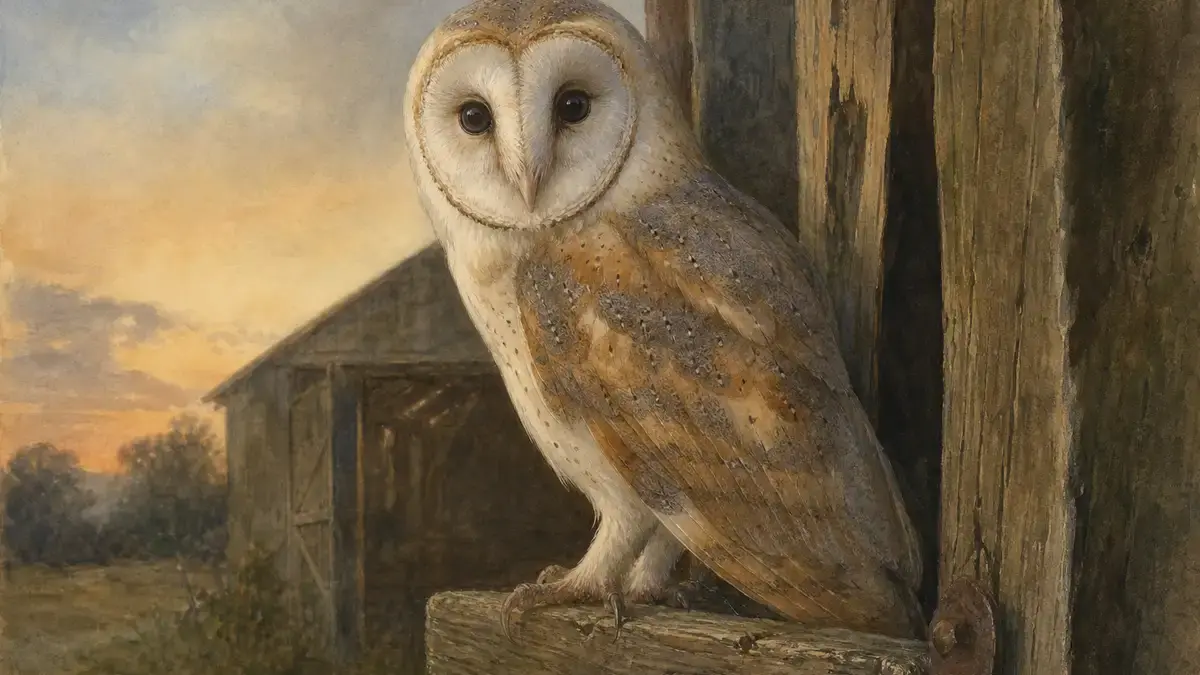
A species photographed in its real environment carries information a studio portrait cannot. A barn owl at a real barn at dusk says something a captive portrait does not.
Honest light
Heavy retouching weakens trust even when it strengthens aesthetics. The 2026 editorial line at Science and National Geographic explicitly requires images to be honest reproductions of what the lens captured.
A point of view
The best biodiversity images take a position — about loss, about wonder, about persistence. A neutral picture is less useful than a picture that frames a question.
Conservation photography in 2026: the editorial landscape
The 2025–2026 cycle has been an inflection point for how biodiversity imagery is judged in editorial settings. Three shifts matter for anyone using or producing the work.
The "made with a camera" line. World Press Photo's 2026 contest rules are explicit: "All photographs entered into the contest must be made with a camera. No synthetic or artificially generated images are allowed, and no use of artificially generative fill is allowed in post-production. Any use of these tools will automatically disqualify the entry from the contest." The Royal Photographic Society's Nature Photographers' Code of Practice has tightened its disclosure rules along similar lines.
Disclosure over prohibition in science. Science journals (Nature, Science, Cell) accept AI-generated illustrations for conceptual figures but require disclosure in the Methods section and prohibit AI manipulation of experimental imagery. National Geographic's editorial standard — "no staging or fabrication" — predates the AI debate and now governs both photographic submissions and contest entries.
The 2025 Wildlife Photographer of the Year results were unambiguous about subject choice. Wim van den Heever of South Africa won the Grand Title with Ghost Town Visitor, a brown hyena in the abandoned diamond town of Kolmanskop, Namibia — a portrait that foregrounds the entanglement of wildlife with human industrial decline. Italian teenager Andrea Dominizi won Young Wildlife Photographer of the Year with After the Destruction, a longhorn beetle (Morimus asper) photographed amid construction machinery in Italy's Lepini Mountains. Both winning images frame loss directly. The contest is increasingly rewarding photographers who tell stories about pressure on biodiversity, not just stories about beauty.
Pixcellence's visual approach: Archibald Thorburn Victorian watercolour
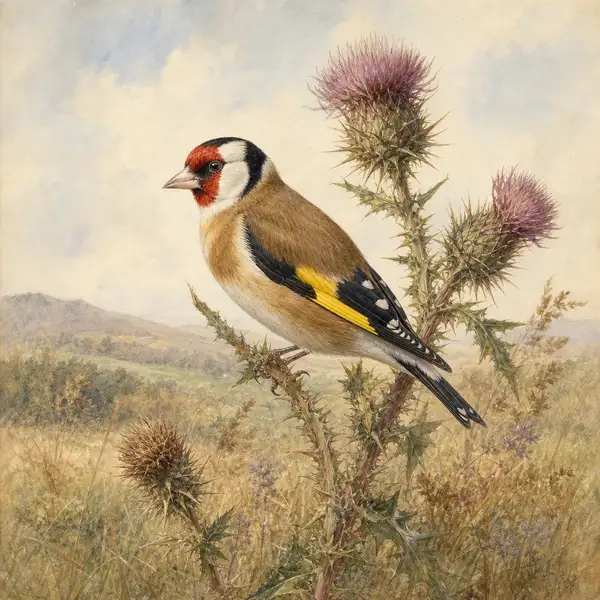
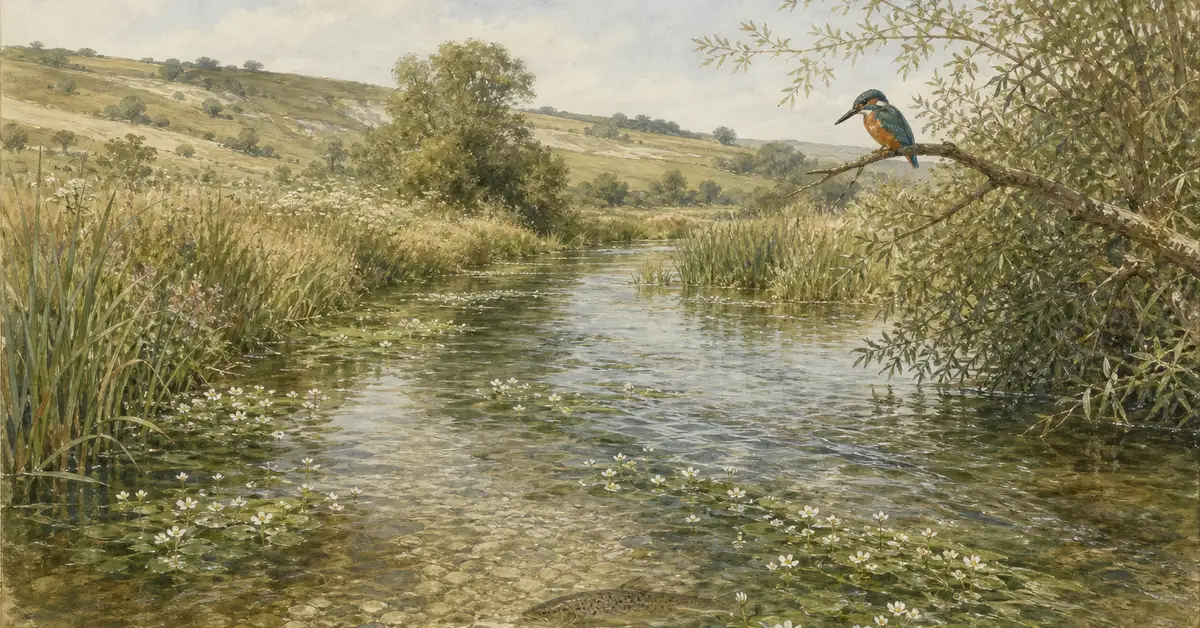
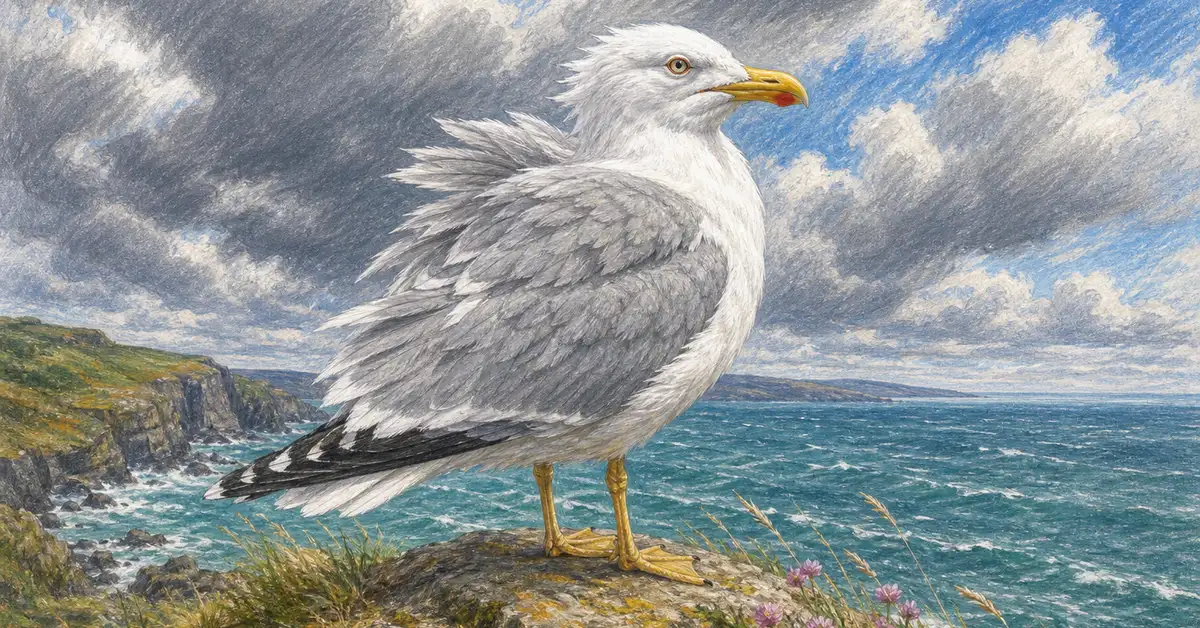
Pixcellence makes a deliberate visual choice across all our content: hand-illustrated biodiversity imagery in the style of Archibald Thorburn, the 19th-century British wildlife painter whose watercolours of birds and mammals defined a generation of natural history publishing. The choice is not nostalgia. It is editorial honesty.
A Thorburn-style watercolour is unmistakably a drawing. It does not pretend to be a photograph. In a 2026 information environment where photo-realistic AI imagery is cheap and copyright-laundered AI nature images circulate freely on social platforms, the watercolour is a credibility signal — the reader can see immediately that what they are looking at is an interpretive illustration, not a fabricated photograph. Where we want to communicate specific scientific data, the watercolour does not get in the way of the numbers. Where we want to evoke a habitat or a species, the watercolour does what hand illustration has always done: it directs attention to the essential character of the subject.
Thorburn himself worked in the late Victorian and Edwardian periods, primarily illustrating birds for sportsmen's books and natural history publications. His technique — delicate watercolour washes, soft luminous backgrounds, fine naturalistic detail, muted earth tones — established a visual grammar for British wildlife illustration that remains instantly recognisable. We have applied his stylistic principles consistently across the Pixcellence library because consistency is itself a brand signal: every Pixcellence article shares the same visual register, which makes our pieces identifiable across search results, social shares, and educational reuse. The same illustrative consistency runs through pieces on biodiversity hotspots, biodiversity loss, and biodiversity poster ideas for students.
Hand-illustration, photography, AI: choosing the right medium
For anyone producing biodiversity content in 2026, the medium itself carries an editorial message. The honest answer for most communicators is to use the medium that matches the claim.
| Medium | Best for | Risks if misused |
|---|---|---|
| Photography (authentic) | Documentary evidence — this animal, this place, this moment. | Over-editing erodes trust. Staged shots presented as wild are now disqualifying in major competitions. |
| Hand illustration (Thorburn-style) | Conceptual scenes, species portraits, habitat cross-sections, anything where interpretation is honest. | Cannot stand in for photographic evidence. Don't claim "documented" when you mean "depicted." |
| AI-generated (disclosed) | Conceptual schematics, speculative scenarios, where labelled as such. Acceptable in science with Methods-section disclosure. | Undisclosed AI is now banned outright from World Press Photo, Wildlife Photographer of the Year, and major conservation publications. |
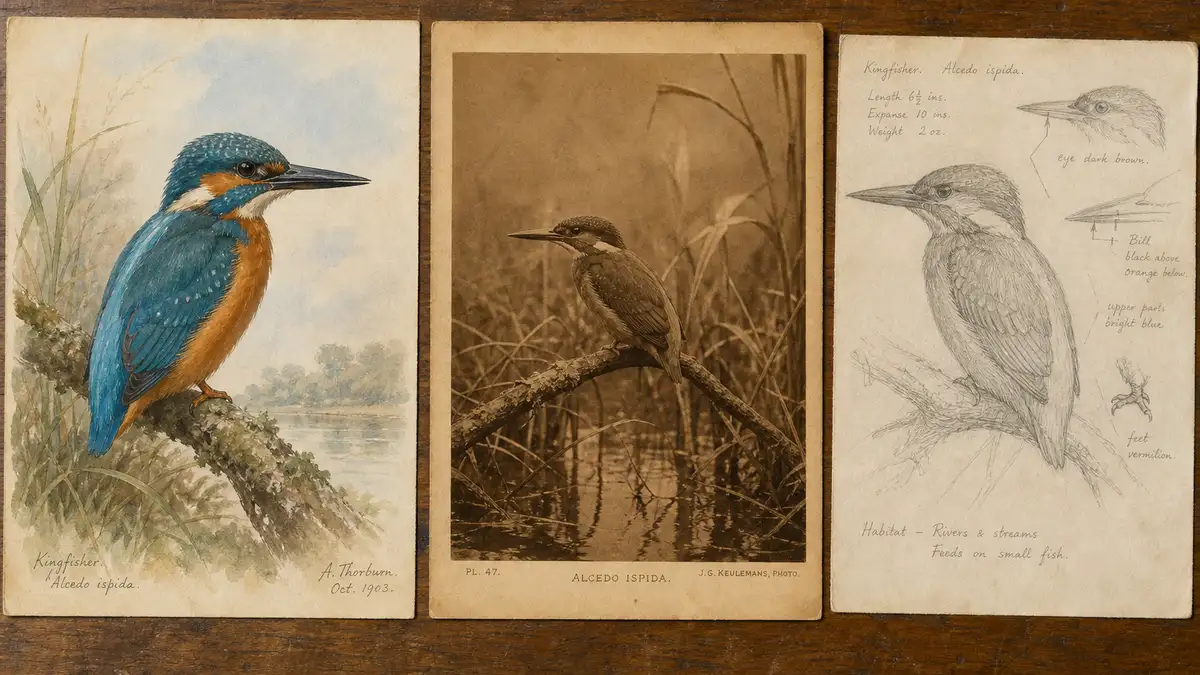
The pragmatic position for most UK conservation communicators — schools, NGOs, bloggers, small charities — is to mix photography with hand illustration, and to use AI only where it can be clearly labelled. This is the editorial posture Pixcellence adopts on every page.
How to use biodiversity images responsibly
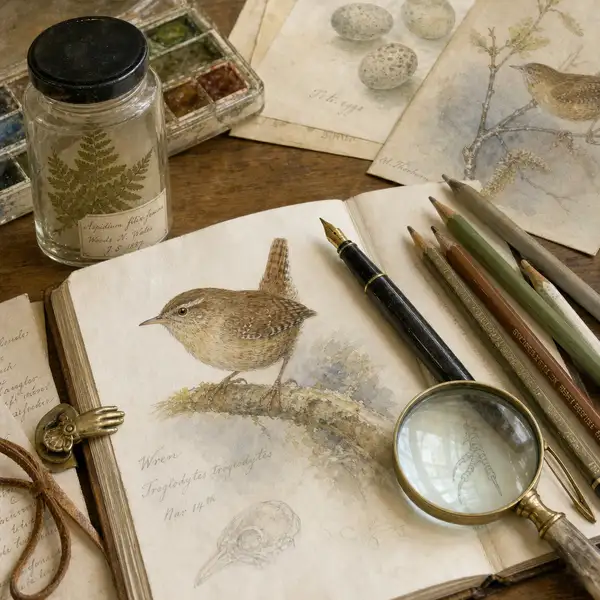
Three responsibilities sit alongside the question of which medium to use. The first is licensing: most biodiversity images on the web are copyrighted by their creator. Pixcellence's piece on where to find free, properly licensed biodiversity pictures walks through ten openly licensed sources — iNaturalist, the Biodiversity Heritage Library, Wikimedia Commons, Natural England, the Natural History Museum data portal — and explains the Creative Commons licence variants. The TASL attribution template (title, author, source, licence) is the discipline for using any image you didn't make yourself.
The second is welfare. The RPS Nature Photographers' Code of Practice principle — "Photography should not be undertaken if it puts the subject at risk" — applies whether you are a professional or an amateur. UK photographers must also respect Schedule 1 of the Wildlife and Countryside Act 1981, which forbids intentional or reckless disturbance of over 80 listed bird species at the nest without a written licence from Natural England, NatureScot, Natural Resources Wales, or the NIEA.
The third is honesty. If an image is staged, say so. If a species was photographed in captivity, say so. If an image is AI-generated, label it. The 2026 editorial landscape rewards this kind of transparency and increasingly punishes its absence — at World Press Photo, Wildlife Photographer of the Year, and across the major conservation publications.
For students putting together a school project or a biodiversity poster, the same principles apply at smaller scale: pick imagery from properly licensed sources, credit the creators, distinguish photographs from illustrations, and pick images that say something rather than images that simply decorate.
Frequently asked questions about biodiversity images
Why are biodiversity images important for conservation?
Biodiversity images shift the unit of attention from species statistics to individual creatures, which is consistently more effective at building public engagement, political momentum, and donor interest. Wildlife Photographer of the Year, founded by the Natural History Museum in 1965, has documented this effect for six decades — single images have demonstrably changed conservation outcomes for species ranging from snow leopards to manta rays.
Are AI-generated biodiversity images acceptable in 2026?
Editorially, only when disclosed. World Press Photo's 2026 rules require all entries to be made with a camera and ban generative fill outright. Nature and Science journals accept AI-generated illustrative figures with Methods-section disclosure but prohibit AI manipulation of experimental images. National Geographic bans AI-generated photographs entirely from contests and editorial use. For school projects, AI-generated images are acceptable if labelled clearly as such.
Why does Pixcellence use Victorian watercolour-style illustrations?
Hand illustration in the style of Archibald Thorburn is unmistakably interpretive — it cannot be mistaken for a photograph, which means it cannot be mistaken for evidence. In an information environment where AI photo-realism is cheap and frequently undisclosed, the watercolour is a credibility signal. The consistent visual register also makes Pixcellence content recognisable across search results, social shares, and educational reuse.
What is the difference between conservation photography and wildlife photography?
Wildlife photography documents a species; conservation photography frames a species within a story about pressure, change, or response. The 2025 Wildlife Photographer of the Year winners reflected this trend — both the Grand Title (Wim van den Heever's brown hyena in an abandoned diamond mining town) and the Young WPY (Andrea Dominizi's longhorn beetle amid construction machinery) framed wildlife alongside human impact rather than in isolation.
Where can I find free, high-quality biodiversity images to use?
Ten reliable openly licensed sources: iNaturalist (Creative Commons photos), the Biodiversity Heritage Library (historic illustrations, public domain), Wikimedia Commons, GBIF media records, IUCN Red List, Flickr Creative Commons, Natural England (Open Government Licence), Forestry England, the Natural History Museum's data portal (CC BY 4.0 specimen photography), and NASA Earth Observatory. Pixcellence's full guide on where to find biodiversity pictures covers each in depth.
How do I credit a biodiversity image correctly?
Use the TASL template: title, author, source, licence. A worked example: "European Robin, photographed by Jane Smith on iNaturalist, licensed CC BY-NC 4.0." Hyperlink the author name to their profile and the licence name to the Creative Commons deed where format allows. The TASL convention satisfies every Creative Commons variant except CC0 (which requires no attribution).
Is hand-illustrated biodiversity imagery taken seriously by editors?
Yes — increasingly so, as a credibility hedge against AI photorealism. The Natural History Museum is expanding its sharing of historic illustration collections from naturalists like John Gould, John James Audubon, and Archibald Thorburn. Hand illustration carries editorial value where the medium itself signals "interpretation, not documentation" — exactly the distinction that AI realism has eroded.
Stay Connected with Conservation
Be the first to know about new guides, wildlife photography features, and conservation updates from across the UK and beyond.
Sources: NHM Wildlife Photographer of the Year 2025; World Press Photo 2026 contest rules; Science journals editorial policies; RPS Nature Photographers' Code of Practice; Wildlife and Countryside Act 1981 Schedule 1; NHM data portal; Creative Commons licences.