A biodiversity action plan is a strategic framework that identifies priority species and habitats, sets measurable conservation targets, and coordinates action among government agencies, NGOs, and local communities. In the UK, biodiversity action plans operate at local, national, and international levels to reverse wildlife decline and protect ecosystems.
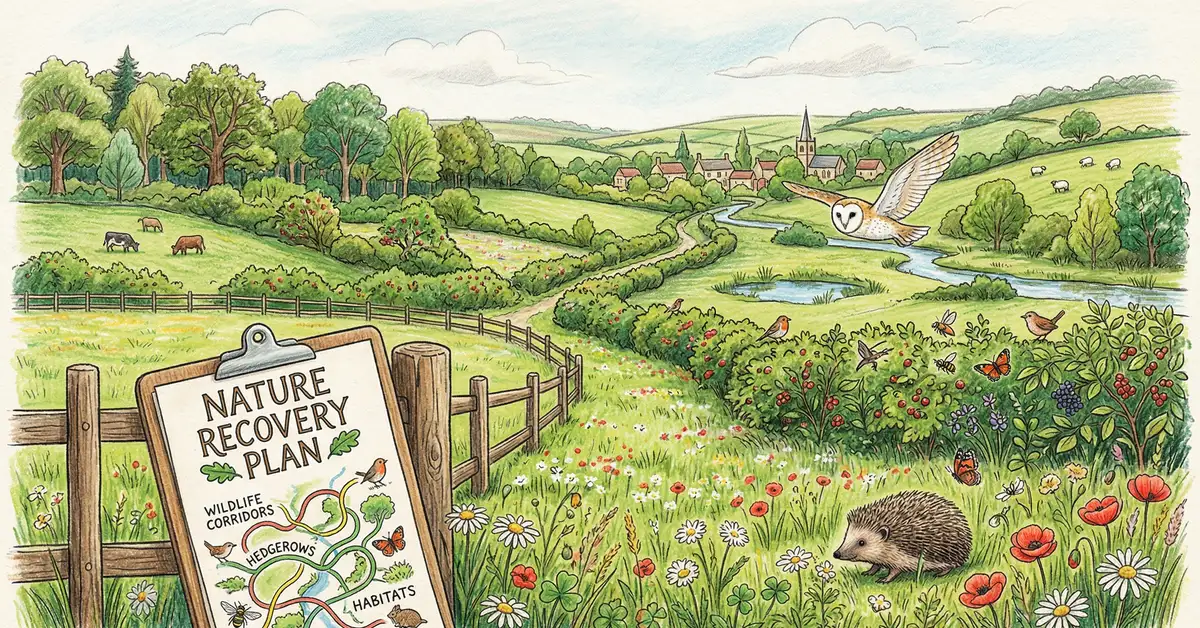
Biodiversity action plans coordinate conservation across the UK's landscapes, from hedgerow networks to upland habitats
The UK was the first country to produce a national biodiversity action plan, published in 1994 in response to the Convention on Biological Diversity signed at the 1992 Rio Earth Summit (JNCC). Since then, the framework has evolved through three major phases: the original UK BAP (1994–2012), the UK Post-2010 Biodiversity Framework (published in 2012), and now the implementation of the Kunming-Montreal Global Biodiversity Framework adopted at COP15 in December 2022. Each phase has refined how we identify, protect, and restore the species and habitats most at risk.
Despite three decades of planning, the UK's monitored species have declined by 19% on average since 1970, and nearly 1 in 6 species is at risk of extinction from Great Britain, according to the State of Nature 2023 report. These figures make clear that biodiversity action plans alone cannot reverse decline—but they provide the essential structure without which recovery would be impossible. Understanding how BAPs work, what they've achieved, and where they fall short is crucial for anyone engaged with conservation in the UK.
1,150
UK BAP priority species after the 2007 review
48
Local Nature Recovery Strategy areas covering England
30×30
Global target: 30% of land and sea effectively conserved by 2030
943
Species of principal importance in England (NERC Act s41)
What Is a Biodiversity Action Plan?
A biodiversity action plan is an evidence-based conservation strategy that identifies the species and habitats most in need of protection, sets quantifiable recovery targets, designates responsible organisations, and establishes monitoring frameworks to track progress. BAPs operate at multiple scales: international frameworks like the Convention on Biological Diversity set global ambitions; national strategies translate these into domestic policy; and local biodiversity action plans deliver on-the-ground conservation tailored to regional ecosystems.
The purpose of a biodiversity action plan extends beyond saving individual species. BAPs address the underlying drivers of decline—habitat loss, pollution, climate change, invasive species, and overexploitation—by coordinating responses across government, the private sector, and civil society. They create accountability structures that translate political commitments into measurable conservation outcomes. As we explore in our guide to causes of biodiversity loss, these drivers interact in complex ways that demand coordinated, strategic responses rather than piecemeal interventions.
Source: Convention on Biological Diversity Secretariat; JNCC UK BAP Framework
How Has the UK Biodiversity Action Plan Evolved Since 1994?
The UK's approach to biodiversity planning has passed through three distinct phases, each reflecting changing scientific understanding, political priorities, and international commitments. Understanding this evolution helps explain both the successes and the persistent gaps in UK conservation.
The Original UK BAP (1994–2012)
Following the 1992 Rio Earth Summit, where the UK signed the Convention on Biological Diversity, the government published Biodiversity: the UK Action Plan in 1994. It set 59 broad targets, and the UK Biodiversity Steering Group's 1995 report set out how to identify the species and habitats of most concern. The original priority lists, drawn up between 1995 and 1999, held fewer than 600 species and 49 habitats. A review in 2007 raised these to 1,150 priority species and 65 priority habitats (JNCC). Species Action Plans and Habitat Action Plans set recovery targets for the priorities.
The UK BAP also gave rise to Local Biodiversity Action Plans, first piloted in 1995, which brought councils, wildlife trusts and local groups together around shared priorities. Several species that received focused action, often alongside legal protection and reintroductions, recovered strongly. Red kites had fallen to fewer than ten breeding pairs in mid Wales by the 1930s and 1940s; by 2016 the UK held an estimated 4,400 pairs (BTO). Peregrines rose from 385 pairs in the 1961 survey to 1,769 pairs in 2014 (BTO). These successes showed that targeted, well-funded action could reverse the decline of individual species.
Source: JNCC, UK Biodiversity Action Plan history and priority lists; BTO
UK Post-2010 Biodiversity Framework (2012–2024)
After devolution in 1998, each UK country developed its own biodiversity strategy. In July 2012 the UK Post-2010 Biodiversity Framework formally succeeded the UK BAP, linking the country strategies to the CBD's Strategic Plan for Biodiversity 2011–2020 and its 20 Aichi Targets. A new UK Biodiversity Framework replaced it in 2024, following the Kunming-Montreal agreement. This represented a philosophical shift from standalone species and habitat planning towards ecosystem-based approaches emphasising natural capital, ecosystem services, and cross-sectoral integration. The transition brought strengths—biodiversity considerations entered agricultural, forestry, and planning policy more deeply—but critics argued it weakened the institutional focus and accountability that the original BAP structure had provided.

The Kunming-Montreal Global Biodiversity Framework sets 23 targets for 2030, including effectively conserving 30% of land and sea
The Kunming-Montreal Era (2022–Present)
The Kunming-Montreal Global Biodiversity Framework, adopted at COP15 in December 2022, sets 4 goals for 2050 and 23 targets for 2030 (CBD). Its best-known target, "30×30" (Target 3), asks countries to ensure that at least 30% of land, inland water, and coastal and marine areas are effectively conserved by 2030. Target 2 asks for at least 30% of degraded ecosystems to be under effective restoration. Other targets include halving the overall risk from pesticides and highly hazardous chemicals, cutting the introduction and establishment of invasive alien species by at least half, and mainstreaming biodiversity across government and the economy.
The UK set out its response in the UK National Biodiversity Strategy and Action Plan, published on 26 February 2025, with each country delivering through its own strategy. In England, the Environmental Improvement Plan 2025 (published 1 December 2025) sits alongside a legal target to halt the decline in species abundance by 2030. Delivery tools include Biodiversity Net Gain for development, 48 statutory Local Nature Recovery Strategies and the Environmental Land Management schemes that replaced EU-era farm subsidies. Progress is slow: Defra's 30by30 delivery plan (July 2026) estimates that only around 7% of England's land currently meets the 30by30 standard.
Source: CBD Decision 15/4 (2022); UK NBSAP (2025); Defra Environmental Improvement Plan 2025; Defra 30by30 delivery plan (2026)
How Do the UK's Devolved Nations Approach Biodiversity Planning?
Biodiversity policy is devolved in the UK, meaning England, Scotland, Wales, and Northern Ireland each develop and implement their own strategies. This creates variation in ambition, funding, and delivery mechanisms—a patchwork that can be both a strength (allowing locally tailored approaches) and a weakness (creating coordination gaps and uneven protection).
England: Environment Act and Legally Binding Targets
England's framework rests on two Acts. The Natural Environment and Rural Communities (NERC) Act 2006 requires a list of habitats and species of principal importance (the Section 41 list), which holds 943 species and 56 habitats. The Environment Act 2021 added legally binding targets, mandatory Biodiversity Net Gain (a 10% gain for most new development), 48 statutory Local Nature Recovery Strategies and a power for Natural England to prepare Species Conservation Strategies. It also strengthened the biodiversity duty on public authorities: they must now consider what action they can take to conserve and enhance biodiversity, and then act on it. Their first reporting period had to end no later than 1 January 2026, with reports due within 12 weeks.
Scotland: Nature Positive by 2030, Restored by 2045
The Scottish Biodiversity Strategy to 2045, published in its final form on 27 November 2024, aims for Scotland to be Nature Positive by 2030, halting biodiversity loss, and to have restored and regenerated biodiversity across the country by 2045. A delivery plan for 2024 to 2030 sets out the actions. Scotland's statutory priority list is the Scottish Biodiversity List, kept under the Nature Conservation (Scotland) Act 2004.
Wales and Northern Ireland
In Wales, the Environment (Wales) Act 2016 places a Section 6 duty on public authorities to maintain and enhance biodiversity. In March 2026 the Welsh Government published an updated Section 7 list of 1,322 species and 69 habitats of principal importance, up from 557 species and 55 habitats on the interim list. The Nature Recovery Action Plan for Wales and Local Nature Partnerships carry much of the delivery. In Northern Ireland, DAERA published the Nature Recovery Strategy for Northern Ireland to 2032 on 27 October 2026, after a public consultation earlier in the year. Its priority species list is being reviewed in tranches and stood at 592 species after the first tranche in February 2023.
Source: gov.uk; legislation.gov.uk; Scottish Government (2024); Welsh Government (2026); DAERA (2023, 2026)
What Are Local Biodiversity Action Plans and How Do They Work?

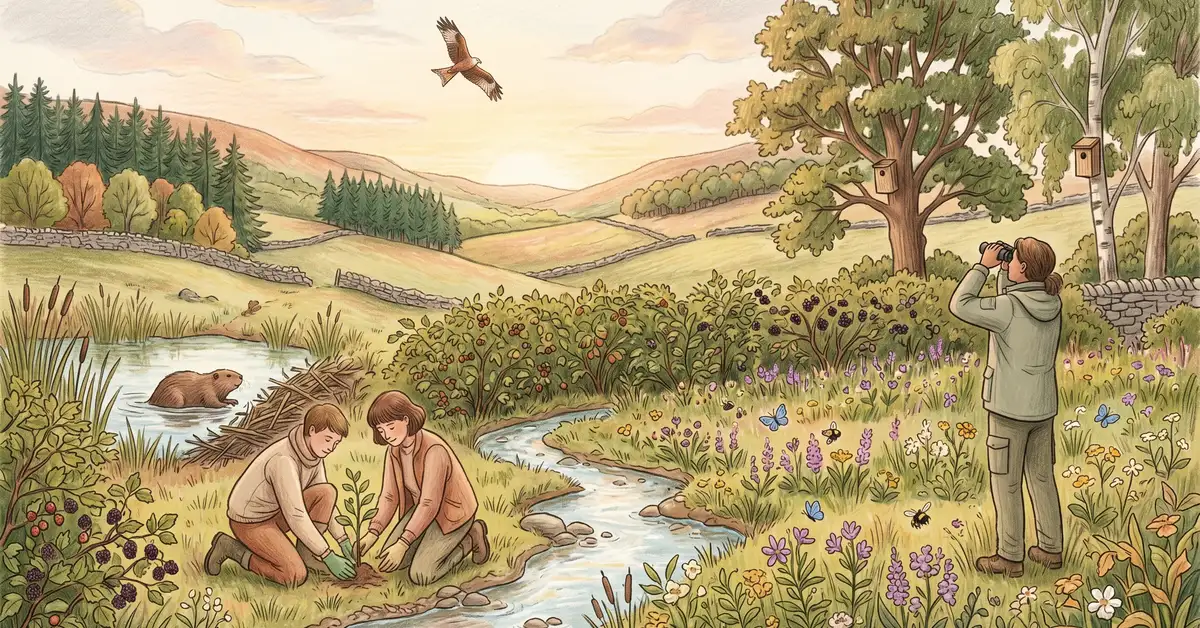
Local Biodiversity Action Plans bring together councils, wildlife trusts, and community volunteers
Local Biodiversity Action Plans translate national conservation priorities into on-the-ground action tailored to specific regions. LBAPs were first piloted in 1995 and were usually produced by local authorities in partnership with wildlife trusts, environmental consultants and community groups. Many are still in use, though there is no single current count. In England, Local Nature Recovery Strategies now set statutory local priorities, while in Wales the Section 7 guidance lists local biodiversity action plans among the plans the priority list should inform.
LBAPs are governed by steering groups comprising local authority officers, wildlife trust representatives, conservation NGOs, and community volunteers. Delivery teams focus on specific species or habitats, while monitoring and evaluation systems track annual progress against targets.
From LBAPs to Local Nature Recovery Strategies
In England, the 48 Local Nature Recovery Strategies now carry much of the role LBAPs once played. Each maps the most valuable existing habitat and the best places to create or restore it. The first, for the West of England, was published on 7 November 2024. By the end of September 2026, 45 of the 48 had been published, with the last 3 close to publication (Defra, November 2026). Local and neighbourhood plans must take account of them, and Defra uses them to target funding for farming, tree planting and natural flood management.
Source: JNCC; Welsh Government (2026); Defra, Environment Act 2021 post-legislative scrutiny memorandum (2026)
Which UK Priority Species Have Recovered Through Biodiversity Action Plans?

Priority species such as the bittern, large blue butterfly, water vole and red squirrel have been the focus of recovery programmes
The original UK BAP's priority species framework has delivered some of Britain's greatest conservation success stories. But the wider picture is poor. In England, the priority species abundance indicator has fallen by around 80% since 1970; of the 161 priority species with trends, 70% declined and 17% increased (Defra, 2026). Across the UK, monitored species have declined by 19% on average since 1970 (State of Nature 2023). The picture is one of targeted successes against a backdrop of systemic decline.
Recovery Success Stories
The red kite is perhaps the UK's most celebrated recovery. Persecution had cut it to fewer than ten breeding pairs in mid Wales by the 1930s and 1940s. Legal protection and reintroductions, such as the 1990 release in the Chilterns, rebuilt the population to an estimated 4,400 pairs by 2016. The peregrine falcon rose from 385 pairs in 1961 to 1,769 pairs in 2014 as harmful organochlorine pesticides were withdrawn. Otters have returned to much of England: the first national survey in 1977–79 found signs at only 5.8% of sites, against 56% of 3,327 sites in 2009–10 (Environment Agency).
Species Still in Decline
Not all priority species have benefited from action planning. The turtle dove has declined by about 98% since around 1970, and a 2021 national survey estimated just 2,092 breeding territories in the UK (BTO). Agricultural intensification has removed the weed seeds these birds depend on, while hunting along migration routes adds to the losses. Hazel dormice declined by 70% between 2000 and 2022 (PTES), despite woodland corridor creation and nest box programmes. Water voles have disappeared from 94% of their former sites in Britain, with predation by American mink a major cause (Mammal Society). These failures highlight that action plans succeed only when underlying drivers of decline—agricultural practices, habitat fragmentation, water pollution—are addressed systemically. Understanding these threats is essential; our article on the importance of biodiversity explores why protecting every species matters.
Source: State of Nature 2023; Defra, Indicators of species abundance in England (2026); BTO; Environment Agency; PTES; Mammal Society
What Legislation Underpins UK Biodiversity Action Plans?
The Environment Act 2021 represents the strongest domestic statutory framework for biodiversity since the original BAP. It introduced legally binding targets alongside new mechanisms that translate conservation ambitions into enforceable obligations. Three provisions are particularly significant for biodiversity action planning.
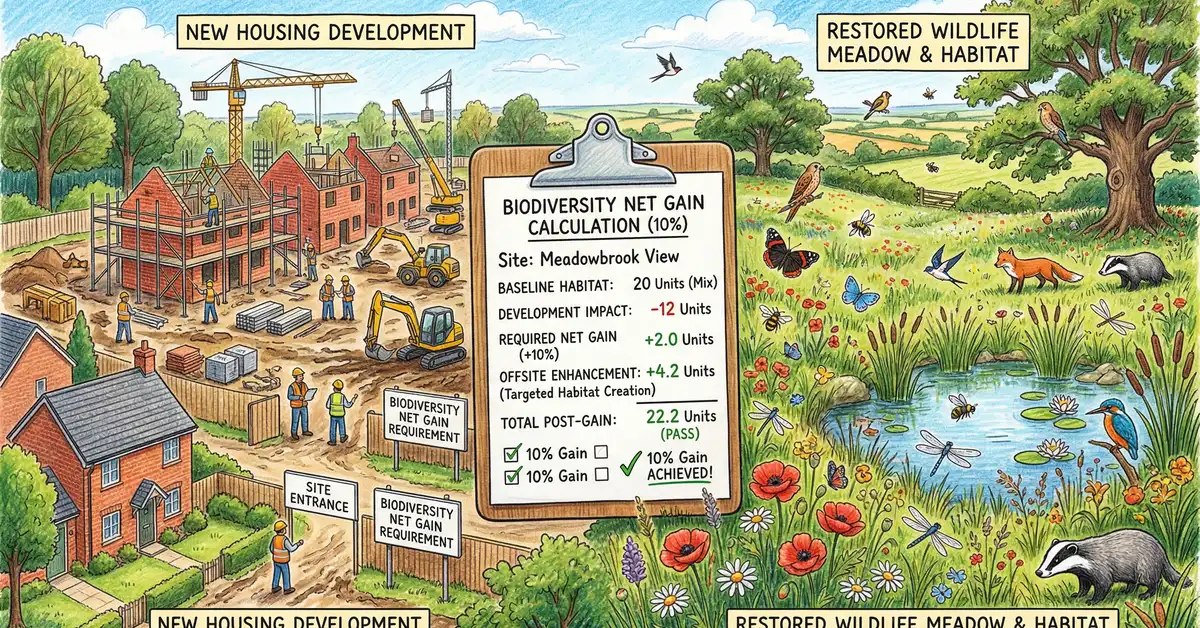
First, Biodiversity Net Gain requires most new development in England to deliver at least a 10% gain in biodiversity value. It became mandatory for major development on 12 February 2024 and for most small sites on 2 April 2024. From 6 August 2026, sites of 0.2 hectares or less are exempt, and nationally significant infrastructure projects come into scope from 2 November 2026. Developers who cannot achieve the gain on site can buy off-site biodiversity units, with statutory biodiversity credits from government as a last resort. Learn more about how this mechanism works in our guide to biodiversity net gain and the BNG regulatory framework.
Second, Local Nature Recovery Strategies create a statutory duty for local authorities to produce nature recovery plans. There are 48 LNRS areas covering the whole of England, and 45 strategies had been published by the end of September 2026. These strategies identify local priorities, map strategic corridors, and integrate biodiversity into Local Plans and planning decisions.
Third, Species Conservation Strategies give Natural England the power to prepare strategies that improve the conservation status of particular species. Pilots have covered water voles, hazel dormice and widespread reptiles, and a strategy for water voles in East Anglia is now in use. Turning these powers into results on the ground remains one of the main challenges facing UK biodiversity policy.
Source: Environment Act 2021; Defra BNG guidance; Defra, Environment Act 2021 post-legislative scrutiny memorandum (2026)
How Is Biodiversity Action Funded and What Are the Key Challenges?

Nature recovery strategies aim to transform degraded landscapes into thriving, biodiverse habitats
There is no single UK budget for nature recovery. In England, the largest public source is the Environmental Land Management schemes, which pay farmers and land managers for actions such as hedgerow restoration, buffer strips and habitat creation. Biodiversity Net Gain brings private money into off-site habitat creation, and the Planning and Infrastructure Act 2025 created a Nature Restoration Fund for strategic conservation measures linked to development. Scotland, Wales and Northern Ireland run their own schemes.
Funding and delivery still fall short of the targets. In January 2026 the Office for Environmental Protection found the government largely off track to meet its environmental commitments in England, including on biodiversity and the protection of land and sea. Our guide to payments for ecosystem services explores how emerging market mechanisms like carbon credits and biodiversity offsetting are beginning to fill this gap.
Integration with Climate Policy
Biodiversity and climate policy increasingly intersect, but tensions exist. Woodland creation targets for climate mitigation can conflict with open habitat conservation—peatlands, for instance, store vast quantities of carbon but are sometimes threatened by afforestation programmes. Offshore wind development, essential for net-zero targets, creates collision risks for marine birds. Hydroelectric expansion fragments river habitats. The emerging concept of "nature-positive" criteria in climate funding aims to resolve these conflicts, but integration mechanisms remain underdeveloped. As we explore in our article on climate change and biodiversity, these interactions demand joined-up policy thinking that treats nature recovery and climate action as complementary rather than competing priorities.
Source: Defra; Planning and Infrastructure Act 2025; Office for Environmental Protection (January 2026)
Key Point on 2030 Outlook
The UK is not yet on track for its 2030 nature commitments. Of the 43 targets and commitments the Office for Environmental Protection assessed for England in January 2026, it judged 5 largely on track, 16 partially on track and 21 largely off track. Closing the funding gap and accelerating implementation of the Environment Act provisions are the most critical factors determining whether the UK meets its Kunming-Montreal commitments.
Further Resources on Biodiversity Action Plans
For readers seeking to deepen their understanding of biodiversity action planning in the UK, these resources provide comprehensive detail:
- Defra Environmental Improvement Plan 2025: England's statutory plan for improving the natural environment, published on 1 December 2025. Available at gov.uk
- State of Nature 2023: The most comprehensive assessment of UK wildlife trends, produced by RSPB, Butterfly Conservation, Bat Conservation Trust, and BTO. Published in 2013, 2016, 2019 and 2023, drawing on data for thousands of species.
- Kunming-Montreal Global Biodiversity Framework: The full text of the GBF adopted at COP15, including all 23 targets for 2030. Available at cbd.int/gbf
- Local Nature Recovery Strategy Guidance: DEFRA's technical guidance for local authorities developing statutory nature recovery plans. Includes mapping tools, habitat priority lists, and partnership requirements.
- Scottish Government Biodiversity Strategy 2045: Scotland's plan to be Nature Positive by 2030 and to restore and regenerate biodiversity across the country by 2045.
- JNCC UK BAP Priority Species Archive: Complete database of original UK BAP priority species and habitats, with status assessments and recovery plans. Available at jncc.gov.uk
For a broader understanding of why biodiversity matters, explore our guides on ecosystem services and biodiversity and conservation. Biodiversity action plans are one essential tool among many—effective conservation requires coordinated effort across policy, funding, community action, and individual commitment.
Frequently Asked Questions About Biodiversity Action Plans
What is a biodiversity action plan and why does the UK need one?
A biodiversity action plan is a strategic framework that identifies priority species and habitats, sets measurable conservation targets, and coordinates action among government agencies, conservation organisations, and communities. The UK needs biodiversity action plans because its monitored species have declined by 19% on average since 1970, and nearly 1 in 6 species is at risk of extinction from Great Britain (State of Nature 2023). Without structured planning, conservation efforts would be fragmented, underfunded, and unable to address the systemic drivers of decline including habitat loss, pollution, and climate change.
What is the Kunming-Montreal Global Biodiversity Framework?
The Kunming-Montreal Global Biodiversity Framework is an international agreement adopted at COP15 in December 2022 that sets 4 goals for 2050 and 23 targets for 2030. Its best-known target is "30×30": ensuring at least 30% of land, inland water, and coastal and marine areas are effectively conserved by 2030. Other targets include putting at least 30% of degraded ecosystems under effective restoration, halving the overall risk from pesticides and highly hazardous chemicals, and mainstreaming biodiversity across government and the economy. The UK set out its response in the UK National Biodiversity Strategy and Action Plan (February 2025), delivered through country strategies including England's Environmental Improvement Plan 2025 and the Scottish Biodiversity Strategy to 2045.
How can I get involved in my Local Biodiversity Action Plan?
Contact your local council's environment or biodiversity officer to find out about your area's LBAP. Most plans welcome volunteer participation in habitat surveys, species monitoring, and practical conservation work such as tree planting or pond creation. Local wildlife trusts are often key delivery partners and run regular volunteer events. You can also contribute through citizen science schemes like the Big Butterfly Count or garden wildlife surveys whose records help inform local nature planning. In England, you can also look up your area's Local Nature Recovery Strategy.
What are UK BAP priority species?
UK BAP priority species were those identified as most in need of conservation action due to rarity, rapid decline, or ecological importance. The original lists, drawn up between 1995 and 1999, held fewer than 600 species; a 2007 review raised this to 1,150 species and 65 habitats. The UK BAP has since been superseded, and each country now keeps its own statutory list: England's Section 41 list under the NERC Act 2006 (943 species and 56 habitats), Wales's Section 7 list (updated in March 2026 to 1,322 species and 69 habitats), the Scottish Biodiversity List, and Northern Ireland's priority species list (592 species after the first tranche of its review in 2023). Priority species include red squirrels, water voles, great crested newts, turtle doves, and freshwater pearl mussels.
Is the UK on track to meet its 2030 biodiversity targets?
Not yet. In January 2026 the Office for Environmental Protection found the government largely off track to meet its environmental commitments in England: of 43 targets and commitments, it judged 5 largely on track, 16 partially on track and 21 largely off track. Defra estimates that only around 7% of England's land currently meets the 30by30 standard (July 2026), and England's priority species indicator has fallen by around 80% since 1970.