Climate change is currently the third largest driver of global biodiversity loss, and a pressure expected to grow in importance over the coming decades if emissions continue. In the UK, it is no longer a future threat to wildlife. It is already detectable in the timing, distribution and abundance of common species — and in 2024 fire, made more likely by heat and drought, caused 48% of tropical primary forest loss worldwide (WRI).
This 2026 guide focuses on the intersection that matters most for the UK conservation community: how climate change is changing British wildlife and habitats now, which species and places are most at risk, what UK policy is doing about it, and what individual and collective action looks like. For the wider IPBES five-drivers framework, see our companion piece on the five drivers of biodiversity loss.
~5 days
Per Decade
UK butterfly emergence shift since 1970s
297 days
Marine Heatwave Days
NW European seas, 2025: a record
80%
UK Peat Degraded
Now emitting carbon rather than storing it
3rd
IPBES Driver Ranking
Of five global drivers of loss
Sources: IPBES Global Assessment 2019 & Transformative Change Assessment 2025; UK Butterfly Monitoring Scheme; IUCN UK Peatland Programme; State of Nature 2023.
In this guide
What climate change is doing to UK wildlife · The four detectable UK signals · The 5 most climate-vulnerable UK habitats · Winners and losers · UK climate policy & biodiversity · What works · FAQs
What climate change is doing to UK wildlife
Climate change in the UK is no longer a forecast. Met Office records confirm 2025 as the UK's warmest year on record (10.09°C mean, beating 2022's 10.03°C), and the 2016–2025 decade was 1.33°C warmer than 1961–1990. Northwest European seas also recorded 297 marine heatwave days in 2025, the most since records began in 1982. The Climate Change Committee's 2025 adaptation progress report found UK preparation for climate impacts inadequate, with no outcome rated as good delivery and only limited progress on the health of terrestrial and freshwater habitats.
For wildlife, the consequences operate through four mechanisms — warming temperatures, shifting rainfall, sea level rise and ocean acidification, and increased frequency of extreme weather events such as droughts, heatwaves and floods. The signal is now strong enough that the UK Butterfly Monitoring Scheme, the British Trust for Ornithology's nest record scheme, and Marine Biological Association sea temperature series all detect coherent change across multiple species — not noise.
Crucially, climate change rarely acts alone. It compounds the other four IPBES drivers of biodiversity loss — habitat fragmentation makes species less able to track shifting climates, pollution weakens populations stressed by drought, invasive species spread faster in warming systems, and overfishing leaves marine food webs more vulnerable to ocean warming. The 2025 IPBES Transformative Change Assessment is explicit on this point: tackling climate change without simultaneously tackling the other drivers does not save biodiversity.
The four detectable UK signals (and what they mean for wildlife)
Four climate signals are now consistently detectable in UK long-term ecological monitoring. Each has well-evidenced biodiversity consequences.
| UK climate signal | What is changing and which species are affected |
|---|---|
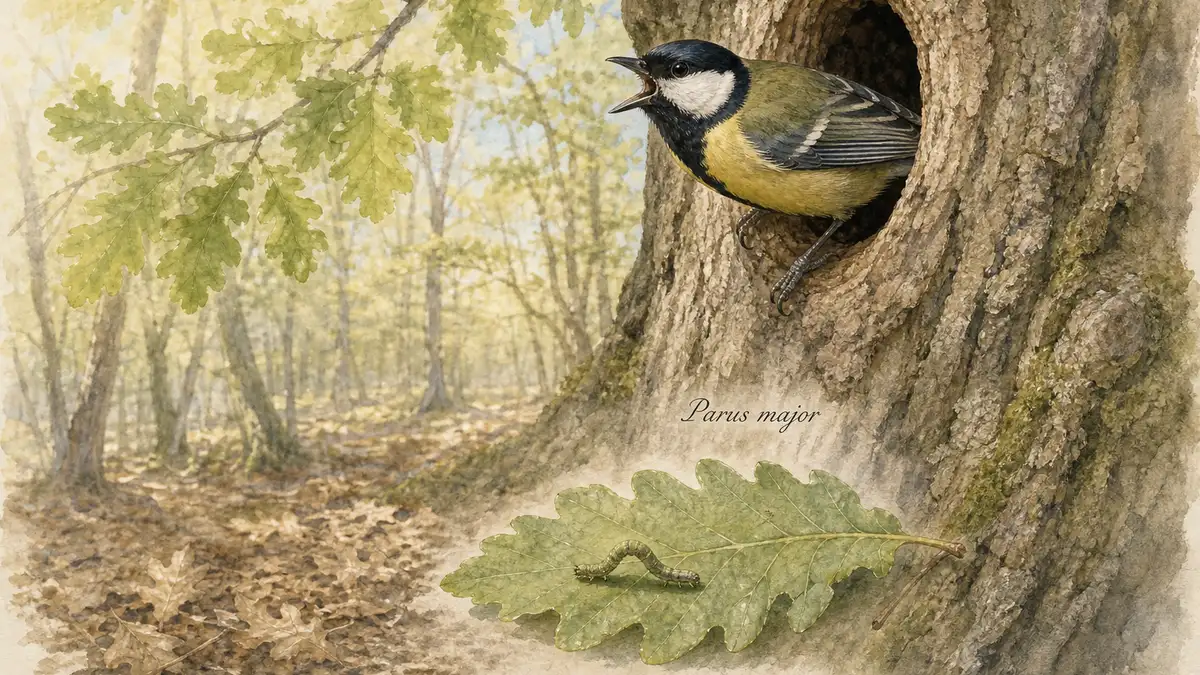
| Phenology shift | UKBMS records show spring-flying butterflies emerging about 5 days earlier per decade since the mid-1970s. Knock-on mismatches for great tits, blue tits, pied flycatchers timing breeding to caterpillar peaks. |
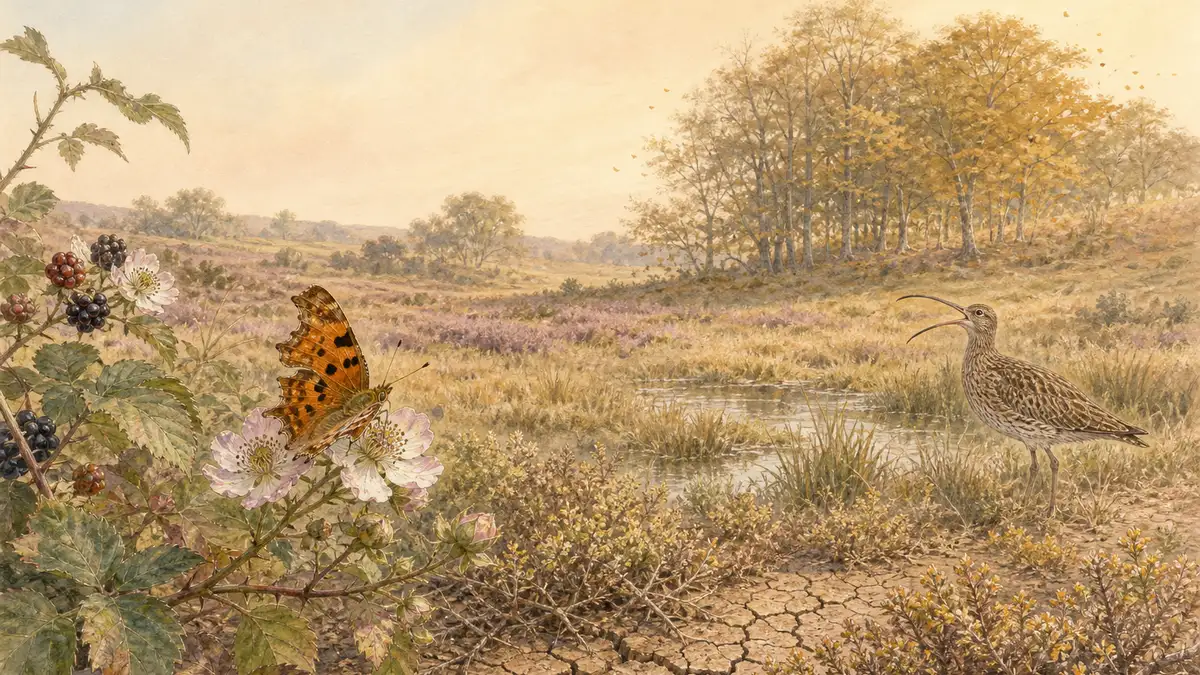
| Range shifts | Northward expansion of warm-adapted species (comma butterfly, little egret, Cetti's warbler). Upward retreat or shrinkage of cold-adapted species (ptarmigan, mountain hare, curlew, dotterel). |
| Marine warming | North Sea reorganising as cold-water species move north and warm-water species arrive. Seabird food chains under stress: puffin, kittiwake and Arctic tern breeding success has fallen at several UK colonies due to sandeel decline. |
| Extreme weather | The 2022 UK heatwave (40.3°C) brought an unprecedented number of wildfires, including on Surrey heathland. Increasing flood frequency raises mortality in burrow-dependent species (water vole, sand martin, kingfisher). |
The 5 most climate-vulnerable UK habitats
Some UK habitats are structurally more exposed to climate change than others — usually because they sit at a climate edge, depend on a narrow temperature or moisture window, or store a feedback (such as carbon) that climate change actively releases.
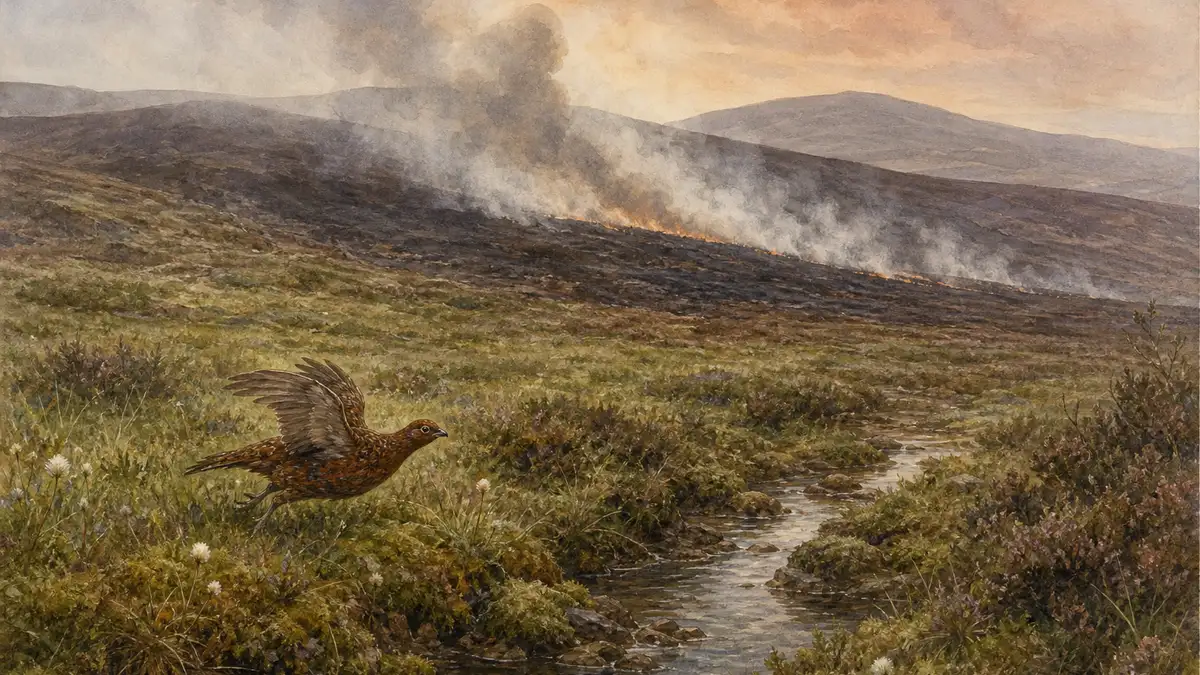
1. Blanket bog and upland peatlands. Around 80% of UK peatlands are in a damaged or degraded condition (IUCN UK Peatland Programme), and drying conditions plus increasing wildfire frequency are now releasing stored carbon. Major moorland fires on Saddleworth Moor (June 2018) and Marsden Moor (April 2019) burned across peat uplands. Species at risk: golden plover, dunlin, large heath butterfly, bog sphagnum mosses.
2. Chalk streams. England holds an estimated 85% of the world's chalk streams — a globally rare freshwater ecosystem. Reduced summer rainfall and rising groundwater extraction are lowering flows; warming water temperatures push trout, salmon and water-crowfoot toward physiological limits. The River Test and River Itchen are among the most-studied.
3. Cairngorms montane plateau and Scottish Highland uplands. The UK's only alpine tundra fragment. Climate envelope is shrinking from below as treelines creep upward. Species at risk: ptarmigan, mountain hare, dotterel, snow bunting, alpine plants such as snow pearlwort.
4. UK coastal and saltmarsh systems. Sea level rise plus increased storm frequency squeezes saltmarsh between rising water and fixed sea defences ("coastal squeeze"). Species at risk: little tern (nests on shifting shingle), redshank, lapwing, breeding seabird colonies.
5. Lowland heathland in the south of England. Sensitive to drought and wildfire; the 2022 heatwave brought serious heath fires in Surrey. Species at risk: Dartford warbler, woodlark, smooth snake, sand lizard, silver-studded blue butterfly.
For a wider taxonomy of UK ecosystem types and their condition trends, see our ecosystems guide.
UK climate winners and losers — so far
"Climate change is bad for wildlife" is too coarse. The honest picture is mixed: some species are doing better in a warming UK climate, others worse. Which side a species falls on depends on its climate envelope, its ability to track shifting conditions, and how much its habitat is already degraded by the other four IPBES drivers.
| Expanding in UK with warming | Declining / squeezed by warming |
|---|---|
| Little egret, Cetti's warbler, comma butterfly, brown argus butterfly, dartford warbler (locally), bee orchid, harlequin ladybird (invasive). | Ptarmigan, mountain hare, curlew, kittiwake, puffin, Arctic tern, Scottish wildcat (range), capercaillie, large heath butterfly, snow bunting. |
The asymmetry matters. The "winners" are often generalists or species already widely distributed across continental Europe. The "losers" tend to be UK specialists, range-edge populations, or cold-adapted species with nowhere left to retreat to. The net result for UK biodiversity is loss — the State of Nature 2023 headline of 19% average species decline since 1970 reflects this, and climate change is now woven through that figure rather than separable from it.
UK climate policy and biodiversity — what's on track, what isn't
The UK's climate policy framework has three pieces that matter for biodiversity. The first is the 2050 net zero target in the Climate Change Act 2008 (as amended in 2019), with the Sixth Carbon Budget covering 2033-2037. The Climate Change Committee's 2025 adaptation progress report concluded that UK preparation for climate change remains inadequate, with limited progress on adapting the natural environment.
The second piece is the Environmental Improvement Plan 2025, which restates the Environment Act 2021's statutory biodiversity targets — halt species decline by 2030, restore or create more than 500,000 hectares of wildlife-rich habitat outside protected sites by 2042. The Office for Environmental Protection's January 2026 report found England largely off track on its environmental targets. Britain is not currently on track to meet its own 2030 commitments without significant acceleration.
The third piece is the 30 by 30 commitment — protecting 30% of UK land and sea by 2030. The headline coverage figures look reassuring on paper, but Defra's own progress reporting shows that only around 7% of England's land currently meets the 30 by 30 standard of being both protected and in favourable or recovering condition. For a climate-vulnerable habitat like blanket bog, designation alone is not enough — active management (rewetting, eliminating burning, removing inappropriate drainage) is required to convert protection on paper into climate resilience on the ground.
What actually works: climate action that delivers for biodiversity
Climate action and biodiversity action sometimes pull in the same direction (peatland restoration, native woodland creation, saltmarsh restoration) and sometimes don't (industrial-scale conifer plantations, large solar arrays on biodiverse grassland, biofuel crops). The interventions below are the ones with the strongest evidence of doing both.
Peatland restoration
Rewetting drained UK peat bogs is the single most cost-effective UK nature-based climate action. The UK Peatland Strategy targets 2 million hectares in good condition by 2040. Restored bog stores carbon, reduces wildfire risk, and supports golden plover, dunlin, large heath butterfly and sphagnum mosses simultaneously.
Native-species woodland creation
Oak, birch, hazel and rowan woodland on appropriate land — not conifer plantations on peat.
Saltmarsh and managed coastal realignment
Managed realignment lets the coastline retreat in places where hard defences are uneconomic, creating new saltmarsh that stores carbon, absorbs storm energy, and supports breeding waders. Wallasea Island and Steart Marshes are leading UK examples.
Connected habitat corridors
Restoring hedgerows, riparian strips, and verges between fragmented habitat patches lets species track shifting climates. Restoring hedgerows is one of the most concrete UK climate adaptations available.
Reduce non-climate stressors on climate-vulnerable species
Cold-adapted UK species (curlew, ptarmigan, capercaillie) struggle most where other pressures stack alongside climate change — predation, disturbance, habitat loss. Removing the stackable stressors gives climate-vulnerable populations a better chance.
Frequently asked questions about climate change and UK biodiversity
How does climate change affect UK wildlife?
Through four detectable mechanisms: phenological shift (UK spring butterflies emerging about 5 days earlier per decade since the mid-1970s), range shifts (warm-adapted species like the comma butterfly and Cetti's warbler expanding north, cold-adapted species like ptarmigan and curlew contracting), marine warming (North Sea fish communities reorganising, seabird breeding success falling at several colonies), and extreme weather (the 2022 UK heatwave brought an unprecedented number of wildfires, including on Surrey heathland).
Which UK species are most at risk from climate change?
UK specialists at the edge of their climate envelope are most exposed. The clearest losers include ptarmigan, mountain hare, capercaillie, curlew, kittiwake, puffin, Arctic tern, large heath butterfly, snow bunting, dotterel and Scottish wildcat. Species expanding into the UK from warmer continental Europe (little egret, Cetti's warbler, comma butterfly, brown argus) are the corresponding "winners," though most are generalists rather than specialist replacements.
What is the most climate-vulnerable UK habitat?
UK blanket bog and upland peatland are arguably the most exposed because they store a major climate feedback (carbon) and are already 80% degraded. Drying and wildfire are converting them from net carbon sinks into net sources. Other highly vulnerable UK habitats include chalk streams (warming, abstraction), the Cairngorms montane plateau (climate envelope shrinking from below), saltmarsh (coastal squeeze), and lowland heath (drought, wildfire).
How does climate change affect biodiversity globally?
The Intergovernmental Science-Policy Platform on Biodiversity and Ecosystem Services (IPBES) currently ranks climate change as the third largest driver of global biodiversity loss — behind land- and sea-use change and direct exploitation of organisms. However, its influence is expected to grow over the coming decades if emissions are not curtailed. In 2024, fire, made more likely by heat and drought, caused 48% of tropical primary forest loss, overtaking agriculture as the leading cause for the first time in WRI's data.
Is climate change the biggest threat to UK biodiversity?
Not yet — but it is becoming so. Historically, intensive agriculture and habitat loss have been the dominant drivers of UK wildlife decline. Climate change increasingly compounds those pressures (drought-stressed fragments are less viable, pollution becomes more harmful in warmer water, invasives spread faster) and could come to outweigh them in future decades. Tackling climate change without tackling habitat loss does not save UK biodiversity, and vice versa.
Is the UK on track for net zero by 2050?
The Climate Change Committee's 2025 adaptation progress report found UK preparation for climate impacts inadequate, with no outcome rated as good delivery and only limited progress on the natural environment. The Office for Environmental Protection's January 2026 report found England largely off track on its environmental targets. For emissions progress towards net zero by 2050, see the Climate Change Committee's annual progress reports.
Can biodiversity recover if climate change is reversed?
Partially — and only with active management. Some changes (range shifts, phenological shifts) would reverse if climate stabilised. Others — species lost from the UK, peatland carbon already released, saltmarsh squeezed out of existence — would not reverse on any meaningful timescale. The framing now widely adopted by UK conservation organisations is "restore as much as we can, accept what we cannot, plan for the climate we will have rather than the climate we had."
What can I do as a UK individual?
Three plays consistently show evidence: (1) support landscape-scale work — RSPB, Wildlife Trusts, Rewilding Britain, the Woodland Trust deliver climate-and-biodiversity wins that small action cannot match; (2) make your own land work harder if you have any — a pond, native plants, a wildlife corridor, no pesticides; (3) vote and respond to consultations — UK biodiversity outcomes are driven by Defra policy, agricultural subsidies and planning law, and consultations matter.
Questions or corrections?
We publish free, evidence-based guides on UK biodiversity and climate. Spotted an error or have a question? Let us know.
Sources: IPBES Global Assessment 2019 & Transformative Change Assessment 2025; State of Nature 2023; Met Office UK Climate; Climate Change Committee 2025 Progress Report; OEP Progress Report 2024-2025; IUCN UK Peatland Programme; Environmental Improvement Plan 2025; UK Butterfly Monitoring Scheme; British Trust for Ornithology; Woodland Trust State of UK Woods 2025.