A strong biodiversity poster picks one specific angle — a single species, a UK habitat, a single threat, or a conservation action — rather than trying to cover all of "biodiversity" in one frame. A widely used layout guideline, from the University of California, Davis, is roughly 20% text, 40% images, 40% white space, with text readable from 1.5 to 2 metres away. This guide collects ten tried-and-tested ideas, layout and font rules from university poster guides, facts you can put on your poster with confidence, and where to find images you can use legally.
Whether the poster is for a Year 7 ecology project, a GCSE Biology classroom display, an A-level field-trip report, or a World Environment Day entry (5 June each year), the principles are the same: narrow the topic, evidence the claims, balance image and text, and design for the back of the room.
20 / 40 / 40
Text / Images / Space
UC Davis poster guideline
≤ 1,000
Total Words
Including image captions
1.5–2 m
Reading Distance
Test body text at this range
5 June
World Environment Day 2026
Hosted by Azerbaijan
Sources: UC Davis Poster Design Principles; University of Chicago Library; World Environment Day 2026 (UNEP).
Key Takeaway
A common reason a biodiversity poster falls flat is scope, not effort. "Save the planet" cannot fit on A2. "Why bumblebees are disappearing from English meadows" can — and is far more interesting.
10 biodiversity poster ideas to choose from
Pick one and resist the urge to broaden it. Each idea here is narrow enough to fit on a single poster, evidence-friendly, and relevant to the UK national curriculum. Numbers in brackets indicate suitable key stage levels.
| # | Poster idea | Angle and KS level |
|---|---|---|
| 1 | One species in trouble | Pick a threatened UK species, such as the turtle dove (globally Vulnerable), white-clawed crayfish (Endangered), hedgehog (Near Threatened) or water vole (Endangered on Britain's mammal Red List). Three causes, three actions. (KS3–KS4) |
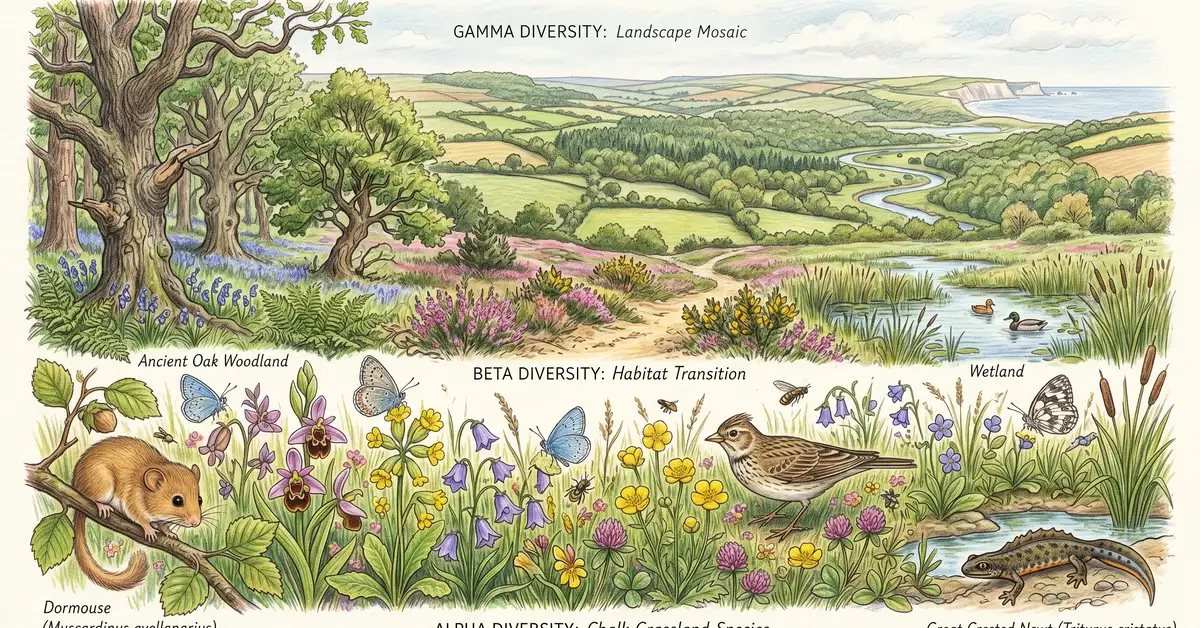
| 2 | A UK habitat in cross-section | Chalk grassland, ancient woodland, peat bog, or coastal saltmarsh. Show the species layers vertically. (KS3–GCSE) |
| 3 | Pollinator decline | Bees, hoverflies, moths, butterflies — what they pollinate, why they're declining, what gardens can do. (KS2–KS4) |
| 4 | Biodiversity in your school grounds | A real survey of what lives on your site — photographs, identification, simple data table. (KS2–KS3) |
| 5 | The 36 biodiversity hotspots | World map of the 36 regions that cover just 2.5% of Earth's land but hold thousands of plant species found nowhere else. (KS4–A-level) |
| 6 | Ecosystem services | Pollination, water filtration, carbon storage, flood control — biodiversity's economic value. (KS4–A-level) |
| 7 | Rewilding case study | Knepp Estate (West Sussex), Cairngorms Connect, or Wild Ennerdale — before and after. (KS3–A-level) |
| 8 | Levels of biodiversity | Genetic, species, ecosystem — three rings on one poster, with an example for each. (KS4–A-level) |
| 9 | Invasive species in Britain | Grey squirrel, signal crayfish, Himalayan balsam, harlequin ladybird — origin and impact. (KS3–KS4) |
| 10 | Climate change and UK wildlife | Range shifts, phenology mismatches, range expansion of southern species. (KS4–A-level) |

What makes a good biodiversity poster: layout, fonts, proportions
There is no single official rule, but university research-poster guides offer sensible starting points that translate well to school projects. The figures below come from guidance published by UC Davis and the University of Chicago Library.
Proportions
UC Davis suggests roughly 20% text, 40% images, 40% white space. The University of Chicago guide caps text at 1,000 words including captions. White space is not waste — it directs the reader's eye.
Fonts
Stick to one or two sans-serif fonts (Arial, Helvetica, Verdana). Suggested minimums: title 85pt, section headings 36pt, body text 24pt (24–36pt is a good range for body text). Test legibility from 1.5–2 metres away.
Build the poster with a clear visual hierarchy: title at the top, three to five sections (don't try seven), one dominant image per section, and a single takeaway phrase at the bottom that summarises the whole poster. Avoid clutter — leave a clear margin on all sides so the design doesn't feel crammed.
Key biodiversity facts you can put on your poster
The facts below are sourced and were checked in November 2026. Pick two or three that fit the angle you've chosen — overloading a poster with statistics is a common mistake. Pixcellence's piece on biodiversity hotspots has the full background if you want to dig deeper.
Global biodiversity: 36 regions have been designated as biodiversity hotspots. Together they cover just 2.5% of Earth's land surface. To qualify, each must hold at least 1,500 plant species found nowhere else on Earth and have already lost at least 70% of its original natural vegetation (Conservation International). Worldwide, 49,505 of the 175,909 species assessed for the IUCN Red List (version 2026-1) are threatened with extinction.
UK biodiversity: The UK is home to more than 70,000 known species, yet it is one of the most nature-depleted countries in the world: its Biodiversity Intactness Index is 42%, the lowest in the G7. The State of Nature 2023 report found that monitored UK species have declined in abundance by 19% on average since 1970, and that around 1 in 6 species is at risk of extinction from Great Britain. Rarer birds such as the barn owl are listed on Schedule 1 of the Wildlife and Countryside Act 1981, which makes it an offence to disturb them at or near an active nest (GOV.UK).
Threats: Loss of tropical primary rainforest fell 36% between 2024 and 2025, but 4.3 million hectares were still lost in 2025 (World Resources Institute / Global Forest Watch). Closer to home, about half of the British wild bee and hoverfly species studied lost range between 1980 and 2013 (Powney et al., 2019); habitat loss, pesticides and climate change are among the pressures.
What works: Indigenous Peoples manage or hold tenure rights over at least a quarter of the world's land, an area that overlaps about 40% of all terrestrial protected areas and ecologically intact landscapes (Garnett et al., 2018). In 2022, the 196 Parties to the Convention on Biological Diversity adopted the Kunming-Montreal Global Biodiversity Framework, including a target to effectively conserve and manage at least 30% of land and sea by 2030 (known as "30by30"). In England, around 7% of land currently meets the 30by30 criteria (Defra, July 2026). Pixcellence's piece on biodiversity loss explains the dynamics in more depth.
Where to find images, illustrations, and data
This is the section most school projects get wrong. A biodiversity poster needs imagery — but Google Images results are usually copyrighted, and dropping a watermarked stock photo onto your poster is poor practice. The shortlist below is openly licensed and reliable. Our full guide to biodiversity pictures covers licensing and attribution in depth.
Free image sources
iNaturalist (many species photos are Creative Commons; check each photo's licence), Biodiversity Heritage Library (historic illustrations), Wikimedia Commons, Natural England (much GOV.UK content is under the Open Government Licence, but check each image's credit).
Free UK data sources
JNCC (biodiversity indicators), RSPB (species and habitat data), National Biodiversity Network (UK species records), the State of Nature report (free download).
Common Misconception
The myth: Any image on Google is fine for a school poster.
The reality: Most images on the web are someone else's copyright. Even for a school project, the correct habit is to source from Creative Commons or public-domain libraries and credit the photographer. Use the TASL caption (Title, Author, Source, Licence) under each image — it teaches good academic practice and protects you if the poster is shared online.
How to plan your poster: a 5-step framework
Narrow the topic
Write the topic in eight words or fewer. "Save biodiversity" is too broad. "Why hedgehogs are vanishing from English gardens" is the right scale.
Build the section map
Choose three to five sections. A reliable structure: "What it is", "Why it matters", "What's threatening it", "What works", "What you can do".
Gather your evidence
Two or three statistics with sources. One graph or chart. Three to five images. A direct quote if you have one. Write down the URL for every source.
Draft the layout
Sketch on A4 first, even if the final poster is A1. Title across the top. Sections flow left to right, top to bottom. One image dominates each section.
Test from the back of the room
Print at quarter-size on A4. Pin it up. Stand two metres away. If you can't read the body text or identify the main message in five seconds, redesign it.

Biodiversity project cover page ideas: title and front page designs
A good biodiversity project cover page — also called a title page or front page — does three jobs: it states the title clearly, signals the topic with one strong image, and carries the essential details. Everything else is decoration. The six designs below work for a project booklet, a coursework folder, or a poster that needs its own title panel.
| # | Cover page idea | How it works |
|---|---|---|
| 1 | Single-species portrait | One large, carefully drawn UK species centred on the page — a hedgehog, barn owl or peacock butterfly — with the project title above it. Simple, strong, and suits every key stage. |
| 2 | Habitat border | Frame the whole page with a border drawn from one UK habitat: hedgerow leaves and berries, pond plants and dragonflies, or woodland ferns and fungi. Title and details sit in the clear centre. |
| 3 | Layers of life | Divide the page into horizontal bands — sky and birds, canopy, ground flora, soil life. Put the title in the sky band. Doubles as a visual summary of an ecosystem. |
| 4 | Web of life | Title in the centre, with small sketches of linked species around it and arrows showing who eats whom. Signals a food-web or ecosystem project at a glance. (GCSE–A-level) |
| 5 | Levels-of-biodiversity rings | Three concentric rings — genetic, species, ecosystem diversity — with one small drawing in each and the title in the middle. Ideal for a definitions project. (KS4–A-level) |
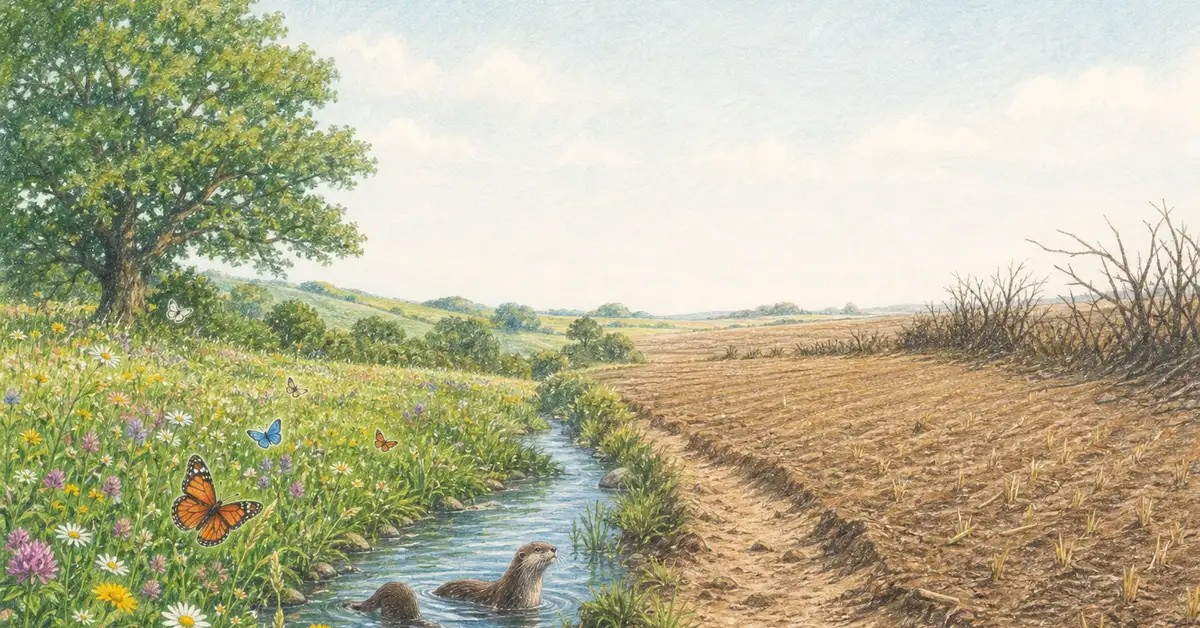
| 6 | Before-and-after split | Left half a degraded landscape, right half the same place restored — hedges replanted, wildflowers back. Title across the dividing line. Suits threats or rewilding projects. |
Layout rules that make any cover page work: make the title the largest thing on the page; choose one focal image rather than a collage; leave white space around it; and put your details — name, class, subject, teacher and date — in a small block along the bottom or in one corner. A hand-drawn species almost always beats clip-art, and if you use a photograph, credit it underneath with the TASL format (title, author, source, licence).
For drawing technique — proportions, light direction and pencil choice — see our guide to easy biodiversity drawing. If you need a photograph or illustration to work from, our guide to free biodiversity pictures lists openly licensed sources and shows how to credit them.
World Environment Day 2026: a focus on climate
World Environment Day 2026 focused on climate change, under UNEP's campaign slogan #NowForClimate. The global celebration was hosted by Azerbaijan, in Baku, on 5 June 2026, and the host country framed it as Inspired by Nature. For Climate. For Our Future. Schools planning poster projects for future World Environment Days (held every year on 5 June) can still use this framing — pieces of nature that contribute to climate resilience (peatlands, woodlands, kelp forests, mangroves) make especially strong subjects, because they tie biodiversity into the climate story that students already follow.
If your school is running a competition or a display, the WED theme gives every poster a shared umbrella while leaving plenty of room for individual angles. Cross-link your posters to the UNEP individual action toolkit at the bottom of each design, so each poster links information to action.
UK resources for biodiversity teaching and learning
The Field Studies Council publishes biology and geography teaching resources for KS3, KS4 and A-level, some of them free to download, as well as identification guides for UK trees, invertebrates and other groups (the printed fold-out charts are sold) that make good raw material for a school poster. Resources from its BioLinks project are useful for invertebrate-focused posters.
The RSPB publishes free schools resources covering UK birds and habitats; the Natural History Museum data portal releases specimen photography under CC BY 4.0; and the National Biodiversity Network aggregates UK species records that students can use to make genuine, evidence-based statements about local biodiversity.
Pixcellence has its own cluster of biodiversity guides aimed at students and educators: what biodiversity is, types of biodiversity, and UK habitats all provide background reading that maps neatly onto KS3 and KS4 ecology specifications.
Need biodiversity imagery for your poster?
Our companion guide on biodiversity pictures lists openly licensed sources, explains the Creative Commons licences in plain English, and shows you how to credit any image you use.
Frequently asked questions about biodiversity posters
What size should a biodiversity poster be for a school project?
A2 (420 × 594 mm) is a common size for GCSE coursework posters and classroom displays in the UK. A1 (594 × 841 mm) is appropriate for school competitions or hallway displays. A3 is fine for KS2 or smaller classroom projects. Size matters less than legibility — body text should be readable from 1.5 to 2 metres away regardless of paper size.
How much text should I put on a biodiversity poster?
Aim for no more than about 1,000 words across the whole poster, including image captions. A widely used guideline from university poster guides is roughly 20% text, 40% images and 40% white space. Posters that try to cover too much information end up unreadable from a distance.
What font and font size should I use?
Use one or two sans-serif fonts (Arial, Helvetica, or Verdana). Aim for at least 85pt for the title, 36pt for section headings and 24pt for body text. Print a quarter-scale draft and stand two metres away — if you can't read the body text, increase the size.
What are good biodiversity poster topics for GCSE?
Narrow topics work best at GCSE level: one UK species in decline (water vole, hedgehog, turtle dove), a single UK habitat in cross-section (chalk grassland, peat bog), pollinator decline, a rewilding case study (Knepp Estate, Cairngorms Connect), or the ecosystem services concept. Each of these links to the ecology and biodiversity topics in AQA, OCR and Edexcel GCSE Biology and Geography.
Where can I get free, legal images for my biodiversity poster?
iNaturalist (many photos are Creative Commons, so check the licence on each), Wikimedia Commons, the Biodiversity Heritage Library (historic illustrations), Natural England via GOV.UK (much content is under the Open Government Licence, but check image credits), and the Natural History Museum's data portal (CC BY 4.0 specimen photography). Always credit the image using the TASL template — Title, Author, Source, Licence.
What was the World Environment Day 2026 theme?
World Environment Day 2026 focused on climate change, under UNEP's slogan #NowForClimate. It was hosted by Azerbaijan, in Baku, on 5 June 2026, with the host's national theme "Inspired by Nature. For Climate. For Our Future." Schools running biodiversity poster projects can tie their work to the WED theme — particularly subjects that link biodiversity to climate resilience (peatlands, woodlands, kelp forests, mangroves).
How do I credit images and sources on a poster?
Use the TASL template — Title, Author, Source, Licence — under each image. For statistics and quotes, include a short Sources line at the bottom of the poster citing IUCN, Natural England, RSPB, JNCC, or the State of Nature report. Even for a school poster, crediting sources properly is good academic practice.
Stay Connected with Conservation
We publish free, evidence-based guides on UK biodiversity and climate. Spotted an error or have a question? Let us know.
Sources: UC Davis Poster Design Principles; University of Chicago Library research posters guide; World Environment Day 2026 — UNEP; Field Studies Council teaching resources; Conservation International biodiversity hotspots; Wildlife and Countryside Act 1981 Schedule 1; State of Nature 2023; Defra 30by30 on land delivery plan (July 2026); Kunming-Montreal Global Biodiversity Framework targets.