Key Takeaway
Rewilding restores self-sustaining ecosystems by allowing natural processes — grazing, predation, flooding and succession — to reshape the landscape with minimal human intervention. The UK's pioneering sites, led by Knepp Estate in West Sussex, demonstrate that biodiversity can recover dramatically within two decades, yet only around 1 per cent of UK land is actively rewilding against a national target of 30 per cent by 2030.
916%
Knepp bird increase
Breeding birds since 2007
~100
Beavers for 2026
Planned wild releases across England
6%
UK land for nature
Effectively managed (target: 30%)
300
Global organisations
Coordinated by Global Rewilding Alliance
In This Article
- What Is Rewilding?
- UK Rewilding Case Studies
- Beavers: The UK's Ecosystem Engineers
- Rewilding Beyond the UK
- Economics of Rewilding
- Controversies and Challenges
- Policy and the Path to 30 Per Cent
- Frequently Asked Questions
What Is Rewilding?
Rewilding is a conservation approach that restores self-sustaining ecosystems by reinstating natural processes — grazing, predation, flooding, and ecological succession — rather than managing landscapes through ongoing human intervention. Where traditional conservation focuses on preserving what remains, rewilding aims to rebuild functional food webs across all trophic levels, creating landscapes capable of regulating themselves without continuous management.
The concept emerged from North American conservation biology in the early 1990s and was formalised by Michael Soulé and Reed Noss in their influential 1998 paper, which established the "3 Cs" framework: Cores (large protected areas), Corridors (habitat connections enabling species movement), and Carnivores (top predators driving trophic cascades). This framework recognised that isolated nature reserves cannot sustain viable populations of wide-ranging species or maintain ecosystem functions across fragmented landscapes.
In practice, rewilding operates across a spectrum. Passive rewilding involves stepping back — removing fences, ceasing intensive management, and allowing natural succession to unfold. Active rewilding requires direct intervention: reintroducing missing species, removing dams to restore river connectivity, or rewetting drained peatland. Trophic rewilding specifically targets the restoration of food-web complexity through reintroduction of keystone species — particularly large herbivores and predators whose ecological activities reshape entire landscapes.
UK Rewilding Case Studies: Evidence from the Ground
Knepp Estate, West Sussex
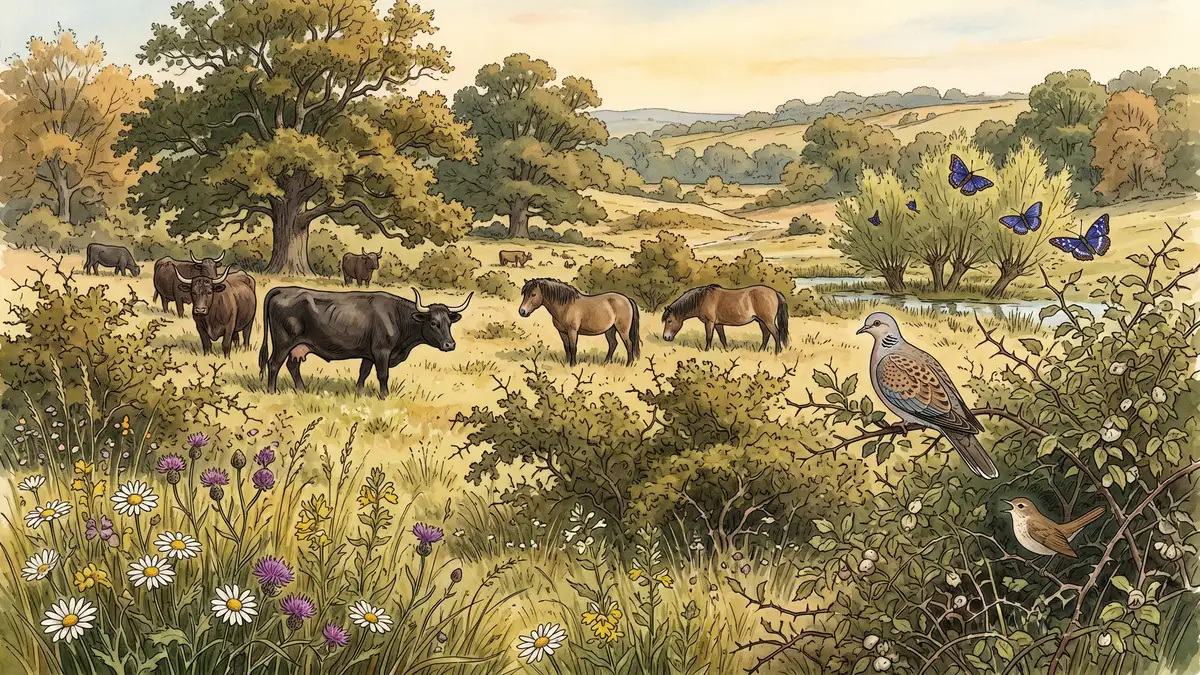
Knepp Estate provides the UK's most comprehensive evidence that rewilding works. This 3,500-acre former dairy and arable farm in the eastern weald of Sussex began its transition in 2001, when owners Charlie and Isabella Tree, faced with unsustainable returns from intensive agriculture, introduced free-roaming cattle, ponies and deer as the primary landscape management tool.
The ecological results after two decades are remarkable. According to Knepp's 2026 ecological review, breeding bird populations in the southern block have increased by 916 per cent since systematic surveys began in 2007, with species richness rising 132 per cent. Individual species tell the story more vividly: common whitethroat populations increased 2,200 per cent, nightingales rose 500 per cent, and turtle doves — a species in catastrophic decline across Europe — grew from just two singing males in 2008 to 22 in 2024.
Recovery extends well beyond birds. Butterfly species richness increased 107 per cent between 2005 and 2025, with the purple emperor butterfly reaching some of the highest densities recorded anywhere in Britain — 283 individuals counted in a single day in 2025. Dragonflies and damselflies surged 871 per cent alongside a 53 per cent increase in species richness along the restored River Adur. Free-roaming herbivores generated approximately 96 hectares of new scrub habitat between 2001 and 2019, creating the mosaic of woodland, grassland and wetland that underpins this biodiversity recovery.
Cairngorms Connect, Scotland
Cairngorms Connect takes a different approach: a partnership of neighbouring land managers within Scotland's largest national park committed to a 200-year vision for habitat restoration. This long-term framing reflects the reality that ecological restoration at landscape scale requires institutional commitment far beyond normal planning horizons. The partnership model — collaborative rather than centralised — may prove more scalable than single-estate approaches, particularly in regions where land ownership is fragmented and local communities exert significant influence over management decisions.
Glen Affric and Peatland Restoration
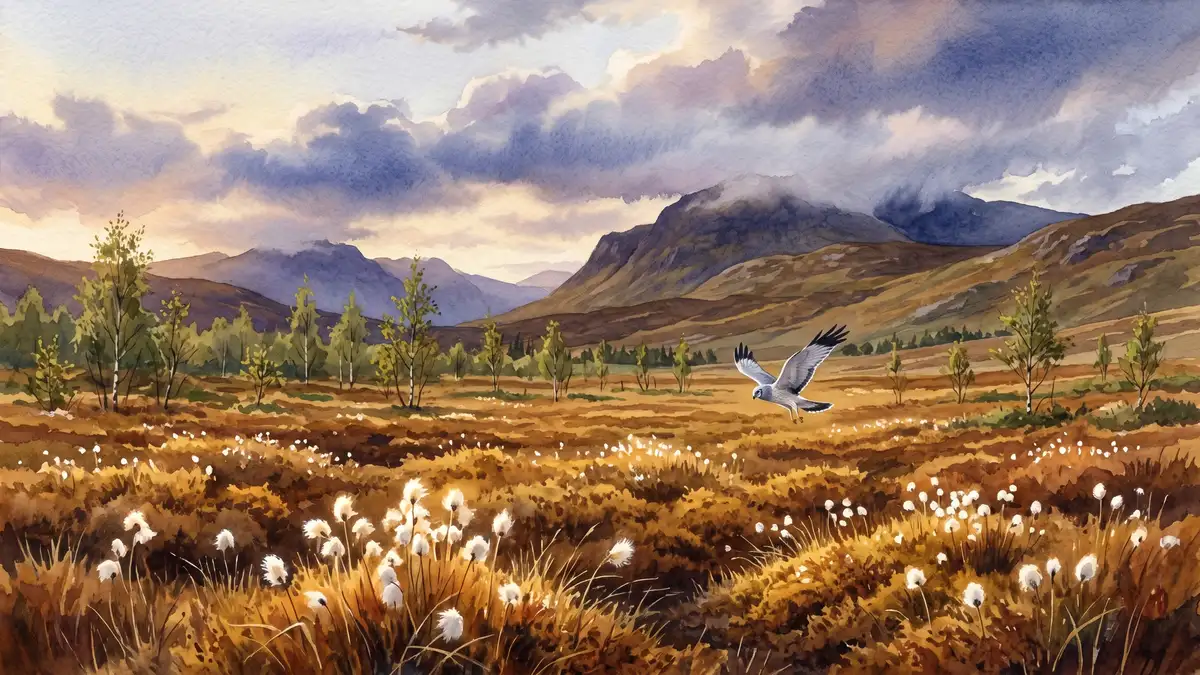
Trees for Life and partners have restored over 1,000 hectares of degraded peatland in the Affric Highlands, supported by the Scottish Government's £250 million Peatland ACTION fund and private financing from Wilderway, a nature and carbon credit company. Peatlands cover just three per cent of the earth's surface yet store over 30 per cent of all soil carbon — more than twice the amount held in the world's forests. Across Scotland, approximately 80 per cent of peatland has been degraded through historical drainage, extraction and overgrazing. Restoration involves blocking drainage channels, reprofiling exposed peat and transplanting sphagnum moss to rebuild functioning bog ecosystems that sequester carbon and improve water quality.
Beavers: The UK's Returning Ecosystem Engineers
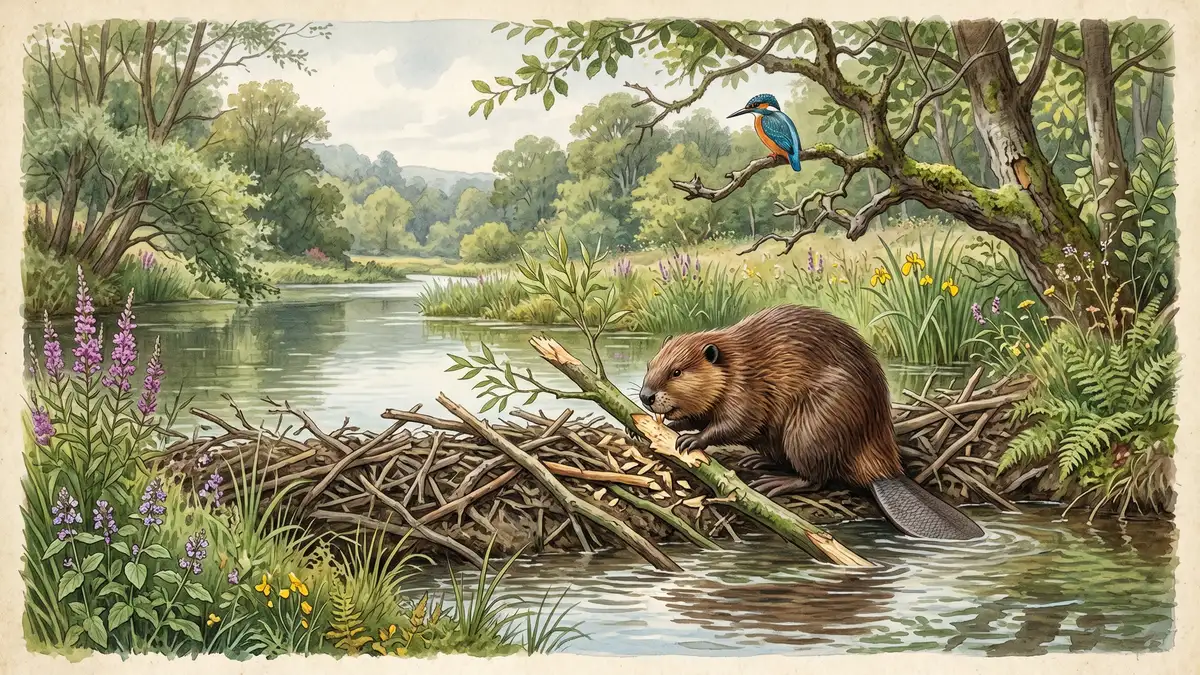
Beaver reintroduction represents one of the fastest-moving chapters in UK rewilding. Hunted to extinction by the sixteenth century, Castor fiber began its UK comeback with the Scottish Beaver Trial at Knapdale in 2009 — the first licensed release of a mammal into the wild in Britain. Over 1,500 beavers now inhabit Scottish waterways.
In February 2025, the UK government announced a landmark policy shift: beavers could be released into the wild in England, no longer restricted to fenced enclosures. The first licensed wild releases followed at the National Trust's Purbeck Estate in Dorset and the Holnicote Estate in Somerset, with Cornwall Wildlife Trust releasing beavers into the Par and Fowey river catchments. According to the Natural History Museum, approximately 100 beavers are planned for release across seven English river systems in 2026, with Natural England evaluating a further 21 projects covering major catchments including the Humber, Severn and Thames.
Water Quality
Research from the University of Stirling found that beaver dams can reduce peak water pollution levels by 95 per cent, functioning as natural kidneys that filter agricultural runoff and sediment from river systems.
Flood Management
Beaver dams impound water and release it slowly through leaky structures, increasing base flows during droughts and reducing peak flood surges — a form of natural flood management costing a fraction of engineered solutions.
Beaver reintroduction does generate management challenges, particularly around agricultural impacts and timber protection. The Natural England licensing framework requires applicants to demonstrate mitigation measures including tree guards, flow-regulating devices and translocation protocols for beavers causing unresolvable conflicts. Estimates suggest that a single beaver reintroduction site could eventually inject approximately £2 million annually into local economies through ecotourism.
Rewilding Beyond the UK
The UK sits within a global movement that has matured rapidly. The Global Rewilding Alliance, established in 2021, now coordinates nearly 300 organisations across six continents, collectively working across more than 2.2 million square kilometres of land and 5–6 million square kilometres of ocean — an aggregate area approaching the size of Australia.
| Project | Location | Scale | Key Focus |
|---|---|---|---|
| Oder Delta | Germany/Poland | Trans-boundary | Dam removal, peatland rewetting, bison and beaver recolonisation |
| Greater Côa Valley | Portugal | 120,000 ha | Wildlife corridor, nature-based economy with 70 local enterprises |
| Rhodope Mountains | Bulgaria | Landscape | European bison and vulture reintroduction, forest restoration |
| American Prairie | Montana, USA | 1.1M+ acres | Grassland reconnection, bison restoration, predator recovery |
| Affric Highlands | Scotland | 1,000+ ha peatland | Peatland restoration, wildcat and beaver reintroduction |
In 2025, Rewilding Europe released European bison and cinereous vultures in Bulgaria's Rhodope Mountains, Mediterranean trout in the Central Apennines, and European hamsters in the Danube Delta. Portugal's Greater Côa Valley has developed a 120,000-hectare wildlife corridor with the Wild Côa Network expanding to 70 member organisations supporting nature-based enterprises — demonstrating that rewilding can underpin viable rural economies, not just ecological recovery.
Species Comeback: Wildcats, Eagles and Beyond
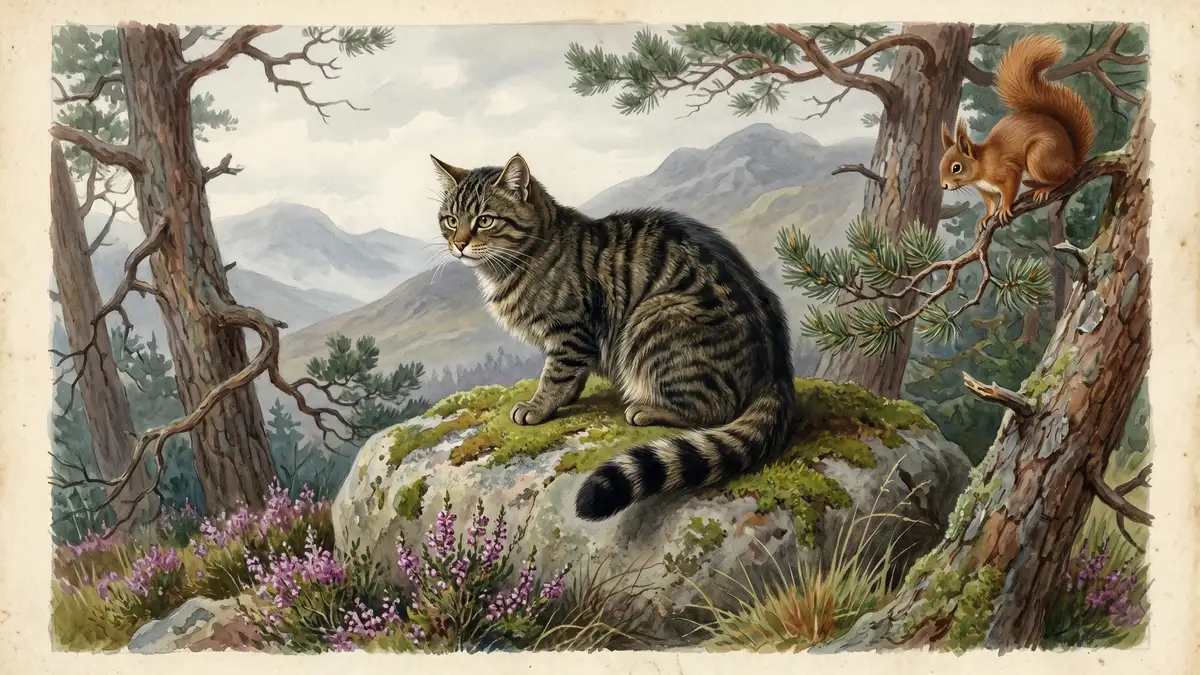
UK rewilding has delivered several notable species reintroduction successes beyond beavers. The Saving Wildcats initiative, supported by Rewilding Europe's European Wildlife Comeback Fund, has released over 35 Scottish wildcats into the Cairngorms National Park since 2023. Mortality rates have been far lower than expected — just four deaths among 35-plus released animals — and seven females bred successfully in 2024, with at least five more in 2025, establishing a self-sustaining population.
White-tailed eagles, reintroduced to Scotland from 1975 after persecution drove them to extinction, now number approximately 200 breeding pairs — a half-century recovery demonstrating that species can rebuild populations when persecution ceases. Scotland's pine marten population, estimated at 3,700 adults and expanding southward, further illustrates the quiet momentum of species recovery across British landscapes.
The Economics of Rewilding

Knepp Estate transformed the economic case for rewilding. Transitioning from a loss-making intensive farm to a diversified enterprise generating revenue from nature tourism, educational programming, holiday accommodation and estate events, it demonstrated that rewilding can deliver superior financial returns to commodity agriculture — at least on marginal land.
Ecotourism research supports this broader pattern. Eco-tourists typically spend 10–25 per cent more per trip than conventional tourists and stay longer, supporting locally owned businesses. A study of British Columbia's Great Bear Rainforest found that bear-viewing tourism generated 12 times more revenue than trophy hunting whilst supporting 510 jobs versus just 11. The Wildlife Trusts anticipate that beaver ecotourism alone could generate £2 million annually per reintroduction site as populations establish.
The Scaling Challenge
Knepp's economic model succeeded within particular institutional and market conditions — a large estate, proximity to London's visitor market, and a charismatic public narrative. Replicating this across diverse farm types, sizes and locations requires policy mechanisms that go far beyond individual enterprise.
Controversies and Challenges
Rewilding vs Food Security
The most persistent criticism of rewilding concerns food production. Academic research published in People and Nature found that many farmers associate rewilding with land abandonment, loss of productive fields and loss of control over land management. The concern is sharpened by equity: large estates and wealthy investors possess far greater capacity to purchase land and enrol in rewilding schemes than small family farms or tenants, creating what some commentators describe as a "green land grab" where conservation benefits accrue to already-privileged landowners.
The counter-argument emphasises that healthier ecosystems deliver carbon storage, reduced flooding and cleaner water — services that ultimately support more resilient food production. The more nuanced position acknowledges that rewilding should focus on marginal, less productive land whilst supporting existing farmers to transition towards nature-friendly systems that maintain food output alongside biodiversity recovery.
Large Predator Debate
Proposals for lynx and wolf reintroduction remain the most contentious dimension of UK rewilding. Ecological research suggests Scotland and England could sustain 256–400 lynx, well above the IUCN threshold of 250 for viable populations. Several organisations are developing reintroduction proposals with community consultation frameworks. However, safety concerns, impacts on sheep farming and questions about compatibility with settled landscapes mean that formal reintroduction remains politically distant — despite ecological feasibility.
Guerrilla Rewilding
In January 2025, at least four Eurasian lynx were illegally released into the Scottish Highlands by an individual unable to maintain them in captivity. All four were captured within 48 hours, but one died shortly after recapture. Similar unauthorised releases of wild boar have occurred in the Cairngorms and on Dartmoor. These incidents highlight the importance of formal reintroduction frameworks that ensure community consultation, welfare safeguards and ecological assessment — whilst also reflecting frustration among some advocates at the pace of official processes.
Policy and the Path to 30 Per Cent
The UK has committed to returning 30 per cent of land and sea to nature by 2030, aligning with the Kunming-Montreal Global Biodiversity Framework. According to Rewilding Britain's 2025 strategy, the current reality falls dramatically short: only six per cent of UK land is effectively managed for nature, with England at just three per cent and Wales at 2.4 per cent. Scotland leads at 12.6 per cent but still falls well short of the target. Active rewilding — land where natural processes are genuinely driving recovery — accounts for approximately one per cent.
Environmental Land Management
New subsidy schemes replacing the CAP to reward nature recovery and rewilding activities rather than production maximisation.
Local Nature Recovery Strategies
Mandated under the Environment Act 2021, these coordinate nature recovery planning across partnerships at landscape scale.
Biodiversity Net Gain
The mandatory 10 per cent net gain requirement integrates nature recovery into mainstream development, creating a market for habitat creation.
Defra and Natural England invested £7.4 million across three years in 12 landscape-scale Nature Recovery Projects covering over 319,480 hectares, recording 2,367 species and sequestering 250,000 tonnes of carbon. These projects now transition into Local Nature Recovery Strategies, creating an institutional framework for coordinating public funding, planning policy and private land management across ownership boundaries.
Frequently Asked Questions
What is the difference between rewilding and conservation?
Traditional conservation focuses on preserving existing ecosystems through ongoing management. Rewilding aims to restore self-sustaining ecosystems by reinstating natural processes — grazing, predation, flooding — so the landscape can regulate itself with minimal human intervention. Conservation maintains; rewilding rebuilds.
Does rewilding actually work in the UK?
Yes. Knepp Estate in West Sussex provides the strongest evidence: breeding bird populations increased 916 per cent since 2007, butterfly species richness rose 107 per cent, and dragonflies surged 871 per cent. Beaver reintroductions across Scotland and England demonstrate natural flood management and water quality benefits, and over 35 Scottish wildcats have been released in the Cairngorms with successful breeding.
How much UK land is being rewilded?
Approximately one per cent of UK land is actively being rewilded through natural processes, according to Rewilding Britain. Around six per cent is effectively managed for nature more broadly. The UK has committed to 30 per cent by 2030 under the Kunming-Montreal Global Biodiversity Framework, but current progress falls significantly short of this target.
Why are beavers being reintroduced to the UK?
Beavers are ecosystem engineers whose dam-building activities create wetland habitat, reduce downstream flooding, improve water quality by filtering up to 95 per cent of peak pollution levels, and increase drought resilience. They were native to Britain until hunted to extinction in the sixteenth century. The UK government permitted wild releases in England from February 2025, with approximately 100 beavers planned for release in 2026.
Will rewilding threaten UK food security?
This is the most debated question in UK rewilding. Proponents argue rewilding should focus on marginal, less productive land rather than prime agricultural areas, and that healthier ecosystems ultimately support more resilient food production through improved soil health, pollination and water management. Critics worry about cumulative loss of farmland and uneven impacts on smaller farmers versus large estates. Most experts advocate integrating nature-friendly farming with targeted rewilding rather than treating them as alternatives.
Could lynx or wolves be reintroduced to the UK?
Ecological research suggests that Scotland and England could support 256 to 400 lynx — above the IUCN threshold for viable populations. Several organisations are developing formal reintroduction proposals with community consultation frameworks. However, political feasibility remains distant due to safety concerns, impacts on sheep farming, and questions about compatibility with settled landscapes. No formal applications for licensed lynx or wolf release have been approved.
Further Reading
- Biodiversity and Conservation: The Complete Guide
- How to Protect Biodiversity: A Practical UK Guide
- Habitat Destruction: Drivers, Consequences and What Can Be Done
- UK Wildlife Decline: Trends, Data and What Is Driving the Crisis
- UK Endangered Species: A Complete Guide
- Biodiversity Net Gain: What It Is and Why It Matters
Sources: Knepp Estate Ecological Review 2026 · Natural History Museum · Rewilding Britain · Mongabay · Rewilding Europe · Natural England