Biodiversity Net Gain (BNG) is a legal requirement in England for most new developments to leave nature measurably better than they found it, by delivering a minimum 10% improvement in biodiversity compared to the site's baseline, secured for at least 30 years. Introduced under the Environment Act 2021, BNG became mandatory for major developments on 12 February 2024, for small sites on 2 April 2024, and for Nationally Significant Infrastructure Projects (NSIPs) in late November 2025. It makes the UK the first country in the world to require quantified net gain as a condition of planning permission — turning the planning system from an instrument that managed biodiversity loss into one that must actively deliver biodiversity recovery.
BNG rests on three pillars: a minimum 10% gain in biodiversity units over baseline; a 30-year legal commitment to management and monitoring; and a three-tier delivery hierarchy — on-site first, registered off-site provision second, statutory credits (currently £68 per unit) as a last resort. Gains are calculated using Defra's Statutory Biodiversity Metric. The system sits inside a wider framework of Local Nature Recovery Strategies, Environmental Land Management schemes, and the Environment Act's statutory target to halt species decline by 2030.
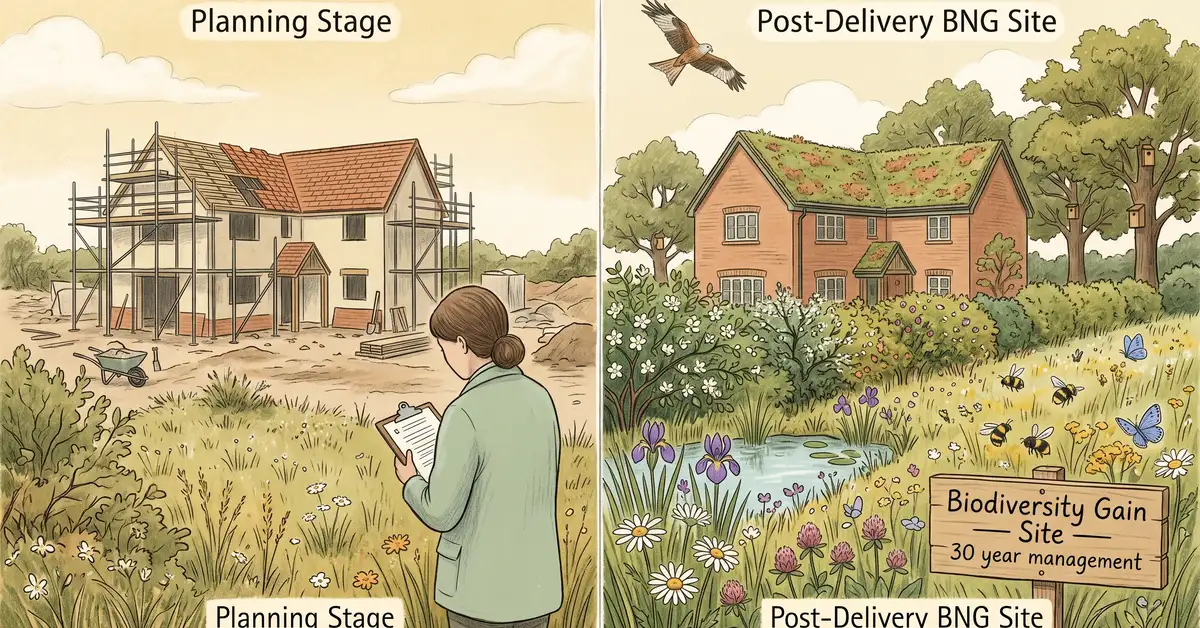
What is Biodiversity Net Gain?
Biodiversity Net Gain is a measurable improvement in the quality and/or quantity of biodiversity resulting from a development, calculated relative to a baseline ecological protected species survey requirements survey and quantified through the Statutory Biodiversity Metric. The Environment Act 2021 requires that planning permission for qualifying development in England is conditional on achieving a minimum 10% net gain in biodiversity, expressed in standardised "habitat units".
This is not an aspirational target. It is a legally enforceable planning condition, backed by a 30-year management covenant and monitored through planning enforcement powers. A scheme that does not achieve the 10% threshold cannot lawfully proceed without modification, off-site provision, or — as a last resort — the purchase of statutory biodiversity credits.
What BNG is — and what it is not
| What BNG is | What BNG is not |
|---|---|
| A mandatory 10% gain in biodiversity units over a pre-development baseline | A guarantee that specific species populations will recover |
| A planning condition with a 30-year management and monitoring obligation | A replacement for Environmental Impact Assessment or Habitats Regulations Assessment |
| Calculated using Defra's Statutory Biodiversity Metric (habitat distinctiveness × condition × strategic significance × area) | A substitute for avoiding biodiversity loss through good design |
| Delivered through a three-tier hierarchy: on-site, registered off-site, statutory credits | A voluntary corporate sustainability programme |
| A lever to direct conservation investment to where it is most strategic | A mechanism that permits unrestricted development |
Where BNG came from
BNG's policy lineage is short but consequential:
- 2019–2020 — The Environment Bill proposed a mandatory net gain target for English development.
- 19 November 2021 — The Environment Act 2021 was enacted, embedding the BNG requirement in sections 98–102 and inserting Schedule 7A into the Town and Country Planning Act 1990.
- 2022–2023 — Defra consulted on the metric, the exemptions, the credits regime, and transitional arrangements.
- 23 November 2023 — The Environment (Statutory Biodiversity Credits) Regulations 2023 (SI 2023/1465) set the initial credit price at £68 per habitat unit.
- 12 February 2024 — Mandatory BNG came into force for major development in England.
- 2 April 2024 — Small-site BNG came into force.
- Late November 2025 — BNG extended to Nationally Significant Infrastructure Projects (NSIPs).
That timeline made the UK the first country in the world to legally require quantified net gain as a condition of planning permission.
Why does BNG exist?
BNG exists because the planning system, as it stood before 2024, was not delivering for nature. The State of Nature Report and successive studies documented an average 69% decline in UK wildlife abundance since 1970. Development was a significant contributor alongside agricultural intensification. The pre-BNG planning system had a mitigation hierarchy — avoid, mitigate, compensate — but it stopped short of mandating net improvement. Ecological mitigation was routinely reduced or traded away late in the planning process, often with little post-consent monitoring.
BNG changes the default. The mitigation hierarchy now reads: avoid, mitigate, compensate, and then deliver measurable net gain. Its policy logic has four strands:
- Reversing decline — making each development a net positive contribution rather than a managed loss.
- Mainstreaming conservation — embedding biodiversity into planning decisions rather than treating it as a post-consent add-on.
- Market signalling — creating demand for registered habitat banks and incentivising landowners to deliver long-term conservation outcomes.
- Target alignment — feeding the Environment Act's statutory targets, including the duty to halt species decline by 2030 and to achieve a 25% species abundance recovery by 2042.
For the wider context of why this matters, see the causes of biodiversity loss and our complete guide to biodiversity and conservation.
The legal framework behind BNG
BNG is anchored in primary legislation and implemented through four statutory instruments.
Primary legislation
The Environment Act 2021 establishes BNG at sections 98–102:
- Section 98 — the general requirement: planning permission must be conditional on achieving 10% biodiversity net gain against baseline.
- Section 99 — exemptions: self-build, householder applications, urgent Crown development, and developments lasting less than ten years with full restoration.
- Section 100 — statutory biodiversity credits: empowers the Secretary of State to create a credits scheme for cases where net gain cannot be delivered on or off site.
- Section 101 — Local Nature Recovery Strategies: local authorities must prepare LNRSs to direct BNG delivery where it will cumulatively benefit biodiversity most.
- Section 102 — 30-year monitoring and enforcement, via planning conditions, Section 106 agreements, or conservation covenants.
The Environment Act also inserted a new Schedule 7A into the Town and Country Planning Act 1990. Schedule 7A specifies which development is "qualifying", requires a Biodiversity Gain Plan to be submitted and approved before development can begin, and sets the 30-year management horizon.
Secondary legislation
| Instrument | Reference | Date | Purpose |
|---|---|---|---|
| Environment (Statutory Biodiversity Credits) Regulations 2023 | SI 2023/1465 | 23 Nov 2023 | Set initial credit price at £68/unit; revenue hypothecated to nature recovery |
| Biodiversity Gain Requirements (Irreplaceable Habitat) Regulations 2024 | SI 2024/266 | Feb 2024 | Defines qualifying development; sets exemptions; specifies Biodiversity Gain Plan content |
| Biodiversity Gain (Town and Country Planning) (Modifications and Amendments) Regulations 2024 | SI 2024/267 | Feb 2024 | Amends TCPA 1990; clarifies small-sites metric; addresses transitional cases |
| Biodiversity Gain Site Register Regulations 2024 | SI 2024/45 | Feb 2024 | Establishes the public register of off-site biodiversity gain sites |
For the full breakdown of regulatory detail and the exemption regime, see our dedicated guide to BNG regulations and exemptions.
How does BNG work in practice?
Every qualifying development in England now goes through the same basic sequence: measure the site's pre-development biodiversity, plan the development to deliver at least a 10% improvement, secure that improvement for 30 years, and report against it for the duration.
The mitigation hierarchy (post-BNG)
BNG has extended — not replaced — the standard mitigation hierarchy. The sequence applied in every qualifying planning application is:
- Avoid — design out biodiversity loss by relocating development to already-developed or lower-value land.
- Mitigate — reduce loss through retention of mature trees, hedgerows, and priority habitats.
- Compensate — replace unavoidable losses with equivalent habitat elsewhere on site.
- Net gain — deliver a measurable 10% uplift above baseline, using on-site, off-site, or (as a last resort) credits.
Before BNG, steps 1–3 were discretionary; step 4 did not exist as a legal requirement. BNG makes step 4 a binding planning condition.
The three-tier delivery hierarchy
The Biodiversity Gain Plan must demonstrate how the 10% gain will be delivered, preferring higher tiers where possible:
- On-site biodiversity net gain — creating or enhancing habitats within the red-line boundary of the development. Preferred because it keeps nature connected to the place where the loss occurred.
- Off-site biodiversity net gain — delivered on land registered on the Biodiversity Gain Sites Register, secured via a Section 106 agreement, a conservation covenant, or equivalent legal mechanism. Can be on land the developer owns, or purchased as habitat units from a third-party provider (including habitat banks).
- Statutory biodiversity credits — purchased from the Secretary of State only where on-site and off-site delivery is genuinely unavailable. Priced at £68 per habitat unit (with higher-distinctiveness tiers), this is deliberately designed to be the least attractive option.
All three tiers carry the same 30-year management and monitoring commitment. A development cannot swap between tiers to dilute obligations; the Biodiversity Gain Plan must be agreed and monitored for the full term.
The Statutory Biodiversity Metric
BNG's 10% is not rhetorical — it is a calculation. The Defra Statutory Biodiversity Metric converts every habitat on the site (and every proposed habitat in the gain plan) into standardised habitat units, based on four factors:
- Habitat distinctiveness — a five-tier scale from Very Low to Very High (for example, rank grassland is Low; ancient woodland is Very High).
- Condition — Poor, Moderate, or Good, assessed against habitat-specific criteria.
- Strategic significance — a multiplier that rewards delivery in places identified in Local Nature Recovery Strategies or priority habitat networks.
- Area (or length, for hedgerows and watercourses) — the physical size of the habitat parcel.
The metric multiplies these four factors together, then applies time-to-target multipliers to account for how long habitats take to reach the proposed condition (a wildflower meadow can be created relatively quickly; ancient woodland cannot be recreated at all). A scheme's 10% uplift must be achieved after these multipliers are applied — making ambitious on-paper gains harder to claim than a simple area calculation would suggest.
For small sites (under 1 hectare and under 10 dwellings, or under 1,000 m² of non-residential floor space), Defra provides a Small Sites Metric (SSM) — a streamlined version with simplified inputs and reduced ecologist requirements, designed to keep compliance costs proportionate for smaller developers.
The metric also enforces trading rules: losses of high-distinctiveness habitat cannot be compensated with low-distinctiveness gains. Ancient woodland and other "irreplaceable" habitats are effectively off-limits to metric-based trading altogether.
BNG across the development lifecycle
A typical BNG-compliant development now proceeds through five stages:
- Pre-application baseline — a qualified ecologist carries out an ecological survey using the UK Habitat Classification system. The site's habitats are mapped and condition-assessed. Typical costs: £800–£2,000 for small sites, £4,000–£8,000 for medium schemes, £8,000–£15,000+ for major developments.
- Planning application — the applicant submits a Biodiversity Gain Plan alongside other planning documents, showing baseline units, post-development units, and the 10% uplift. This is scrutinised by the Local Planning Authority (LPA) ecologist or contracted expert.
- Decision and conditions — planning permission (when granted) carries a pre-commencement condition requiring the Biodiversity Gain Plan to be formally approved before any works begin. Off-site delivery is secured by conservation covenant or Section 106 agreement. Statutory credits are purchased before commencement.
- Delivery — on-site habitats are created or enhanced; off-site gain sites are registered and managed. Works are typically staged across construction and post-completion phases.
- 30-year monitoring — habitat condition is monitored to an agreed schedule (typically at years 2, 5, 10, 15, 20, 25 and 30). Failure to meet condition targets triggers remedial management, and ultimately planning enforcement.
This lifecycle reframes how development engages with nature. The ecological baseline is no longer an afterthought — it is the dataset that defines the scheme's legal obligation for a generation.
Key exemptions and transition rules
BNG applies to most development in England, but the Environment Act and subsequent regulations carve out a defined set of exemptions:
- Self-build and custom housebuilding — where an individual is building their own home.
- Householder applications — extensions, outbuildings, and minor works to an existing dwelling.
- De minimis impact — developments that will not disturb more than 25 m² of priority or non-priority habitat, and not more than 5 metres of linear habitat (hedgerow or watercourse).
- Biodiversity Gain Sites themselves — sites registered to deliver off-site BNG for other developments.
- Urgent Crown development — where the Secretary of State certifies urgency.
- Certain temporary and time-limited permissions — typically where the permission lasts less than ten years and includes full restoration obligations.
- Certain permitted development — where the General Permitted Development Order applies and BNG is not specifically imported.
Two transitional arrangements are also important. First, planning applications submitted before the relevant commencement date (12 February 2024 for majors, 2 April 2024 for small sites) can proceed under pre-BNG rules — meaning a substantial pipeline of consented development will remain outside BNG for years to come. Second, outline planning permissions granted before commencement are largely grandfathered, though reserved matters applications may still need to demonstrate compliance depending on how the permission was drafted.
The most recent threshold change was the extension to Nationally Significant Infrastructure Projects in late November 2025. NSIPs — including major energy, road, rail, and water schemes — now fall within BNG, closing a major carve-out that had generated policy concern about the scale of infrastructure exempted from net gain obligations.
For the full regulatory detail of what counts as "qualifying" development and how exemptions interact in practice, see our separate guide to BNG regulations and exemptions.
Statutory biodiversity credits
Statutory biodiversity credits are the tier of last resort in the BNG delivery hierarchy. They exist to guarantee that every qualifying development can achieve the 10% requirement, even if on-site and off-site options are genuinely exhausted — but they are deliberately priced, and procedurally restricted, to steer applicants toward real habitat creation wherever possible.
Key features of the credits regime:
- Issued by the Secretary of State, administered by Natural England.
- Priced at £68 per habitat unit for the initial tier under the Environment (Statutory Biodiversity Credits) Regulations 2023 (SI 2023/1465), with tiered premiums for higher-distinctiveness habitats. Pricing is under review and likely to change over time.
- Revenue is hypothecated — ring-fenced — for investment in habitat creation and nature recovery, not returned to general government income.
- Purchased before commencement of the relevant development, with evidence submitted to the LPA.
- Last-resort status — the LPA must be satisfied that on-site and off-site options have been genuinely exhausted before accepting a credits-based Biodiversity Gain Plan.
Policymakers have been explicit that credits are not intended to be commercially attractive. They function as a safety valve and a price signal; where a private off-site provider can deliver habitat units more cheaply (and with better ecological outcomes), the market is expected to clear through registered gain sites rather than through credits.
The Gain Sites Register and off-site market
The Biodiversity Gain Sites Register is the public register, maintained by Natural England under the Biodiversity Gain Site Register Regulations 2024, of all land formally registered to deliver off-site biodiversity gain. Registration is a landowner-led process. Each registered site is legally bound to a specific habitat creation or enhancement plan, secured through a conservation covenant or Section 106 agreement, and monitored to the 30-year horizon. Units generated on the site can then be sold to developers needing to discharge BNG obligations.
Around this register a new habitat market has emerged, comprising:
- Landowners — farmers, estates, and charities (including Wildlife Trusts and the National Trust) registering land for habitat creation.
- Habitat banks — aggregated sites with pre-approved habitat creation plans, selling units at scale.
- Brokers and unit-trading platforms — intermediaries connecting developers with registered gain sites.
- Conservation covenants — introduced by the Environment Act 2021 as a new legal instrument to bind land to long-term biodiversity outcomes without requiring a traditional Section 106 agreement.
- Responsible bodies — organisations approved by the Secretary of State to hold conservation covenants.
Market development has been uneven. Habitat banks have scaled rapidly in regions with strong demand and available land; in other regions, the supply–demand match remains imperfect, and some developers have struggled to find sufficient registered units locally. Ongoing policy questions include the spatial principle (how local is "local enough"?), pricing transparency, and quality assurance across gain sites.
Early experience and learning (2024–2026)
After two years of mandatory operation, early experience of BNG points to a mix of strengths and structural challenges.
What is working
- Cultural shift — biodiversity is no longer a marginal planning consideration. Developers, architects, and local authority ecologists now routinely engage with the Statutory Biodiversity Metric from the earliest design stages.
- Habitat market emergence — registered gain sites and habitat banks have scaled, creating a new category of income for farmers and landowners, and supporting landscape-scale restoration projects that would not otherwise have been commercially viable.
- LNRS integration — the requirement to consider Local Nature Recovery Strategies when calculating strategic-significance multipliers has given LNRSs more weight in development planning than many commentators anticipated.
- 30-year horizon — the explicit management term has shifted conversations about habitat creation from "tick-box" mitigation to long-term stewardship.
What is proving difficult
- LPA capacity — Local Planning Authority ecologist capacity remains a bottleneck in many areas, with reports of significant backlogs in Biodiversity Gain Plan approvals.
- Ecology consultant supply — surge in demand for baseline surveys has outpaced the supply of qualified ecologists in some regions, pushing up costs.
- Metric application variability — interpretation of habitat condition categories, strategic significance, and trading rules varies between LPAs, ecologists, and developers, producing inconsistent outcomes for similar sites.
- Ecological versus metric gain — CIEEM and conservation bodies have cautioned that a "metric-compliant 10%" is not the same as ecologically meaningful recovery. Some schemes deliver units through low-cost, low-value habitats (for example, standard amenity grassland to "modified grassland" of moderate condition) that may not translate into species-level benefit.
- Enforcement at year 5, 15, 25 — the credibility of the 30-year monitoring regime depends on LPAs actually pursuing non-compliance decades after consent. This capacity has not yet been fully tested.
- Small-site compliance — smaller developers, particularly individual housebuilders and small firms, face proportionately higher advisory costs. The Small Sites Metric helps, but compliance remains uneven.
These are not fatal flaws — they are implementation challenges common to every major new regulatory regime. But they are the issues likely to dominate BNG policy debate over the remainder of this decade.
BNG within the wider UK policy framework
BNG does not stand alone. It sits within a layered policy architecture that has emerged since 2021 and continues to develop through 2025–2026.
- Environment Act 2021 statutory targets — the overarching obligation to halt species decline by 2030 and deliver a 25% recovery in species abundance by 2042.
- Local Nature Recovery Strategies (LNRSs) — 48 LNRSs under development across England, identifying where habitat creation is strategically most valuable. LNRSs directly shape BNG calculations through strategic-significance multipliers.
- Environmental Land Management (ELM) schemes — the Sustainable Farming Incentive, Countryside Stewardship, and Landscape Recovery pay farmers for environmental outcomes. Landscape Recovery projects are a natural partner for off-site BNG delivery at scale.
- Nutrient Neutrality and Water Neutrality — separate planning regimes addressing water quality impacts, particularly in catchments of protected habitats. BNG operates alongside these, not in place of them.
- Species Conservation Strategies — Natural England-led strategies for species such as Great Crested Newts, designed to streamline licensing by directing mitigation to priority landscapes. BNG provides an additional layer of habitat-based protection.
- Kunming-Montreal Global Biodiversity Framework — the UK has committed to the framework's 2030 targets including protecting 30% of land and sea. BNG is one of the mechanisms through which the UK's contribution is delivered (see our full guide to biodiversity and conservation).
For readers working in planning or policy, the practical implication is that BNG must be read alongside these other regimes, not as a standalone obligation. A well-designed scheme can contribute simultaneously to BNG, nutrient neutrality, ELM scheme eligibility, and LNRS priorities — and the commercial and ecological returns are highest where these layers align.
Frequently asked questions
What does Biodiversity Net Gain mean in simple terms?
Biodiversity Net Gain (BNG) is a UK planning rule that requires most new developments in England to leave nature measurably better than they found it. Every qualifying development must deliver at least a 10% improvement in biodiversity, calculated using Defra's Statutory Biodiversity Metric and measured in habitat units, and must secure that improvement for 30 years through planning conditions or legal agreements.
When did BNG become mandatory?
BNG became mandatory for major development in England on 12 February 2024, for small sites on 2 April 2024, and for Nationally Significant Infrastructure Projects (NSIPs) in late November 2025. Planning applications validated before the relevant commencement date can proceed under pre-BNG rules.
Why is the BNG requirement 10% and not higher?
Ten per cent was set as a minimum in the Environment Act 2021 after consultation. The figure was designed to be high enough to generate real net improvement, but low enough to be deliverable at scale across the diverse landscape of English development. Many schemes voluntarily deliver more than 10% — particularly where Local Nature Recovery Strategies or planning authority policies raise expectations. Some commentators argue 10% is too low; others argue it should be seen as a floor above which market and policy competition can lift ambition.
What is the Statutory Biodiversity Metric?
The Statutory Biodiversity Metric is Defra's standardised calculation tool for BNG. It converts the habitats on a site into habitat units by multiplying four factors: habitat distinctiveness (a five-tier scale), condition (Poor, Moderate, Good), strategic significance (rewarding delivery in Local Nature Recovery Strategy priority areas), and area. Post-development habitats are calculated the same way, after time-to-target and difficulty multipliers are applied. The percentage change in units between baseline and post-development defines the scheme's BNG score. A Small Sites Metric is available for qualifying small developments.
Are there any exemptions from BNG?
Yes. Self-build and custom housebuilding, householder applications (extensions and outbuildings), urgent Crown development, certain temporary permissions, registered biodiversity gain sites themselves, and developments with de minimis impact (under 25 m² of habitat and under 5 m of linear features) are exempt. Some permitted development is also outside the regime. Transitional rules mean applications validated before commencement dates are grandfathered.
How much do statutory biodiversity credits cost?
Statutory biodiversity credits were initially priced at £68 per habitat unit under the Environment (Statutory Biodiversity Credits) Regulations 2023 (SI 2023/1465), with tiered premiums for higher-distinctiveness habitats. Pricing is under government review and may change. Credits are deliberately priced to be the least attractive option, reserved for cases where on-site and off-site delivery are genuinely not possible. Revenue is hypothecated to nature recovery.
Can I register my land as a Biodiversity Gain Site?
Yes. Landowners can register land on the public Biodiversity Gain Sites Register, administered by Natural England under the Biodiversity Gain Site Register Regulations 2024. The process requires a habitat enhancement plan, legal agreement securing the site for 30 years (through a Section 106 agreement or conservation covenant), and approval by the relevant authority. Once registered, habitat units generated can be sold to developers needing to discharge off-site BNG obligations. Many landowners work through habitat banks, conservation charities, or specialist brokers.
Conclusion: BNG as infrastructure for nature recovery
Biodiversity Net Gain is, in policy terms, a quiet revolution. It has moved English planning from a regime that managed biodiversity loss to one that legally requires biodiversity gain. Its 10% minimum, 30-year management horizon, and metric-based calculation have — for the first time — created a repeatable, enforceable, and fundable system for biodiversity recovery as a default condition of development. In two years of mandatory operation it has seeded a habitat market, integrated biodiversity into Local Nature Recovery Strategies, and shifted development culture in ways that will outlast the immediate rules.
It is not, on its own, enough. Metric compliance is not guaranteed ecological recovery. LPA capacity remains thin. A "10% gain" on a site whose baseline was already degraded is a different thing from the restoration of species and ecosystems. BNG is one instrument among several — alongside Environmental Land Management, Local Nature Recovery Strategies, and the Kunming-Montreal Global Biodiversity Framework — that together must deliver the UK's legal commitment to halt species decline by 2030 and recover nature by 2042.
For readers who want to go deeper, our companion resources cover the detailed regulatory architecture in BNG regulations and exemptions, the wider policy frame in biodiversity action plans and UK policy, and the scientific context in the causes of biodiversity loss and biodiversity and conservation. For the economic logic behind the credits system and habitat markets, see payments for ecosystem services.
The mark of BNG's success will not be counted in habitat units on a register — it will be counted, a generation from now, in whether England's wildlife is recovering. The tools are in place. The delivery is now the work of thousands of planners, developers, ecologists, landowners, and communities whose decisions, layered across millions of hectares and hundreds of thousands of consents, will shape the biodiversity of the next century.