
Biodiversity conservation is the active protection, management, and restoration of species, habitats, and ecosystems, combining in-situ protection (such as protected areas), ex-situ measures (like seed banks), species recovery programmes, policy frameworks, and community action to halt and reverse nature loss. In the UK, conservation matters acutely: the nation ranks amongst the most nature-depleted countries on Earth, yet targeted interventions — from a 916% rise in breeding birds at the rewilded Knepp Estate to the red kite's recovery from 30 pairs to roughly 10,000 individuals — prove that decline can be reversed when science, policy, funding, and community effort align.
The Dasgupta Review values global ecosystem services at £125–140 trillion per year — roughly 1.5× global GDP. Conservation is no longer a charitable aspiration; it is the protection of humanity's most valuable asset. But the decisive decade runs to 2030: the Kunming-Montreal Global Biodiversity Framework's 23 targets demand that 30% of land and sea is protected and degraded ecosystems actively restored. As of June 2025, only 26% of countries had even submitted their implementation plans. The next five years will determine whether today's policy ambition becomes tomorrow's measurable recovery.
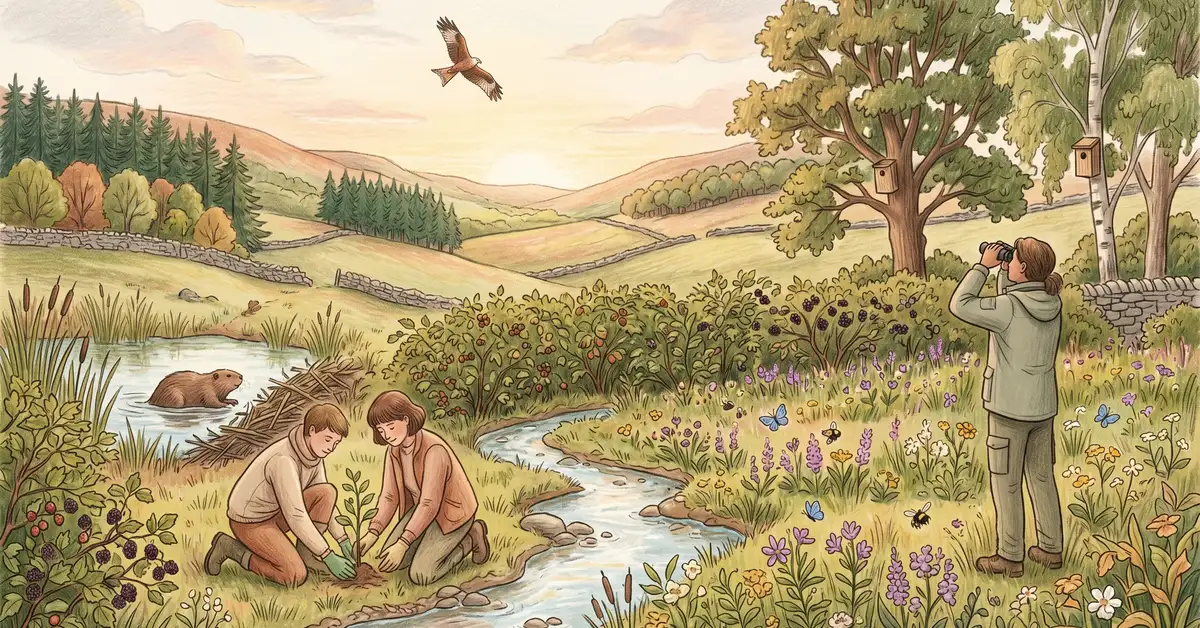
Why does biodiversity conservation matter?
Biodiversity conservation matters because nature underpins every economy, every food system, and every human culture on Earth — and because an estimated one million species now face extinction at rates faster than at any point in recorded history. The case for action rests on three reinforcing dimensions: the intrinsic value of nature, the ecological services it provides, and its unambiguous economic worth.
The intrinsic value argument holds that other species and ecosystems have inherent worth independent of human utility. The Society for Conservation Biology's foundational statement — that "there is intrinsic value in the natural diversity of organisms" — reflects a conviction shared across conservation science that preservation would be justified even absent economic returns. You do not need ethical absolutism to accept this; most people, asked whether a songbird, a bumblebee, or an ancient oak has worth beyond what it does for humans, instinctively answer yes.
The ecological argument rests on interdependence. Biodiversity is the engine that runs ecosystem services — pollination, water purification, flood regulation, carbon sequestration, nutrient cycling, pest control, soil formation. Approximately 75% of the world's food crops depend at least partly on animal pollinators, and higher species diversity typically delivers greater resilience in the face of disturbance, disease, or climate shocks. When biodiversity declines, systems do not fail gracefully: they tip, often suddenly, with consequences that cascade upwards into human wellbeing.
The economic valuation is where the most compelling modern case sits. The 2021 Dasgupta Review, commissioned by the UK Treasury, placed the annual value of ecosystem services at £125–140 trillion — approximately 1.5 times global GDP. By contrast, deforestation alone costs the world £2–5 trillion every year. Conservation investment delivers returns that dwarf almost any other category of public spending, yet it remains chronically underfunded relative to subsidies that damage nature.
Finally, there is urgency. The UK is one of the world's most nature-depleted countries, with a growing list of endangered species. A decade of observation at a single London park recorded hedgehog populations collapsing from an average of 28 individuals to just six. The window for halting and reversing loss is narrowing, and 2030 — the target date for most international commitments — is under four years away.
What does conservation actually mean?
In modern usage, conservation is the active protection, maintenance, and restoration of species, habitats, ecosystems, and the natural processes that sustain them. It differs importantly from simple preservation. Where preservation sets land aside in its current state and minimises intervention, conservation embraces ongoing management — culling invasive species, restoring degraded habitats, reintroducing lost wildlife, guiding succession, and integrating sustainable human use.
The International Union for Conservation of Nature (IUCN) defines a protected area as "a clearly defined geographical space, recognised, dedicated and managed, through legal or other effective means, to achieve the long term conservation of nature with associated ecosystem services and cultural values." Three ideas are embedded in that definition: conservation is not passive (it requires active management), it encompasses cultural and social values alongside ecology, and it can be delivered through many different legal and management mechanisms.
The Convention on Biological Diversity (CBD), signed in 1992 and now with 196 parties, frames conservation around three pillars: conservation of biological diversity, sustainable use of its components, and fair and equitable sharing of the benefits arising from the use of genetic resources. Crucially, the CBD recognises that conservation is not incompatible with human livelihoods — the goal is to ensure use is sustainable and benefits are shared.
Modern practice recognises several complementary modes:
- In-situ conservation — protecting species and processes in their natural ecosystems through protected areas, nature reserves, and landscape management.
- Ex-situ conservation — safeguarding species outside their natural habitats in seed banks, zoos, gene banks, and botanic gardens.
- Community-based conservation — grounding action in the priorities and stewardship of Indigenous Peoples and local communities.
- Landscape-scale conservation — working across mosaics of different land uses so that nature recovery happens outside as well as inside formal reserves.
- Other Effective area-based Conservation Measures (OECMs) — areas like certified forests, agroecological farms, or cultural sites that deliver conservation outcomes without being formally designated protected areas.
These approaches are not alternatives — they are layers. Conservation at a scale sufficient to halt loss requires them all, acting together.
What are the main approaches to biodiversity conservation?
Conservation in 2025–2026 operates across seven complementary approaches. Each has distinct evidence, advantages, and limitations, and each is essential to the overall effort.
1. In-situ protection: protected areas and marine reserves
Protected areas remain the foundation. Globally, 17.33% of terrestrial and inland water areas are now designated as protected areas or OECMs, with marine coverage expanding steadily. In England, the area of land and sea effectively protected grew by 170% between 2005 and 2025 — from 1.3 million to 3.5 million hectares. This comprises approximately 1 million hectares of terrestrial and freshwater sites (about 8% of England's land area) plus 2.4 million hectares of marine protected areas within the 12-nautical-mile limit (49% of inshore English waters).
The central policy commitment is the 30by30 target — protecting 30% of land and 30% of sea by 2030. The UK has endorsed this, and substantial marine designation has occurred. But designation alone is not enough. The "paper parks" problem — sites legally designated but functionally unmanaged — means that an area shown on a map may deliver little actual conservation benefit. Effective protected areas require sustained funding for monitoring, management, enforcement against damaging activity, and adaptive response to pressures like invasive species and climate change.
2. Ex-situ conservation: seed banks, zoos, and gene banks
Ex-situ measures provide insurance against extinction and a biological library for future restoration. The Millennium Seed Bank at Wakehurst, Kew's rural outpost, is the world's largest wild plant conservation programme. Since 2000 it has accumulated nearly 2.5 billion seeds from over 40,000 plant species through partnerships with 279 organisations in more than 100 countries. From 2020–2024, 71% of seed requests received were used actively — in research, restoration, and crop breeding — making the bank a living resource rather than a passive archive. This matters because Kew scientists estimate that 45% of all flowering plants globally are at risk of extinction.
Zoos and aquaria contribute through coordinated captive-breeding programmes for critically endangered species. Organisations like Chester Zoo and ZSL run breeding programmes linked to international studbooks, with the long-term aim of reintroducing animals to the wild when and where habitat conditions permit.
3. Habitat restoration and rewilding
Rewilding — restoring natural processes and letting ecosystems self-organise — has emerged as one of the most powerful responses to nature loss. Rewilding Britain's ambition is that at least 30% of Britain's land and sea by 2030 moves toward rewilding: self-sustaining forests, peatlands, rivers, saltmarshes, and seas supporting sustainable rural economies alongside biodiversity.
The Knepp Estate in West Sussex is the emblematic British case. A 20-year review completed in 2025 found a 916% increase in breeding bird numbers across the southern portion of the estate, with species richness more than doubling since 2007 — from 55 individuals of 22 species to 559 individuals of 51 species. Common whitethroats increased 2,200%, lesser whitethroats 1,000%, and the estate now hosts 62 singing male nightingales, accounting for around 1% of the UK population. Butterfly numbers rose 107% and dragonfly abundance rose 871%.
Cairngorms Connect, a 200-year vision covering roughly 600 km² across three conglomerate estates, demonstrates landscape-scale restoration. Centuries of predator removal allowed red deer populations to balloon from a sustainable 2.5 per km² to 10 per km² (up to 25 in some areas), preventing tree regeneration. Strategic deer management now allows woodlands, peatlands, and montane habitats to recover in the long arc.
4. Species recovery programmes
Where populations have crashed, targeted recovery programmes combine captive breeding, reintroduction, habitat management, and legal protection. The UK has produced some of conservation's most instructive success stories:
- Red kite: from around 30 pairs in the 1990s to approximately 10,000 individuals today, now classified as Green conservation status.
- Large blue butterfly: declared extinct in the UK in 1979, reintroduced from continental populations and now thriving in carefully managed grasslands thanks to Somerset Wildlife Trust, Butterfly Conservation, and partners.
- White-tailed eagle: absent from England since 1780, reintroduced to the Isle of Wight from 2019. The first wild-born English chick in over 240 years fledged in 2023; by August 2025, 45 birds had been released and pairs in Sussex and Dorset both bred successfully.
- Great Bustard: reintroduced to Salisbury Plain from 2004; around 50 birds now established and breeding every year since 2009.
- Pine marten: 13 individuals released into Cumbria in 2024 with further releases in 2025, supported by a European Wildlife Comeback Fund grant — a reintroduction that also benefits native red squirrels by suppressing non-native grey squirrels.
5. Ecosystem engineers: the beaver returns
The 2024 policy change permitting wild beaver release in England marked a historic shift. Beavers are ecosystem engineers — their dam-building transforms river hydrology, creates wetland habitat, improves water quality, and buffers against both floods and droughts. The National Trust has released groups at Holnicote in Somerset, the Cornwall Wildlife Trust has released pairs into the Par and Fowey catchments, and the Wildlife Trusts aim to release approximately 100 beavers into seven rivers across 2026. In Scotland, up to four families will be reintroduced at Glen Affric National Nature Reserve. Beavers illustrate a deeper principle: restoring species can restore processes, which restores habitats, which restores further species.
6. Policy and legal frameworks
Conservation science without enforceable policy achieves little. The UK's most significant recent instrument is the Environment Act 2021, which sets a statutory target to halt the decline of species populations by 2030 — a legal obligation, not merely an aspiration. Biodiversity Net Gain (BNG) became mandatory for most developments in England in February 2024, requiring a minimum 10% measurable improvement in biodiversity over the pre-development baseline, secured for 30 years. From late November 2025, BNG expanded to cover Nationally Significant Infrastructure Projects, broadening its scope to major road, rail, and energy schemes. For operational detail, see our full guide to BNG regulations and exemptions.
7. Community-based conservation
Conservation cannot succeed without the engagement of Indigenous Peoples and local communities, who steward many of Earth's most biodiverse landscapes. The ICCA Consortium's 2024–2028 Strategic Plan explicitly advances rights-based standards and ethical partnerships over tokenistic engagement. In 2024, the Consortium coordinated legal advances in Chile and Senegal and secured growing recognition of "territories of life" within CBD frameworks. The principle also applies domestically: Local Wildlife Trusts, Friends of groups, community nature reserves, and citizen-science recorders collectively deliver conservation at scales that state agencies cannot reach alone.
Which UK conservation projects are working?
The clearest argument for conservation is the evidence that it works. These UK case studies — each with measurable outcomes — show what is possible when science, funding, and community commitment align.
Knepp Estate, West Sussex: 916% more breeding birds in 20 years
Since 2000, the 3,500-acre Knepp Estate has shifted from conventional farming to rewilding, using free-ranging longhorn cattle, Tamworth pigs, Exmoor ponies, and fallow deer to replicate the disturbance patterns of lost wild herbivores. The 2025 20-year review documents extraordinary gains: breeding bird numbers up 916%, butterfly numbers up 107%, dragonfly and damselfly numbers up 871%, and the most significant UK nightingale and turtle-dove population boost on record. Knepp's significance is not just ecological — it is cultural. It has shifted the British conservation conversation from "protect what remains" to "restore what is possible."
Cairngorms Connect: a 200-year landscape-scale vision
Spanning approximately 600 km² across the Cairngorms, this partnership between Wildland Limited, Forestry and Land Scotland, RSPB Scotland, and NatureScot represents the longest-horizon conservation vision in the UK. The programme's explicit century-scale commitment reflects the reality that genuine landscape recovery — from commercial shooting estates to functioning forest and peatland mosaics — cannot happen in a five-year political cycle. Recovery indicators already include expanded woodland regeneration zones, peat restoration across thousands of hectares, and pine marten and capercaillie population stabilisation.
Red kite: from 30 pairs to 10,000 birds
The red kite reintroduction, beginning in 1989 with releases at sites across England and Scotland, is one of Europe's most celebrated recoveries. From populations of roughly 30 pairs concentrated in mid-Wales, red kites have spread across much of the UK with around 10,000 birds today. The programme required sustained decades of action: release of captive-bred birds, legal protection, public education reducing persecution, and ongoing monitoring of residual threats — particularly anticoagulant rodenticide poisoning, climate-driven drought, and road traffic accidents.
Large blue butterfly: extinction reversed
Declared extinct in the UK in 1979, the large blue was reintroduced from Swedish populations after scientific work by Jeremy Thomas revealed its obligate relationship with a specific red ant species (Myrmica sabuleti) whose abundance depends on precise grass sward heights. Carefully managed grasslands maintained by Somerset Wildlife Trust, Butterfly Conservation, and the National Trust now support thriving populations, with 2023 and 2024 recording some of the strongest flight seasons since reintroduction began.
White-tailed eagle: first wild breeding in England in 240+ years
Reintroduced to the Isle of Wight from 2019 by the Roy Dennis Wildlife Foundation in partnership with Forestry England, the white-tailed eagle is re-establishing a lost apex predator. The first wild-hatched chick in England since the 1780s fledged in 2023; pairs in Sussex and Dorset both bred in 2025. Forty-five birds had been released as of August 2025, with additional territories establishing. Beyond its ecological role, the project is reshaping public and landowner attitudes toward large predators.
Beaver reintroduction: 2024–2026 acceleration
Following the UK Government's 2024 policy change permitting wild beaver release in England, reintroduction has scaled rapidly. Alongside the National Trust's Holnicote releases and the Cornwall Wildlife Trust's Par and Fowey catchment releases, the Wildlife Trusts' coordinated 2026 programme aims to release approximately 100 beavers across seven rivers. Early outcomes include documented wetland creation, improved water quality, and evidence of natural flood management in pilot catchments.
Pine marten recovery in Cumbria
The South Cumbria Pine Marten Recovery Project — a partnership between the University of Cumbria, Forestry England, the University of Leeds, and regional Wildlife Trusts — released 13 pine martens in 2024 with further releases in 2025. Supported by a €50,000 grant from Rewilding Europe's European Wildlife Comeback Fund, the project has a double ecological logic: it restores a native predator whilst suppressing non-native grey squirrels, indirectly supporting the recovery of native red squirrels. It exemplifies how contemporary conservation increasingly operates through multi-institutional partnerships addressing ecological processes, not just individual species.
How can individuals and communities contribute?
Conservation is not the sole domain of ecologists and policy-makers. Individuals and communities generate measurable conservation outcomes through four main routes: direct habitat action, citizen science, consumer choices, and political engagement.
Garden-scale action
UK gardens collectively cover more land than all National Nature Reserves combined. Small choices, multiplied across millions of gardens, reshape landscape-scale biodiversity:
- Hedgehog highways — 13×13 cm holes in fences allow hedgehogs to traverse the fragmented gardens they need to find food, mates, and hibernation sites. With UK hedgehog numbers having fallen from around 1.5 million in 1995 to 522,000 in 2016 (and declining further since), this fix is genuinely population-relevant.
- Native and pollinator-friendly planting — hawthorn, hazel, honeysuckle, and open single-flowered varieties feed insects and birds; double-flowered cultivars and many imported ornamentals do not.
- Ponds and water features — even a small pond of 1 m² can support frogs, newts, dragonflies, and aquatic invertebrates.
- No-mow and meadow patches — reduced mowing (for example, Plantlife's "No Mow May") delivers dramatic gains in wildflower abundance and insect populations.
- Dark skies — switching off or shielding outdoor lighting protects moths, bats, and other nocturnal species disrupted by artificial light at night.
Citizen science
Tens of thousands of UK volunteers contribute biodiversity data through structured, high-quality schemes. The RSPB Big Garden Birdwatch, running every January since 1979, is the world's longest-running garden bird monitoring scheme. The Big Butterfly Count each July–August tracks butterfly populations. iRecord and iNaturalist let anyone record any species, with expert verification feeding national distribution maps. The BTO Garden BirdWatch, National Moth Recording Scheme, and FreshWater Watch (the UK's largest citizen-science water quality programme) each provide data that would be impossible to collect professionally. Participation is free and often trains volunteers in identification skills that last a lifetime.
Community conservation
Local Wildlife Trusts (46 across the UK) manage over 2,300 nature reserves and coordinate thousands of volunteers in practical habitat work: coppicing, scrub clearance, invasive species removal, meadow cutting, pond creation. "Friends of" groups manage parks and local green spaces. Community nature reserves bring neighbours together around shared stewardship. These organisations provide the connective tissue that turns national ambition into on-the-ground action.
Consumer choice and political engagement
Purchasing decisions shape land use at scale. Forest Stewardship Council (FSC) certification supports sustainably managed forests; peat-free compost reduces pressure on UK peatland ecosystems; Marine Stewardship Council (MSC) fish certification and reduced consumption of unsustainably fished species shift market signals. At the policy level, the Kunming-Montreal Global Biodiversity Framework explicitly recognises that achieving targets requires action from "all other actors" — not just governments. Voting, writing to MPs, supporting conservation NGOs, and responding to planning consultations all shape the policy environment that determines whether BNG, Environmental Land Management schemes, and 30by30 succeed.
What is the UK policy framework for 2025–2026?
The UK operates a layered conservation policy framework spanning statutory targets, financial incentives, and devolved administrations.
Environment Act 2021 and statutory targets
The Environment Act 2021 establishes legally binding targets, including the obligation to halt the decline of species populations by 2030. This is a legal duty, not a political preference — a change that in theory exposes government failure to meet targets to judicial review. Implementation runs through multiple instruments: BNG, Local Nature Recovery Strategies, Environmental Land Management (ELM) schemes, and sector-specific legislation on water, air, and waste.
Biodiversity Net Gain
Mandatory BNG requires most new developments in England to deliver a minimum 10% measurable improvement in biodiversity over pre-development conditions, secured through planning conditions or Section 106 agreements for at least 30 years. The biodiversity gain hierarchy prioritises on-site improvement, then registered off-site provision, with statutory credits only as a last resort. Off-site sites are recorded in a public register. From late November 2025, BNG extended to Nationally Significant Infrastructure Projects. For detail on what is and is not covered, see our full treatment of BNG regulations and exemptions.
Environmental Land Management (ELM) schemes
Post-Brexit, UK agricultural policy is shifting from area-based Basic Payment Scheme subsidies (being phased out by 2028) toward outcome-focused environmental payments. The three ELM schemes in England are:
- Sustainable Farming Incentive (SFI) — as of 1 October 2025, there were 44,500 active SFI agreements (25,200 in SFI23, 19,300 in the expanded offer). SFI pays farmers for practices including cover crops, no-till, hedgerow management, and integrated pest control. The scheme closed for new applications for most applicants in August 2025.
- Countryside Stewardship — mid-tier support for targeted habitat management such as species-rich grasslands, wetlands, and woodland edges.
- Landscape Recovery — supports large-scale, long-term habitat restoration. Two pilot rounds are supporting more than 50 projects testing market-based payments alongside public funding, including biodiversity credits (distinct from BNG), natural flood management, and water-quality offsets.
Defra allocated approximately £1.74 billion under Farm Support payments in FY 2024–25, with a commitment of £5 billion over two years for sustainable farming and nature recovery and over £2.7 billion per year secured for 2026–29. A £150 million Capital Grants scheme in August 2025 was fully allocated within five weeks — evidence of strong farmer demand for environmental funding.
Local Nature Recovery Strategies
Forty-eight Local Nature Recovery Strategies (LNRSs) are being developed across England, each identifying local priorities and where nature recovery investment is most needed and most likely to succeed. LNRSs translate national targets into place-specific strategies that coordinate landowners, councils, NGOs, and community groups. Scotland is implementing its Biodiversity Strategy to 2045; Wales operates under the Environment (Wales) Act 2016 with its independent environmental watchdog; Northern Ireland remains the devolved nation with the greatest conservation gaps — only 8.6% woodland cover compared with 19% in Scotland, 15% in Wales, and 11% in England.
What is not working — and why?
Honest conservation writing must acknowledge what is not working. The gap between policy ambition and ecological outcome remains large, and three structural failures recur.
The Aichi and 2020 UK target failures
The Aichi Targets, adopted under the CBD in 2010 for achievement by 2020, were universally missed — no single target was fully achieved globally. The UK failed to meet 14 of its 19 domestic 2020 targets. Biodiversity continued declining despite expanded protected areas and increasing conservation effort. Between 2019 and 2024, the distribution index of all species in England fell from 130% to 127% — a 3% decline even in recent years of intensified policy attention.
The Kunming-Montreal implementation gap
The Kunming-Montreal Global Biodiversity Framework set ambitious 2030 targets in December 2022. As of June 2025, only 26% of parties had submitted new national biodiversity strategies and action plans (NBSAPs); 85% missed the October 2024 deadline. More than half of the plans that have been submitted fail to commit to the flagship 30% territorial protection target. A former UK lead negotiator has stated publicly that the goal to halt and reverse biodiversity loss by 2030 is "close to slipping beyond reach" and "may have not been achievable when it was set in 2022." This is not a reason to abandon targets — ambition drives action — but it is a reason for honesty about the gap.
Paper parks and management effectiveness
Designation is not protection. "Paper parks" — sites legally designated but lacking effective management for five years or more — undermine the meaning of protected area coverage statistics. The Wildlife and Countryside Link's 30by30 progress analysis concludes that the UK is "an order of magnitude away" from meeting the target through well-managed, representative protected area networks. Marine protected areas particularly suffer from insufficient monitoring data, and land-based protected areas often lack the resources to control damaging activities, manage invasive species, or restore degraded habitats. Achieving 30 by 30 on paper will not halt biodiversity loss; only 30 by 30 in practice will.
Declines despite protection
Even the UK's most heavily protected ecosystems continue to decline. Much of this reflects drivers that operate outside protected area boundaries: agricultural intensification, pesticide use, development, climate change, and fragmentation. Protected areas cannot function as biodiversity islands in a degraded matrix. The implication is clear — conservation must be mainstreamed into all land uses, not confined to formally protected sites. The full suite of pressures is examined in our analysis of the causes of biodiversity loss.
How do global frameworks fit together?
UK conservation sits inside a set of interlocking international frameworks, each addressing a different slice of the overall challenge.
The Kunming-Montreal Global Biodiversity Framework (CBD COP15, December 2022) is the governance centrepiece. Its four 2050 goals and 23 specific 2030 targets cover protected areas, restoration, sustainable use, pollution reduction, harmful subsidies, climate-biodiversity integration, and equitable benefit-sharing. All 196 CBD parties, including the EU and UK, must submit progress reports by February 2026 for review at CBD COP17 in October 2026.
The EU Nature Restoration Law (NRL), adopted in 2024, is the world's first legally binding nature restoration requirement. Member states must submit National Restoration Plans by September 2027 setting measures to 2050. A 2026 mid-term assessment finds implementation underway in most member states, with restoration measures in agricultural, forest, marine, and freshwater systems. Progress remains uneven and short of what binding targets require — the law's significance lies in shifting the default from "protecting what remains" to "restoring what has been lost."
The High Seas Treaty (formally the BBNJ Agreement — Biodiversity of Areas Beyond National Jurisdiction) entered into force on 17 January 2026. It creates the first legal framework for protecting biodiversity across nearly half the planet's surface and is essential to the marine portion of 30by30, since significant ocean area lies beyond national jurisdiction. The treaty enables High Seas marine protected areas, mandates environmental impact assessments for activities in international waters, and establishes fair benefit-sharing from marine genetic resources.
Alongside these frameworks, natural capital accounting, biodiversity credits, eDNA monitoring, bioacoustic surveys, and AI-assisted camera-trap analysis are reshaping how conservation is financed, measured, and delivered. These technologies promise dramatic expansion of monitoring capacity — but they are tools, not solutions. They work only if coupled with the policy, funding, and community effort described above.
Frequently asked questions
What is the difference between biodiversity and conservation?
Biodiversity is the variety of life at genetic, species, and ecosystem levels. Conservation is the active human practice of protecting, managing, and restoring that biodiversity — through protected areas, species recovery programmes, habitat restoration, policy, and community action. In short: biodiversity is what exists in nature; conservation is what we do to keep and recover it.
Does biodiversity conservation work?
Yes — targeted conservation works when it is well-resourced and sustained. Documented UK successes include the red kite (30 pairs to around 10,000 individuals since 1989), the large blue butterfly (extinct in 1979, now thriving at managed sites), and the Knepp Estate (916% increase in breeding birds over 20 years). However, at landscape and global scales, current conservation effort remains insufficient to halt overall biodiversity decline, and most countries are behind on their 2030 Kunming-Montreal commitments.
What is 30by30?
30by30 is the commitment — adopted under the Kunming-Montreal Global Biodiversity Framework at CBD COP15 in December 2022 — to protect at least 30% of the world's land and 30% of its sea by 2030. The UK has endorsed the target and has made significant progress on marine designation (49% of inshore English waters now protected), but terrestrial progress is slower and concerns remain about whether designated areas are effectively managed.
What is the difference between conservation, preservation, and rewilding?
Preservation sets nature aside in its current state and minimises human intervention. Conservation actively manages species, habitats, and ecosystems — including restoration, reintroduction, and sustainable use — to achieve defined biodiversity outcomes. Rewilding is a form of conservation that emphasises restoring natural processes and self-sustaining ecosystems, often including the return of missing species such as beavers, white-tailed eagles, or pine martens. All three can coexist within a well-designed conservation landscape.
How can I help with biodiversity conservation in the UK?
Effective personal actions fall into four groups. First, make your garden wildlife-friendly: hedgehog highways, native plants, a small pond, no-mow patches, and reduced outdoor lighting. Second, participate in citizen science schemes such as the RSPB Big Garden Birdwatch, Big Butterfly Count, iRecord, iNaturalist, and FreshWater Watch. Third, support conservation charities — Wildlife Trusts, RSPB, Woodland Trust, WWT, Butterfly Conservation, Plantlife — through membership and volunteering. Fourth, engage politically: vote, respond to planning consultations, and write to your MP on biodiversity legislation.
What is Biodiversity Net Gain (BNG)?
BNG is a UK planning requirement — mandatory in England since February 2024 for most developments, and since November 2025 for Nationally Significant Infrastructure Projects — requiring new developments to deliver at least a 10% measurable improvement in biodiversity compared with pre-development conditions. Improvements must be secured for at least 30 years through planning conditions or legal agreements. The mitigation hierarchy prioritises on-site delivery, then registered off-site provision, with statutory credits as a last resort.
Conclusion: the decisive decade
Biodiversity conservation in 2026 stands at a pivotal moment. The evidence that conservation can work is overwhelming: red kites soaring across landscapes where they were almost lost, large blue butterflies recolonising grasslands fifty years after extinction, nightingales returning to a rewilded Sussex estate, beavers engineering wetlands again in Somerset and Cornwall. These are not sentimental successes — they are scientifically documented, replicable, scalable.
But the evidence of what is not yet working is equally clear: missed 2020 targets, slow Kunming-Montreal implementation, ongoing species declines, paper parks, and the persistent gap between legal designation and effective management. The decade to 2030 will determine which of these trajectories prevails. The tools exist. The frameworks exist. The economic case is unanswerable. What is needed is scale — policy scaled to the size of the crisis, funding scaled to the value of what is at stake, and community engagement scaled across every garden, farm, reserve, and vote.
For readers new to the topic, our foundation guide to why biodiversity matters explores the ethical, ecological, and economic case in depth. To understand what we are protecting nature from, see the causes of biodiversity loss. For climate-specific pressures, see climate change and biodiversity. And for how conservation turns into economic policy, see what are ecosystem services? and payments for ecosystem services.
Conservation is ultimately a collective act — a practical demonstration of care, repeated at every scale, from a hedgehog-friendly fence to a 200-year landscape vision. The biodiversity we still have is worth protecting. The biodiversity we have lost is worth restoring. And the biodiversity our children will inherit depends on the choices made now, in this decisive decade.


