Key Takeaway
Polar bears eat primarily ringed seals and bearded seals, relying on Arctic sea ice as a hunting platform. An adult polar bear needs roughly one seal every 10 days and can consume up to 45 kg of energy-dense blubber in a single feeding session. With Arctic sea ice declining at 12.2% per decade, polar bears face shrinking hunting windows that threaten their survival — terrestrial foods simply cannot replace the calories that seals provide.
What Do Polar Bears Eat?
Polar bears eat almost exclusively meat, making them the most carnivorous of all bear species. Their primary prey consists of ringed seals and bearded seals, which together make up the overwhelming majority of their diet across the entire Arctic range. Unlike brown bears or black bears, which supplement their diet with berries, roots, and insects, polar bears have evolved over hundreds of thousands of years as specialist marine predators whose survival depends on access to ice-dwelling seals.
When a polar bear catches a seal, it prioritises consuming the blubber — the thick layer of fat beneath the skin that can comprise 30–50% of a seal's total body mass. This blubber is extraordinarily energy-dense, providing the high-fat nutrition essential for surviving Arctic temperatures that regularly drop below minus 30°C. A single adult polar bear can consume approximately 45 kilograms of seal blubber in one feeding session, according to the Association of Arctic Expedition Cruise Operators. On average, an adult needs roughly one ringed seal every 10 days to meet its caloric requirements, though this varies with the bear's size, sex, and activity level.
Bearded seals represent a higher-value prize, weighing 200–400 kg compared to the ringed seal's modest size. A single bearded seal provides caloric returns equivalent to several ringed seals, though these larger animals are considerably harder to catch. Research from Svalbard shows that bearded seals become increasingly important in polar bear diets during summer months when retreating sea ice reduces access to ringed seal hunting grounds.
How Do Polar Bears Hunt Their Prey?
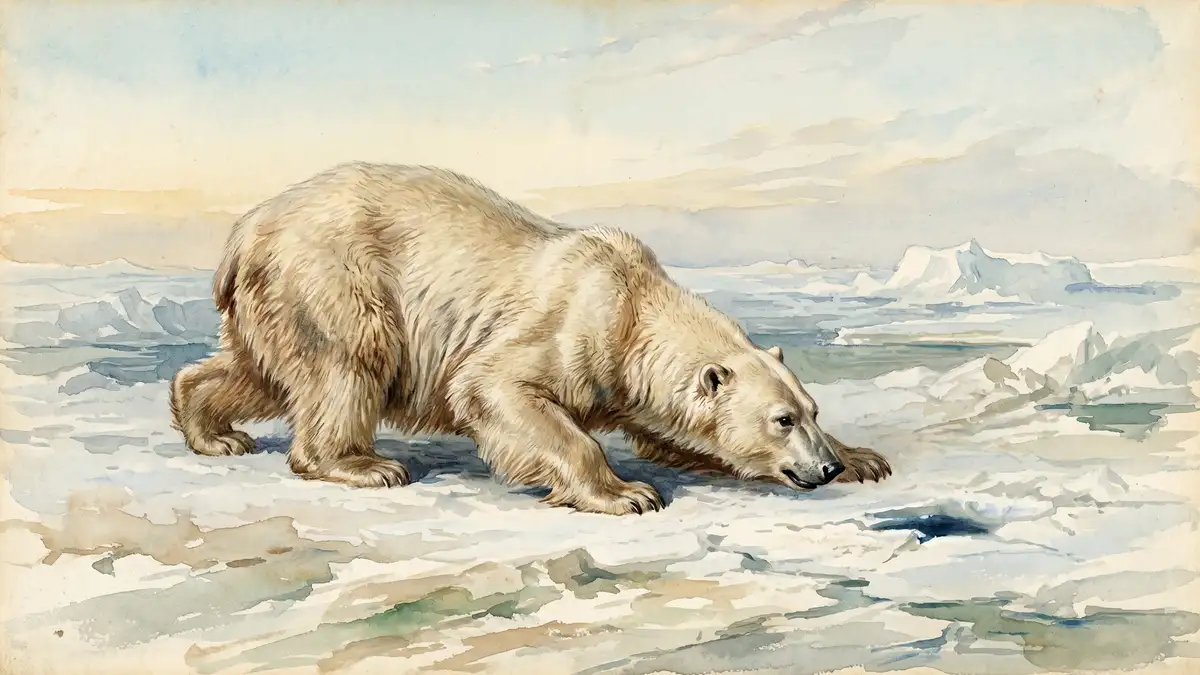
Polar bears use several hunting techniques, each adapted to different ice conditions and prey behaviour. The most iconic method is still-hunting at seal breathing holes — ringed seals maintain multiple openings in the ice where they surface for air, and polar bears can detect these holes using their extraordinary sense of smell from distances up to one kilometre. Once positioned, the bear waits motionlessly, sometimes lying flat on its belly to minimise detection. Documented cases show bears remaining motionless for 12–20 hours at a single breathing hole, demonstrating patience that few predators can match.
Stalking involves approaching seals resting on the ice surface. The bear crawls across the ice, staying low to reduce its profile, then charges from close range. This technique requires considerable stealth since hauled-out seals are highly vigilant and will slip back into the water at the first sign of danger. Aquatic stalking has been documented with increasing frequency in recent research — bears swim stealthily through open water or dive beneath ice edges to approach seals from below. Polar bears swim at approximately 2 km per hour and are capable divers, making them effective underwater hunters.
A 2025 study from Svalbard found that spring represents the pivotal hunting season, with fast ice providing maximum accessibility for all three techniques — breathing hole hunting, stalking, and aquatic stalking. As temperatures rise and ice breaks up, the available hunting area shrinks dramatically, forcing bears to compress their feeding into progressively shorter windows.
Why Is Spring the Most Critical Feeding Season?
Spring is when polar bears accumulate the vast majority of their annual energy reserves. Research published in PMC documenting Svalbard polar bear feeding patterns found that bears can acquire approximately 70% of their annual caloric intake during just a few months of intensive spring and early summer hunting. This extraordinary concentration of feeding reflects the seasonal pulse of seal pup availability — ringed seals give birth in early April, producing pups weighing roughly five kilograms that rapidly grow to over 20 kg within a month.
These vulnerable young seals, born in snow lairs on the ice surface, provide relatively easy prey for experienced bears. The combination of seal abundance and pup vulnerability creates what researchers call a "high payoff feeding window" — a brief period when hunting success rates peak and bears can build the fat reserves they need to survive months of leaner conditions. Understanding this seasonal pattern is essential for appreciating why climate change poses such a fundamental threat: even modest shifts in ice timing can disrupt this critical feeding window.
70%
Annual energy gained in spring/summer hunting window
45 kg
Blubber consumed in a single feeding session
12.2%
Arctic September sea ice decline per decade (1981–2010 baseline)
How Is Climate Change Affecting What Polar Bears Eat?
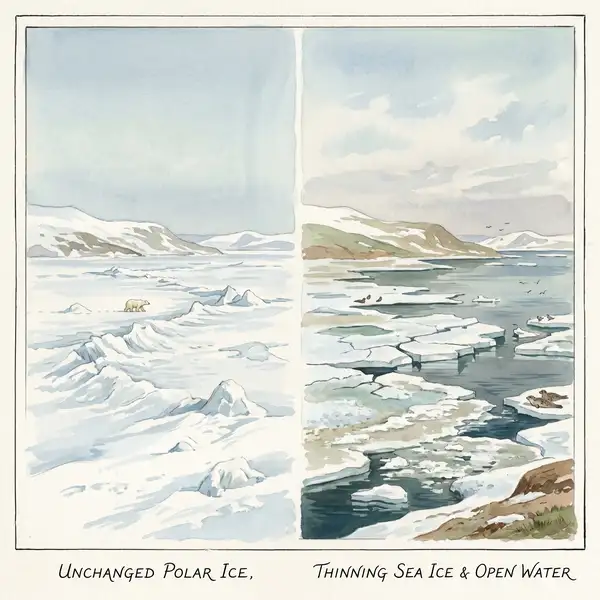
Arctic sea ice — the platform polar bears depend on for hunting — is disappearing at an alarming rate. Satellite monitoring shows that Arctic sea ice area has decreased by approximately 31,000 km² annually during winter and 71,000 km² annually during summer over the period 1979–2025, according to the European Environment Agency. September sea ice — the annual minimum — is shrinking at 12.2% per decade compared to the 1981–2010 average, as confirmed by NASA. The most recent measurement from March 2026 recorded Arctic sea ice extent at 14.29 million km², closely tracking the record low set in 2025.
As ice forms later in autumn and breaks up earlier in spring, the hunting window narrows. Polar bears forced onto land during extended ice-free periods lose approximately one kilogram of fat per day while fasting, according to Polar Bears International. In Western Hudson Bay, ice formation now occurs roughly 7–10 days later than in the 1980s, adding approximately two additional weeks of ice-free conditions annually. This seemingly modest timing shift creates substantial caloric deficits that directly affect survival and reproduction.
The ice is also becoming younger and thinner. In the late 1970s, approximately 60% of Arctic sea ice was at least one year old and relatively thick. Today, that figure has dropped to around 35%. Younger ice is more susceptible to early breakup, further compressing the period during which bears can effectively hunt. These changes cascade through the entire Arctic food web, affecting not just polar bears but every species that depends on sea ice habitats.
Can Polar Bears Survive on Land-Based Foods?
As ice-free periods lengthen, polar bears increasingly consume terrestrial foods including berries, grasses, kelp, bird eggs, and occasionally terrestrial mammals such as reindeer. Observations of these dietary shifts have increased substantially in recent decades, leading some to wonder whether bears might adapt to a more varied diet. The short answer, supported by comprehensive research, is no — terrestrial foods cannot nutritionally replace a seal-based diet.
Polar Bears International's analysis found that reindeer provide half or less of the energy found in seals per kilogram of body mass, primarily because reindeer carry substantially less body fat. Bird eggs, while calorie-dense individually, simply do not exist in sufficient abundance to sustain polar bear populations. The fundamental energy economics are stark: seal blubber delivers concentrated fat calories that no readily available terrestrial food can match, making the distinction between marine and land-based diets one of survival versus gradual starvation.
| Food Source | Energy Value | Availability | Population Viability |
|---|---|---|---|
| Ringed Seals | Very high (blubber 30–50% body mass) | Sea ice dependent | Primary food — sustains populations |
| Bearded Seals | Very high (200–400 kg per animal) | Lower abundance, harder to catch | Important supplement in some regions |
| Reindeer/Caribou | Moderate (≤50% of seal energy/kg) | Seasonal, land-based | Cannot sustain populations |
| Bird Eggs/Berries | Low to moderate | Seasonal, limited quantities | Supplementary only |
Why Adaptation to Terrestrial Food Won't Work
Some commentators suggest polar bears will simply "adapt" to eating land-based foods as sea ice disappears. Research comprehensively contradicts this. Polar bears that spend summer on land lose roughly 1 kg of fat daily while fasting. The calories available from berries, eggs, and kelp are insufficient to offset this loss at a population level. As Polar Bears International notes, land-based foods "cannot preserve current polar bear distribution and population numbers."
How Many Polar Bears Are Left in the Wild?
The IUCN Polar Bear Specialist Group estimates the global polar bear population at approximately 23,315 individuals, with a confidence range of 15,972 to 31,212. This figure, updated in 2019, covers 20 recognised subpopulations across the Arctic. Of these, four are in documented decline, two are increasing, five are stable, and eight lack sufficient data for reliable assessment.
The Western Hudson Bay population illustrates the trajectory most concerning to scientists. A 2021 aerial survey counted approximately 618 bears — a 27% decline from 849 in 2016 and roughly half the estimated 1,200 bears recorded in the 1980s. Pregnancy rates in this population have declined 12% from 1991 to 2021, with year-to-year variation now swinging between 50% and 100%, according to research documented by Polar Bears International.
Polar bears are classified as Vulnerable to Extinction on the IUCN Red List — a status they have held for over 30 years. The international commercial hunting ban implemented in the 1970s allowed populations to recover from severe depletion, transforming the species from an estimated 5,000 individuals to today's levels. However, climate-driven sea ice loss now represents a threat that hunting restrictions alone cannot address, because it erodes the habitat polar bears need to feed.
How Do Polar Bear Cubs Learn to Hunt?
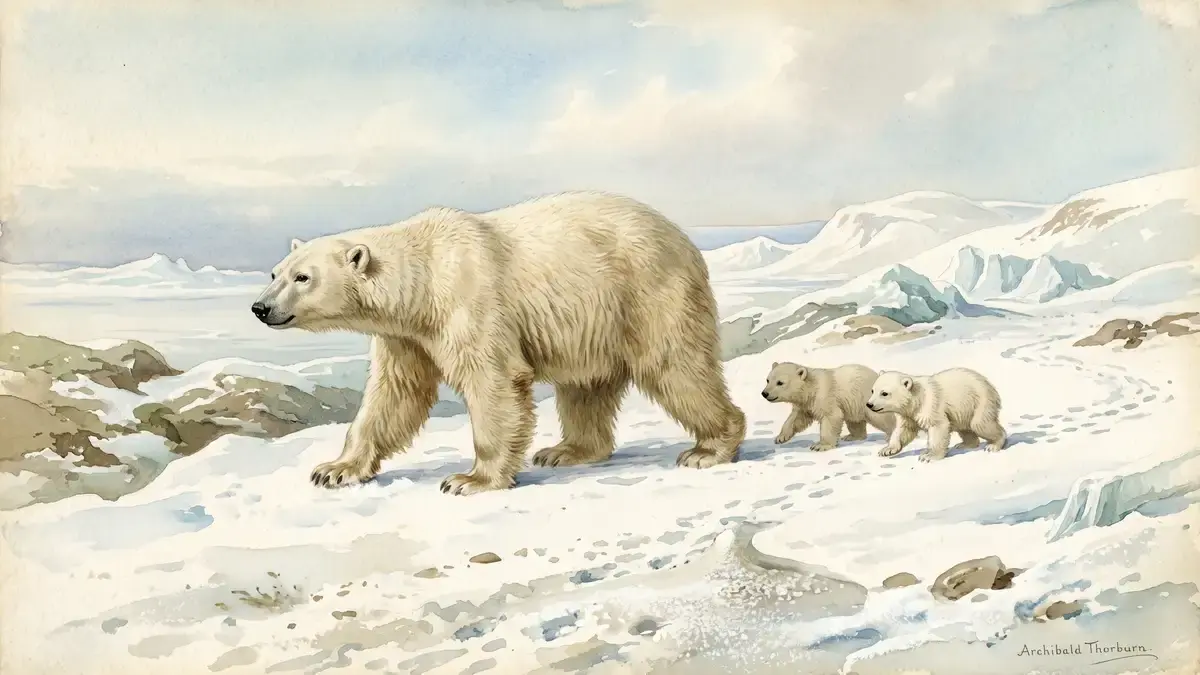
Young polar bears are not born knowing how to catch seals. Cubs remain with their mother for approximately 2.5 years, during which they learn hunting, swimming, and navigation through direct observation and imitation. Mothers lead cubs to productive hunting areas, demonstrate prey detection at breathing holes, and provide opportunities for practice on both live and dead prey. This extended learning period reflects the genuine complexity of Arctic predation — success requires understanding seal behaviour, reading ice conditions, and mastering techniques that take years to refine.
Young bears typically achieve lower hunting success rates than experienced adults, with proficiency improving progressively with age. The transmission of hunting knowledge from mother to cub becomes particularly critical as sea ice conditions shift, potentially requiring bears to adapt techniques suited to changing environments. This maternal teaching represents an important dimension of biodiversity — the behavioural diversity within a species that enables adaptation to environmental change.
Where Can You See Polar Bears in the UK?
The United Kingdom maintains two primary facilities housing polar bears, both contributing to conservation education and Arctic awareness. Highland Wildlife Park near Aviemore in the Scottish Highlands is home to two male bears, Arktos and Walker, who settled into a specially designed habitat in 2025. The park implements comprehensive enrichment programmes including varied food presentation, environmental complexity, and swimming opportunities that support natural behaviours. Yorkshire Wildlife Park in Doncaster similarly maintains polar bear exhibits focused on educational outreach.
UK-based organisations including WWF-UK and Polar Bears International run programmes supporting Arctic research, habitat protection, and climate advocacy. British universities and the British Antarctic Survey maintain long-term Arctic research programmes, contributing crucial data on sea ice dynamics and wildlife responses. The UK's connection to polar bear conservation extends beyond zoos — as a major economy, the country's climate commitments directly influence the future of Arctic sea ice and the species that depend on it.
Highland Wildlife Park
Located near Aviemore in the Scottish Highlands, home to polar bears Arktos and Walker. Part of the Royal Zoological Society of Scotland, the park focuses on conservation breeding, research, and public education about Arctic species and the threats they face from climate change.
Yorkshire Wildlife Park
Based in Doncaster, South Yorkshire, the park houses polar bears in spacious habitats designed to promote natural behaviours. The facility runs educational programmes raising awareness of Arctic conservation challenges and supports international wildlife protection initiatives.
Explore Arctic and Climate Science
Polar bears are just one species feeling the effects of a changing climate. Discover how rising temperatures, habitat loss, and shifting ecosystems affect wildlife across the UK and beyond.
Read Our Climate Change GuideFrequently Asked Questions
What is a polar bear's favourite food?
Ringed seals are the primary prey of polar bears across their entire Arctic range. Specifically, polar bears prefer to eat the blubber — the thick fat layer that can make up 30–50% of a seal's body mass. This energy-dense fat provides the concentrated calories polar bears need to survive in extreme cold. Bearded seals are also highly valued, particularly by larger adult males.
How often do polar bears need to eat?
An adult polar bear needs approximately one ringed seal every 10 days on average to meet its caloric requirements. However, polar bears do not eat at steady intervals — they accumulate roughly 70% of their annual energy intake during intensive spring and early summer hunting, then may fast for months during ice-free periods when seals are inaccessible.
Do polar bears eat fish?
Polar bears occasionally eat fish, but fish are not a significant part of their diet. Unlike brown bears that specialise in catching salmon, polar bears are adapted to hunting seals on sea ice. Fish provide considerably less energy per kilogram than seal blubber and are harder for polar bears to catch efficiently in Arctic waters. Some bears consume Arctic char when other food sources are scarce.
Why can't polar bears just eat other foods instead of seals?
The energy density gap between seal blubber and alternative foods is too large. Reindeer provide half or less of the energy per kilogram compared to seals, and bird eggs exist in insufficient quantities for population-level nutrition. A polar bear fasting on land loses approximately 1 kg of fat per day — land-based foods simply cannot provide enough calories to offset this loss across an entire population.
How many polar bears are left in the world?
The IUCN Polar Bear Specialist Group estimates approximately 23,315 polar bears globally as of 2019, spread across 20 subpopulations. Four subpopulations are in documented decline, including the well-studied Western Hudson Bay population, which fell 27% between 2016 and 2021. The species is classified as Vulnerable to Extinction on the IUCN Red List.
Where can I see polar bears in the UK?
The UK has two main facilities housing polar bears: Highland Wildlife Park near Aviemore in Scotland (home to Arktos and Walker) and Yorkshire Wildlife Park in Doncaster. Both facilities focus on conservation education and provide enrichment programmes that support natural polar bear behaviours including swimming, foraging, and exploration.
Discover More Wildlife Guides
From Arctic predators to UK butterflies, explore our growing library of evidence-based wildlife and conservation resources.
Browse All GuidesClwyd Probert
Founder of Pixcellence, a conservation and biodiversity resource celebrating wildlife through photography and education. Passionate about making complex environmental science accessible to everyone.
Sources: WWF — Polar Bear | Polar Bears International | NASA — Arctic Sea Ice | European Environment Agency — Sea Ice Indicators | PMC — Svalbard Polar Bear Body Condition