What Does Defining Biodiversity Actually Mean?
Defining biodiversity means establishing a precise scientific and legal framework for describing all the variety of life on Earth — from genes within a single population to entire ecosystems spanning continents. The term itself is relatively young, coined only in 1985, yet the concept it captures underpins virtually every modern conservation policy, planning decision, and ecological assessment in the United Kingdom and beyond.
Getting the definition right matters enormously. When the UK government mandated Biodiversity Net Gain under the Environment Act 2021, developers needed a measurable standard — and that standard depends directly on how biodiversity is formally defined. A vague definition produces vague targets. A rigorous one enables accountability.
This guide traces how the term was created, what the internationally agreed definition actually says, how biodiversity operates across three interconnected levels, how scientists measure it, and why these definitions shape real-world outcomes for UK ecosystems and habitats.
Key Takeaway
Biodiversity is not simply a count of species. The internationally agreed definition encompasses genetic variation within species, the variety of species within ecosystems, and the diversity of ecosystems themselves. Understanding all three levels is essential for effective conservation policy — including the UK's mandatory Biodiversity Net Gain requirement.
Where Did the Term Biodiversity Come From?
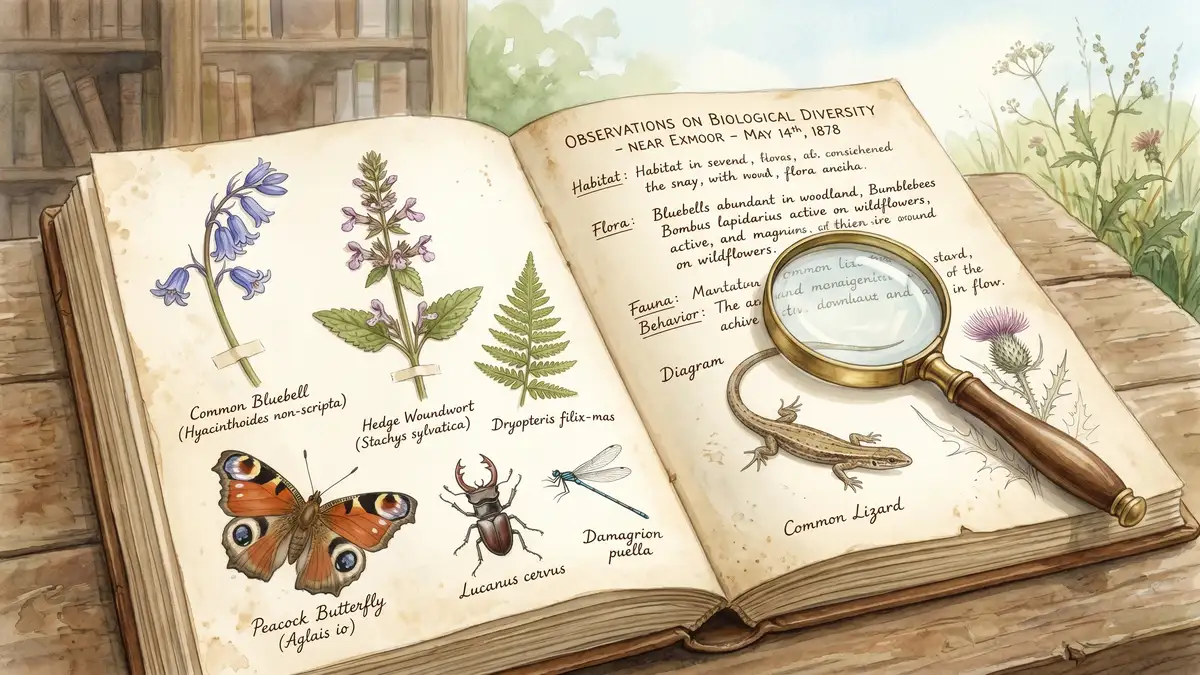
The word "biodiversity" was coined by American entomologist Walter G. Rosen in 1985 while organising a major scientific conference. Rosen contracted the phrase "biological diversity" into a single, more memorable term during planning discussions for the National Forum on BioDiversity, held in Washington, D.C. in September 1986.
Before Rosen's coinage, scientists used "biological diversity" or simply "species richness" — terms that failed to capture the full scope of life's variation. The 1986 Forum, organised by the National Academy of Sciences and the Smithsonian Institution, brought together ecologists, economists, policymakers, and development specialists. The proceedings, edited by E.O. Wilson and published in 1988 as Biodiversity, became one of the most widely cited scientific publications of the late twentieth century.
What made the term revolutionary was its breadth. Unlike "species richness," which counts only the number of different species, biodiversity explicitly includes variation at every biological scale — from the genetic sequences within a single hedgehog population in Shropshire to the mosaic of woodlands, heathlands, and wetlands across the British landscape. This conceptual shift changed how governments, landowners, and conservation organisations approached protection of the natural world.
What Is the Official International Definition of Biodiversity?
The most widely accepted formal definition comes from the Convention on Biological Diversity (CBD), adopted at the 1992 Earth Summit in Rio de Janeiro. Article 2 defines biodiversity as:
"The variability among living organisms from all sources including, inter alia, terrestrial, marine and other aquatic ecosystems and the ecological complexes of which they are part; this includes diversity within species, between species and of ecosystems."
— Convention on Biological Diversity, Article 2 (1992)
This definition has been ratified by 196 nations, making it the foundation for international conservation law and national legislation worldwide. The UK, as a signatory to the CBD, incorporates this definition into domestic policy — including the Environment Act 2021, the biodiversity targets set under the Kunming-Montreal Global Biodiversity Framework, and the statutory Biodiversity Net Gain metric.
Several aspects of the CBD definition are worth noting. First, it centres on variability — not just the number of species, but the differences between and within them. Second, it explicitly spans all ecosystems: terrestrial, marine, freshwater, and the "ecological complexes" that connect them. Third, it formally recognises three nested levels of organisation: within-species (genetic), between-species, and ecosystem-level diversity.
1985
Term Coined
Walter G. Rosen contracts "biological diversity"
1992
CBD Adopted
196 nations ratify the formal definition
2024
BNG Mandatory
UK requires 10% biodiversity uplift for developments
Sources: Convention on Biological Diversity 1992, Environment Act 2021
What Are the Three Levels of Biodiversity?
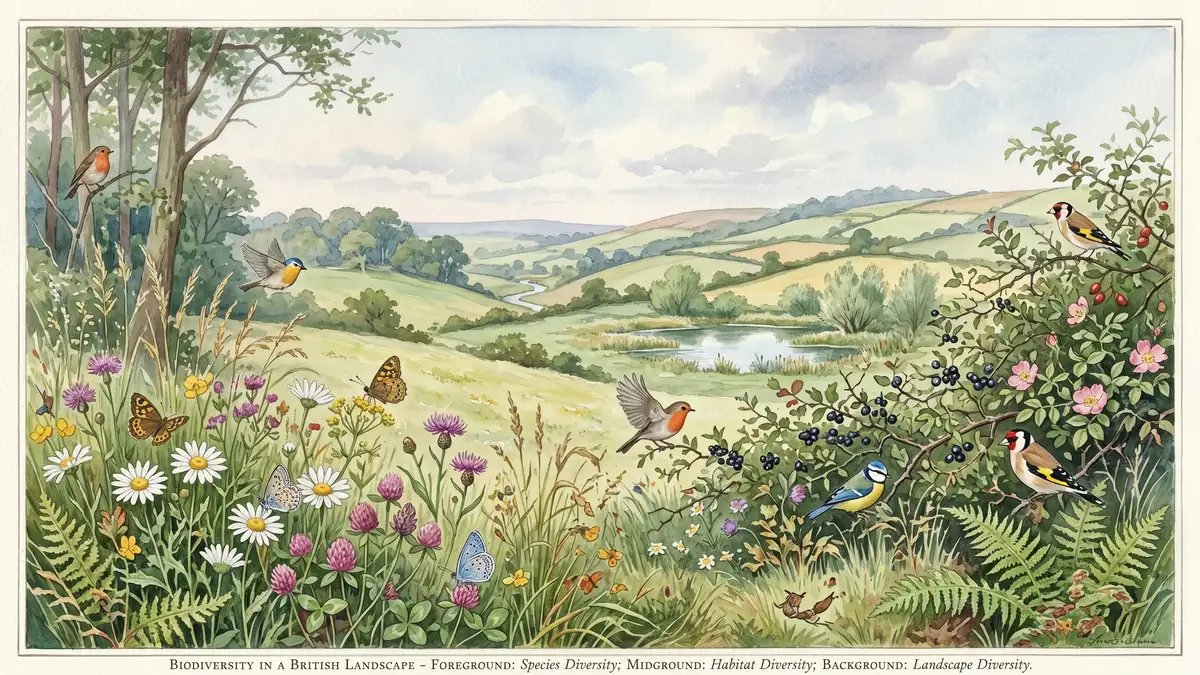
Biodiversity operates across three interconnected levels: genetic diversity (variation within species), species diversity (the variety of species within an area), and ecosystem diversity (the range of habitats and ecological communities). Each level supports and depends upon the others — lose genetic diversity within a species, and that species becomes more vulnerable to disease and environmental change; lose species from an ecosystem, and the ecosystem's functions begin to degrade.
For a deeper exploration of each level with UK examples, see our guide to the types of biodiversity.
| Level | What It Describes | UK Example | Why It Matters |
|---|---|---|---|
| Genetic | Variation in DNA within a single species | Scottish wildcat populations have dangerously low genetic diversity due to hybridisation with domestic cats | Enables adaptation to disease, climate change, and environmental stress |
| Species | Number and relative abundance of different species | The UK harbours approximately 55,000 multicellular species | Greater species richness supports more resilient and productive ecosystems |
| Ecosystem | Variety of habitats and ecological communities | UK hosts ancient woodlands, chalk grasslands, peatlands, salt marshes, and marine kelp forests | Different ecosystems provide different services — carbon storage, flood management, pollination |
Source: CBD Article 2, State of Nature 2023
Understanding these three levels is not merely academic. When a developer applies for planning permission in England, the Statutory Biodiversity Metric requires assessment at the habitat (ecosystem) level — measuring the distinctiveness, condition, and strategic significance of habitats before and after development. Species-level and genetic-level considerations inform Environmental Impact Assessments and protected species licensing.
How Do Scientists Measure Biodiversity?
Measuring biodiversity requires different tools depending on which level is being assessed. Scientists use mathematical indices, field surveys, and increasingly sophisticated technologies to quantify life's variety — each method capturing a different dimension of the concept.
Species Richness (S)
The simplest measure — a straight count of how many different species are present in an area. An ancient woodland might contain 200+ plant species; an intensively farmed field might hold fewer than 20.
Shannon-Wiener Index (H')
Accounts for both species richness and evenness (how equally individuals are distributed among species). A habitat with 10 species each having 100 individuals scores higher than one with 10 species where a single species dominates with 900 of 1,000 individuals.
Environmental DNA (eDNA)
A breakthrough technology that detects species from trace DNA shed into water, soil, or air. A single water sample from a river can reveal the presence of great crested newts, fish species, and invasive signal crayfish — without disturbing a single organism.
Remote Sensing and AI
Satellite imagery, drone surveys, and artificial intelligence now enable habitat classification and change detection across vast areas. The UK Centre for Ecology and Hydrology uses these technologies to map habitat condition for the full range of UK ecosystems.
Citizen Science
Programmes such as the UK Butterfly Monitoring Scheme, the BTO Breeding Bird Survey, and the Big Garden Birdwatch generate vast datasets that track population trends over decades. These volunteer-led efforts underpin the State of Nature reports and inform government policy.
Why Does the UK's Biodiversity Status Matter?
The UK is one of the most nature-depleted countries in the world. The State of Nature 2023 report — the most comprehensive assessment of UK wildlife — found that nearly one in six species face extinction, with 151 species already lost since 1500. These are not abstract statistics. They represent the collapse of ecological functions that underpin food production, water purification, flood defence, and human wellbeing.
~55,000
UK Species
Multicellular species recorded
1 in 6
Face Extinction
UK species at risk of being lost
26%
Plants Threatened
UK vascular plants on the Red List
68%
Global Decline
Average vertebrate population loss since 1970
Sources: State of Nature 2023, WWF Living Planet Report 2024, BSBI GB Red List for Vascular Plants 2024
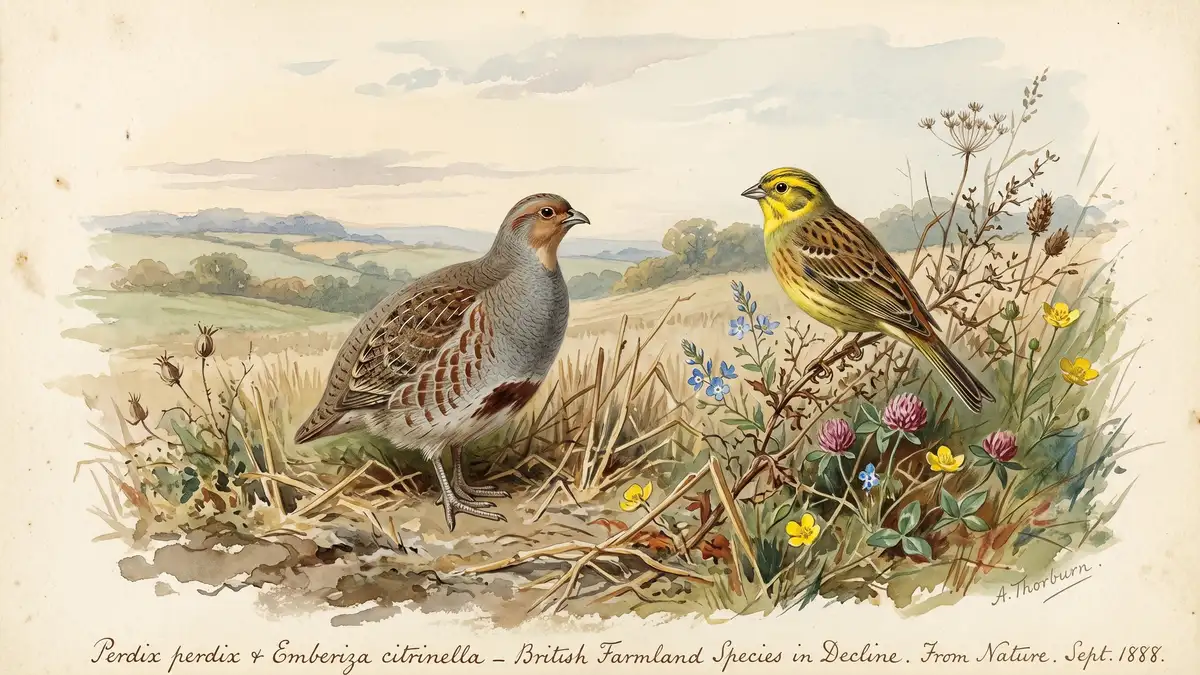
The picture for individual groups is stark. UK butterfly populations have declined by 18% since 1976, with habitat specialists faring far worse. Farmland birds have been devastated — Grey Partridge down 92%, Corn Bunting down 83%, and Yellowhammer down 62% between 1968 and 2021. Nearly 70% of the 250 regularly occurring UK bird species now hold red or amber conservation status.
These declines matter precisely because biodiversity — as defined by the CBD — encompasses not just species counts but functional variety. When farmland loses its insect pollinators, its seed-dispersing birds, and its soil-building invertebrates, the ecosystem's capacity to produce food declines even if the land itself remains unchanged. Understanding the drivers of biodiversity loss requires grasping what biodiversity actually means at all three levels.
The Bottom Line
UK security professionals now recognise ecosystem collapse as a genuine national security threat. This represents a pivotal shift — biodiversity is no longer viewed merely as an environmental amenity but as foundational to social stability, economic prosperity, and human security.
Explore how biodiversity is structured across different ecosystem types in the UK.
Discover UK EcosystemsHow Does Biodiversity Net Gain Use These Definitions?
Biodiversity Net Gain (BNG) is perhaps the clearest example of how defining biodiversity translates into real-world consequences. Since February 2024, most new developments in England must deliver at least a 10% increase in biodiversity value compared to the pre-development baseline, sustained for a minimum of 30 years.
The mechanism for calculating this uplift — the Statutory Biodiversity Metric — operates primarily at the ecosystem (habitat) level of biodiversity. It assigns numerical values to habitats based on three factors: distinctiveness (how rare or irreplaceable the habitat is), condition (how well the habitat is functioning ecologically), and strategic significance (whether the habitat aligns with local nature recovery priorities).
What BNG Measures
Habitat area, distinctiveness score (1–8 scale from low to very high), condition assessment (poor/moderate/good), and strategic significance multiplier. A lowland meadow in good condition scores far higher than improved grassland, reflecting its greater biodiversity value.
What BNG Cannot Capture
The metric does not directly assess genetic diversity within species or measure species populations. A site could score well on habitat area whilst still losing its population of great crested newts. This is why protected species surveys remain separate legal requirements alongside BNG.
The BNG framework demonstrates both the power and the limitations of formal biodiversity definitions. By defining biodiversity through measurable habitat units, the policy creates accountability — developers cannot simply promise to "protect nature" without quantifiable evidence. Yet the definition's focus on habitat-level metrics means species-level and genetic-level considerations require separate regulatory mechanisms.
What Are Common Misconceptions About Biodiversity?
Several persistent misconceptions distort public understanding of what biodiversity means and why it matters. Clearing these up is essential for informed conservation action.
Four Misconceptions That Undermine Conservation
Misconception 1: Biodiversity just means "lots of species." Species richness is only one component. A forest plantation with 50 tree species but no genetic variation within them and no functioning understorey community has poor biodiversity despite a respectable species count.
Misconception 2: Biodiversity only matters in tropical rainforests. Every ecosystem contributes. UK peatlands store approximately 3.2 billion tonnes of carbon — more than all the forests in Britain and France combined. Temperate biodiversity is globally significant.
Misconception 3: We can offset biodiversity loss by creating new habitats. Ancient woodlands, species-rich grasslands, and established peatlands took centuries to develop their full biological complexity. Creating new habitat is valuable but cannot replace what took hundreds of years to build.
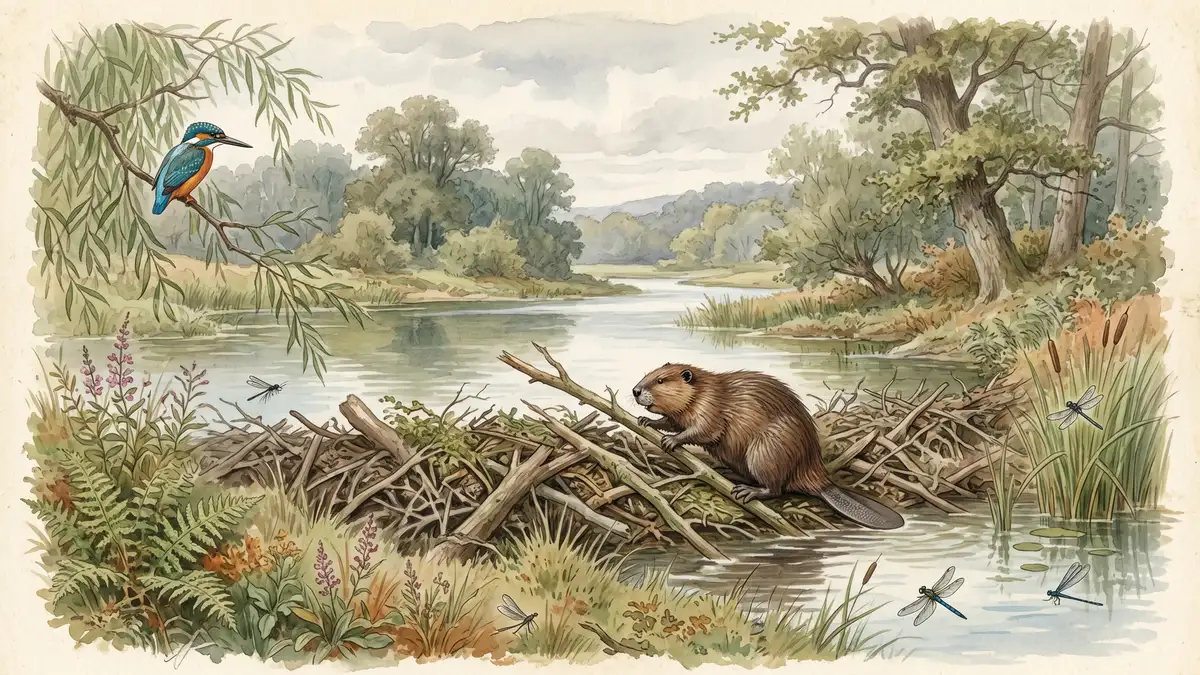
Misconception 4: Individual species don't matter if the ecosystem is "healthy." Species interact through pollination, predation, seed dispersal, nutrient cycling, and disease regulation. Removing a single keystone species — such as beavers from river systems — can cascade through the entire ecosystem, altering hydrology, vegetation, and fish populations.
Understanding these nuances helps explain why conservation policy must address all three levels of biodiversity simultaneously, not just the easiest to measure. For more on how climate change interacts with biodiversity loss, explore our dedicated guide.
Frequently Asked Questions About Defining Biodiversity
What is the simplest definition of biodiversity?
Biodiversity is the variety of all living things — the differences within species (genetics), between species, and between ecosystems. It encompasses every organism on Earth and the ecological relationships connecting them.
Who created the term biodiversity and when?
Walter G. Rosen coined the term in 1985 by contracting "biological diversity" while organising the 1986 National Forum on BioDiversity in Washington, D.C. The proceedings, edited by E.O. Wilson, popularised the concept globally.
What is the difference between biodiversity and species richness?
Species richness counts only the number of different species present. Biodiversity is broader — it includes genetic variation within those species, the evenness of species populations, and the variety of ecosystems they inhabit. A site can have high species richness but low overall biodiversity if genetic diversity is depleted or ecosystem functions are degraded.
How does Biodiversity Net Gain relate to the definition of biodiversity?
BNG translates the ecosystem-level component of biodiversity into a measurable metric. Developers must demonstrate a minimum 10% uplift in habitat biodiversity value using the Statutory Biodiversity Metric — which scores habitats by distinctiveness, condition, and strategic significance. However, BNG does not directly measure genetic or species-level biodiversity.
Why does biodiversity matter for everyday life?
Biodiversity underpins ecosystem services that humans depend upon daily — including pollination of food crops (worth an estimated £690 million annually to UK agriculture), natural water filtration, flood defence through wetlands and floodplains, carbon storage in peatlands and forests, and the discovery of medicines derived from wild species.
Is the UK's biodiversity getting better or worse?
The evidence is clear: UK biodiversity continues to decline overall, though some targeted interventions show promise. The State of Nature 2023 report found one in six species at risk of extinction. However, specific recovery programmes — such as beaver reintroduction, targeted butterfly habitat restoration, and marine protected areas — demonstrate that decline can be reversed with sustained effort and adequate funding.
Want to Explore Biodiversity Further?
From the genetic diversity within a single species to the vast mosaic of UK ecosystems, our guides cover every level of biodiversity in depth. Explore, learn, and share.
Clwyd Probert
Founder, Pixcellence
Clwyd founded Pixcellence as a community resource celebrating wildlife through photography and education. With a passion for UK conservation, he produces evidence-based guides to help people understand and protect the natural world.
Sources: Convention on Biological Diversity Article 2 (1992), State of Nature 2023, Environment Act 2021, Statutory Biodiversity Metric (Natural England), WWF Living Planet Report 2024, BSBI GB Red List for Vascular Plants 2024, National Academy of Sciences BioDiversity (1988)